← Gazillion Industries/Reading material
Free formant shifter plugins, and the move they cannot make
The vocal is tuned, the take is kept, and the singer on the bounce is somebody fifteen years younger. The fix is a formant control, and the first question is whether you have to pay for one. For the corrective job, no. For the opposite job, read on.
Several free formant shifters are current and genuinely free: Minimal Audio's Formant, GVST's GForm, g200kg's RoVee, the Free Edition of Auburn Sounds' Graillon, and MeldaProduction's MAutoPitch. Logic Pro and FL Studio ship formant controls of their own. All of them make the decoupled move, formants without the note. The coupled move, where the note and the size of the singer travel together the way a sped-up record does, is varispeed, and that is what SKRUU does for $29. Decide which one you want before you download anything.
The short version
- Formant only, no pitch
- Minimal Audio Formant — free, Mac and Windows
- Pitch and formant, independent
- GVST GForm, g200kg RoVee, Graillon Free Edition, Logic's Vocal Transformer
- Formant inside a free tuner
- MAutoPitch (free bundle), FL Studio's Pitcher
- Formant filters, which are a different tool
- Kilohearts Formant Filter, the Formant knob on Live's Vocoder, FORM on Fruity Vocoder
- The coupled move
- SKRUU, $29: pitch, time and the size of the voice moving as one
- Where free stops
- consonants, polyphony, and a throat you want to keep moving
What a free formant shifter has to do
One thing, independently. A formant shifter finds the resonant peaks of a voice, slides them up or down, and leaves the note where it was. Shift down a semitone and the envelope moves by a ratio near 6 percent; shift down an octave and the 500 Hz peak lands at 250. The mechanism is on the formant shifting page. For this page, the test of a free one is simple: a control labeled formant, in semitones or a ratio, that does nothing to the pitch when you move it.
That rules out two things people download by mistake. A formant filter boosts two frequencies to imitate a vowel and is applied to whatever you feed it; it analyzes nothing and preserves nothing. And a pitch shifter with no formant control moves the throat with the note, which is the problem you came here to fix. Both are useful. Neither is the tool.
The free formant shifters, sorted by what they move
Formant only: Minimal Audio Formant
Formant is free, for macOS and Windows, and does exactly one thing. Minimal Audio describe it as changing the perceived character of a voice without affecting its pitch. The whole interface is an XY pad, with formant shift on one axis and a tilt EQ on the other, plus a Dry/Wet knob. It ships as VST3, AU and AAX. If your job is the villain ad-lib or the same vocal twice as wide, this is the shortest route to it, and there is nothing to learn.
Pitch and formant on separate controls: GForm, RoVee, Graillon
GVST GForm is a free VST that GVST describe as a pitch and formant shifter primarily for monophonic vocal recordings. Pitch runs plus or minus 12 semitones and Formant has the same range, with an oversample switch and a tweak tab for the pitch-detection range and a gate. It depends on pitch tracking, so GVST say it is unlikely to do anything useful on chords or a mixed record, and that is the honest limit of the whole free field.
g200kg RoVee is a free voice-changer VST with four controls: Formant, Pitch, Robotic and Mix. It is a cut-down version of the maker's KeroVee tuner, ships as a single VST .dll, and its last version is dated 2013. Old, small, and still the quickest way to hear what a formant shift does.
Auburn Sounds Graillon is now at version 3.2 and is pitched as a pitch correction tool, with formant shifting listed among its features. The Free Edition download is on the product page; the Full Edition adds exactly three things, pitch-tracking modulation, keyboard tuning and a vocal doubler. It runs as VST, AAX, AU and LV2 on Windows, macOS and Linux. Of the free options here it is the only one that also tunes, which matters if the pitch move that caused the problem is happening in the same plugin.
Formant inside a free tuner: MAutoPitch and FL Studio's Pitcher
MeldaProduction MAutoPitch is free as part of MFreeFXBundle. Melda describe it as automatic tuning for vocals and other monophonic instruments, with formant shift and stereo expansion as the creative extras. The free tier keeps the sound and takes away presets, modulators, upsampling and interface resizing, and leaves a reminder box at the bottom of the window; the $55 upgrade removes all of that. For correction after a tuning move, it is enough.
FL Studio's Pitcher has a Formant control described in the manual as formant preservation, which holds the formant constant as the pitch is varied, plus a formant override. Pitcher is included from the Signature Bundle upward, so Fruity and Producer Edition users are back to the downloads above.
Already in Logic Pro: Vocal Transformer
Logic ships the most complete free one, and it is already installed. Vocal Transformer has a Pitch knob in semitone steps and a separate Formant knob, and Apple's own guide is explicit that moving Pitch leaves the formants alone. Their description of the Formant knob is the clearest in any manual: positive values and "the singer sounds like Mickey Mouse", negative values and you get "vocals reminiscent of Darth Vader". Robotize mode flattens or mirrors the melody, and the extended parameters include a Formants menu with a Keep Unvoiced option that leaves sibilants alone. Logic's other two pitch tools, Pitch Shifter and Pitch Correction, have no formant control at all.
What is in your DAW that is not a formant shifter
The word appears on three stock devices that do something else. Ableton Live's Shifter is a pitch, frequency and ring shifter with a Window control and no formant parameter; the Formant knob on Live's Vocoder shifts the carrier's filterbank, which changes the vocoded voice and leaves the dry one untouched. Both are in Standard and Suite only. FL Studio's Fruity Vocoder has a FORM slider that changes the pitch relationship between the modulator and the vocoded bands, in every edition. Kilohearts' Formant Filter, free with an account, boosts two frequencies to make a vowel and has no shift amount and no pitch control. Good tools, for a vocoded or synthetic voice. For a recorded singer, use the list above.
The other move: when you wanted the new singer
Half the people searching this term pitched a sample, heard the throat move with it, and liked it. That is varispeed. Every frequency in the file changes by one ratio, the note, the breath, the room and the formants together, which is why a pitched-up sample sounds like a record and a formant-corrected one sounds like a person. There is no free formant shifter for that job because it is the opposite job.
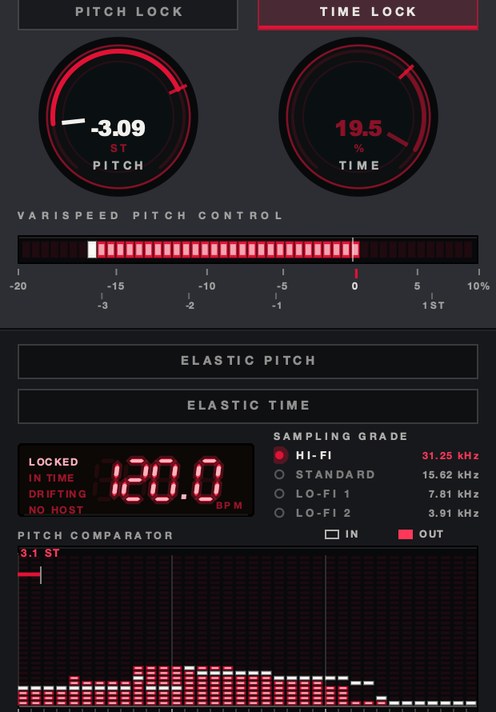
SKRUU is ours, $29 for Mac and Windows in VST3, AU and standalone, and it makes the coupled move on purpose and by an amount you can read. PITCH runs from −20% to +10% and reads out in semitones against what went in. TIME runs from −50% to +25% and moves nothing but the length, so you can take the voice down and leave the tempo alone. Let go of either knob with ELASTIC on and it runs home along one of sixteen SLOPE shapes. The honest edge: it has no formant control and will not hold a throat still. It is the wrong $29 if correction is what you need, and the right one if the pitched-down voice was the sound.
Test a free formant shifter in ten minutes
- Load eight bars of a dry lead vocal with words in it.
- Bypass every section of the plugin except the formant control.
- Shift formants down 4 semitones with pitch at zero and listen for the size change.
- Listen to "s" and "t" sounds on headphones and note the first word that goes plastic.
- Shift formants up 4 semitones and check that the low end of the voice survives.
- Pitch up 3 semitones and shift formants down 3, then compare against the dry vocal.
- Set the formant control to zero and null the output against the dry track.
- Open ten instances and read the CPU meter.
Step seven is where free tools separate. A formant engine parked at zero should hand back what you gave it, and anything left in the null is analysis and resynthesis running whether you asked or not. On a stacked vocal that residue adds up.
Where free runs out
Consonants go first. An "s" is broadband noise with no harmonic structure for the envelope estimator to hold, so a shifted vocal lisps or whistles on the sibilants before the vowels show any damage. Logic's Keep Unvoiced option exists for exactly this, and most of the free downloads have no equivalent, so you will be automating the shift around the words that break.
Polyphony goes second. GForm says plainly that it tracks one pitch; Soundtoys call their $99 Little AlterBoy a monophonic voice manipulator; Polyverse say their $149 Manipulator works on monophonic audio. A stacked chorus through any of them is an afternoon lost. And a few jobs no shifter does at any price: the moment you want the throat to move with the note, you have left the category, and the tool for that costs $29 and is called varispeed.
Questions people ask
Is there a free formant shifter plugin?
Yes. Minimal Audio Formant is free for Mac and Windows and shifts formants only. GVST GForm, g200kg RoVee and the Free Edition of Graillon add independent pitch. MAutoPitch is free in Melda's bundle with formant shift inside a tuner. Logic Pro's Vocal Transformer is already installed.
What is the best free formant shifter for vocals?
For the effect on its own, Minimal Audio Formant, because the control is independent of pitch and there is nothing else in the way. For correction after a tuning move, Graillon's Free Edition or MAutoPitch, since the tuner and the formant control are in one window. On a Mac with Logic, Vocal Transformer first.
Does Ableton Live have a formant shifter?
Not as a dedicated device. Shifter has no formant control; the Vocoder's Formant knob moves the carrier filterbank of a vocoded voice. For a recorded vocal, load one of the free plugins above as VST3 or AU.
Does FL Studio have a formant control?
Pitcher has a Formant control, described by Image-Line as formant preservation with an override, and it is included from the Signature Bundle upward. Fruity Vocoder's FORM slider shifts the vocoded result in every edition. For a plain shifter in Fruity or Producer Edition, download one.
Is a pitch and formant VST the same as a formant shifter?
A pitch and formant plugin has both controls and lets you move them separately, which is the decoupled job. A pure formant shifter has only the second one. Varispeed moves both by the same ratio and has neither control, which is the coupled job.
Can SKRUU shift formants?
No. SKRUU moves pitch and time, each on its own knob, and when PITCH moves the formants move with it the way they do on a sped-up record. That is the point of it, and the reason the free shifters above exist.
What SKRUU does
SKRUU is our varispeed pitch and time stretch plugin for Mac and Windows, in VST3, AU and standalone, and it puts rate and length on two knobs that do not touch each other. PITCH runs from −20% to +10% in 128 states and reads out in semitones as well as percent. TIME runs from −50% to +25% and moves nothing but the length. PITCH LOCK and TIME LOCK hold one while you play the other. ELASTIC makes either knob sprung, SLOPE is the shape of the trip home with sixteen to choose from, DRAG sets how long a new speed takes to arrive, and SAMPLING GRADE steps the whole thing down from 31.25 kHz to 3.91. The formant shifter field covers the paid decoupled tools; chipmunk soul is the coupled move on a record.
So: the singer is fifteen years younger on the bounce. One of the free tools above puts the years back. SKRUU is for the days you decide to keep them off.
SKRUU — varispeed pitch and time stretch for Mac and Windows. Pitch and time move independently, with sixteen elastic return shapes.
Keep reading
- Best formant shifter plugins — What formant shift moves, how to test one, and the free plugins worth installing.
- Formant shifting — What formants are, and why a pitched-up voice sounds like a smaller person.
- What is varispeed — Speed and pitch together: the math, how it differs from pitch shifting, and how it's used.
- Chipmunk soul — Choosing the vocal, how far to pitch it up, and the drums that go under it.