← Gazillion Industries/Reading material
Drum bus compressor settings
Gazillion Industries · · updated
Every control on a drum bus compressor, what it actually
changes, and a starting point that works on most material. Written by the
people who then built a compressor
with none of them.
The short version
- Ratio
- 4:1
- Attack
- 10–30 ms
- Release
- 100–300 ms, or auto
- Threshold
- set for 2–4 dB of gain reduction on the loudest hits
- Knee
- soft
- Make-up
- matched, so bypass and engaged are the same loudness
That will glue a drum bus without hurting it. Everything below is why, and
when to leave it.
Attack decides whether drums punch
Attack is how long the compressor waits before it clamps down. A fast
attack — under about 3 ms — catches the transient itself and
flattens the stick. A slower one, 10 to 30 ms, lets the transient through
and compresses the body behind it.
That second behavior is why a compressed drum bus can sound
bigger rather than smaller: the hit stays sharp and everything under
it comes up. If your drums got weaker when you compressed them, attack
is almost always the reason.
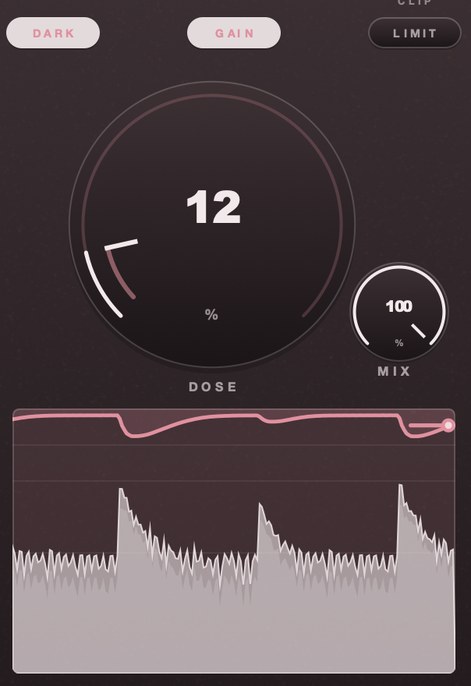 DOSE 12. The line along the bottom is the gain reduction, and here it barely leaves the top.
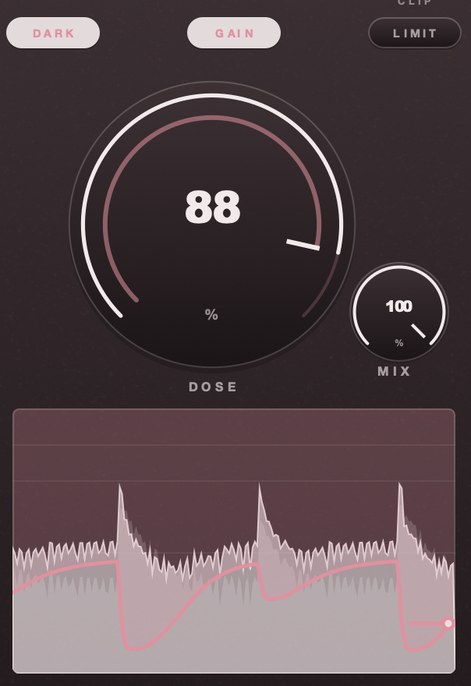 DOSE 88. Same source. It dives on each hit and takes the bar to come back — that recovery is what people mean by pump.
Release decides whether it breathes
Release is how fast the gain comes back. Short, 50 to 100 ms, recovers
inside the gap between hits — that recovery is what people hear as pump.
Long, past about 300 ms, holds still and glues instead.
The trap is a release near the tempo of the track. Land on it and the
compressor breathes in time and sounds musical; land slightly off and the
whole bus sounds seasick. Auto-release exists because that edge is hard to
find by hand and moves whenever the material does.
Ratio matters less than people think
On a drum bus, 2:1 to 4:1 covers nearly everything. A higher ratio does not
really mean "more compressed" — it changes character more than amount,
and it interacts with threshold. 4:1 with a high threshold does less than 2:1
with a low one, so the two are only meaningful together.
Set threshold by the meter, not the number
The threshold value on its own tells you nothing, because it depends
entirely on how hot the bus is running. Watch gain reduction instead:
- 2–4 dB
- glue — you feel it more than hear it
- 4–6 dB
- obvious, still musical on drums
- 6 dB+
- an effect; commit to it or back off
If the needle is pinned and never returns, you are limiting, not
compressing.
Or don't watch the meter at all — there is an argument for a bus
compressor with one control and none of these, which is
what we ended up building. There is a demo on the page.
Questions people ask
What attack and release should I use on a drum bus?
Set attack by ear rather than by number: the fastest setting at which the hit still
sounds struck. Set release against the tempo, so the gain returns just before the next
accent. Both depend on the material and the bpm, which is why copied numbers rarely
travel.
How much gain reduction should a drum bus compressor do?
On a drum bus, several decibels on the loudest hits is normal and reads as a room. On a
mix bus, a decibel or two. If the kit sounds like it is moving rather than playing, it is
doing too much.
What ratio is best for drums?
Lower than most people set. The ratio decides how hard it clamps once it is working,
and on drums the interesting part is the timing rather than the amount, so a modest ratio
with the timing right beats a high ratio with the timing wrong.
Should I compress each drum or just the bus?
The bus, first. It is the stage that makes separate hits sound like one kit, and it is
the one you would miss. Individual compression is for fixing a specific problem on a
specific drum, not a default.
Knee
A soft knee eases compression in gradually as the signal approaches the
threshold; a hard knee applies it all at once. Soft is more forgiving on drums
and harder to hear. Hard is the right choice when you want to hear the
compressor working.
Make-up gain, and the only honest A/B
Compression costs level, make-up gain gives it back, and louder always
sounds better for the first few seconds. Match the bypassed and
engaged loudness before you judge anything. A large share of "this
plugin sounds incredible" moments are an unmatched level and nothing else.
Glue, specifically
Glue is what people call it when separate hits stop sounding like separate
hits and start sounding like one performance in one room. Mechanically there
is nothing mystical about it: the compressor is reacting to the whole bus at
once, so every loud element ducks everything else fractionally, and the room
and the quieter hits rise relative to the peaks.
It comes from a slower attack, a release long enough not to pump, and less
gain reduction than you think — 2 to 4 dB. Reaching for more usually
produces density, not glue.
Mix bus and master bus
Same controls, less of everything. A drum bus will take obvious
compression and often sounds better for it; a full mix will not. Start around
1 to 2 dB of gain reduction, a gentler ratio, and a slower attack so the
transients that carry the whole arrangement survive.
The other difference is that mistakes compound. Everything already
compressed on the way in gets compressed again, so the mix bus is the wrong
place to fix a problem that belongs further back.
What DRUGS does instead
Having written all of that: DRUGS has none of it. One
knob, called DOSE.
Everything above — curve, knee, attack, release — moves
underneath it, together, and you do not get a vote. There are no settings on
this page to get right, which is either a relief or a problem depending on
what kind of producer you are.
Turn it up until it sounds good.
DRUGS — a one-knob bus compressor for drums, free for Mac and Windows.
One control called DOSE, with GAIN and a soft ceiling on the way out.
FREE DRUGS
Keep reading
- How to compress drums — Attack, release and how much gain reduction, on single drums and on the bus.
- Glue compression — What a bus compressor does to a group, and where to start.
- Parallel compression — Blending a crushed copy under the dry track, and the alignment trap.
- Compression explained — Threshold, ratio, attack, release, and settings that are a fair place to start.
- How to saturate drums — Kick, snare, drum bus and parallel saturation, and how to keep cymbals from turning harsh.
- What is a one-knob compressor, and is one knob enough? — What a single macro gives up, what it buys, and when a specific problem still needs threshold and ratio.
- What is a drum bus, and why put things on it? — One channel for the whole kit: how to build it, what to put on it, and why the sum behaves differently.
- What order should the plug-ins on my drum bus go in? — Cuts, then compression, then tone, then weight, then a ceiling — level-matched at every step.
- Best drum compressor plugins — Which one suits a drum bus, and the settings that matter.