← Gazillion Industries/Reading material
Best drum compressor plugins
Gazillion Industries · · updated
A loop that filled the room on monitors goes small in the car. The kick and
the snare still land, but the hats, the ghost notes and the air between them have gone
somewhere. That missing middle is the job of a drum bus compressor, and it is a different job
from the one a channel compressor does.
The best drum bus compressor for most records is a clean, fast-acting VCA-style plugin set
slow: 2:1 to 4:1, attack 10 to 30 ms, release 150 to 300 ms, pulling 2 to 4 dB
on the loudest hits, with a sidechain high-pass near 100 Hz so the kick stops steering the
whole kit. Free covers that. DRUGS is ours, free, and does the job from one control called DOSE,
timing underneath rather than on the face.
The short version
- What we would put on the bus
- DRUGS — ours, free, one knob called DOSE
- Best type of compressor for drum bus
- VCA — fast, predictable, stays out of the way
- Starting point, dialing it yourself
- 4:1, 20 ms attack, 200 ms release, 3 dB of gain reduction
- Sidechain high-pass
- 80–120 Hz, so the kick is not the only thing it hears
- Best free drum compressor plugin
- ours; then TDR Kotelnikov for control, Klanghelm DC1A for character
- The real fork
- control, character, or the decision already made
Everything below is the reasoning, the numbers, and an audition test that takes ten minutes
and settles the argument faster than a month of forum reading.
What a drum bus compressor does that a channel compressor does not
A channel compressor listens to one drum and controls that drum. A drum bus compressor
listens to all of them summed and controls the sum. The difference sounds administrative and it
is the whole category.
When the detector sees the whole kit, every loud element pulls everything else down with it
for as long as the gain stays reduced. The kick lands, the hats duck a fraction of a decibel,
the room duck along with them, and the gain walks back up in the gap. That coupling is the
effect. Separate hits stop reading as separate recordings and start reading as one performance
in one space, because they now share a single moving gain. The reason a
drum bus exists at all is to give you a place
to do that.
The second thing it does is raise the floor. Compressing peaks and adding make-up gain lifts
everything that was not a peak: the decay of the snare, the bleed in the overheads, the tail of
the room. A kit with a high
crest factor has a lot of space under the peaks, and
a bus compressor is the cheapest way to fill it. This is why a compressed drum bus reads as
bigger and not merely quieter, which is the single most common thing producers report and the
thing they cannot get from compressing each drum on its own.
The cost is that the coupling works in both directions. Put a compressor across the bus and
the kick now modulates the hats. Whether that reads as groove or as a wobble depends entirely
on the release time relative to the tempo, which is the section with the numbers in it.
Best type of compressor for drum bus: VCA, FET, opto, vari-mu
Four gain-cell families turn up in the marketing copy for nearly every compressor plugin
sold, and on drums they are not interchangeable. What follows is what each one does to a kit,
in the order most useful to you.
VCA
A voltage-controlled amplifier design gives you fast, accurate, fully adjustable timing. The
attack can be genuinely fast, the release can be genuinely long, and the gain change tracks the
control voltage without much of its own opinion. On a drum bus this is usually what you want.
You are shaping timing, and timing is the one thing a VCA topology will give you exactly. Most
digital bus compressors, including the console-style ones everybody reaches for, sit in this
family. If you only ever own one, own this.
FET
A field-effect transistor design is very fast and it distorts on the way. That distortion is
the appeal. Attack times in the microseconds mean a FET-style plugin can grab a stick hit before
the stick has finished, which flattens the transient and pushes the body forward, and the
harmonic mess it adds while doing so reads as aggression. On a snare channel it is frequently
the best compressor plugin for snare drum duty you will find. Across a whole bus it can be
glorious or it can be a smear, depending on how much low end is hitting the detector.
Opto
An optical design uses a light source and a light-dependent resistor, and the resistor takes
its time. Attack and release are slow, program-dependent and largely out of your hands, which
makes an opto plugin a poor first choice on a drum bus: drums are a timing problem and this is
the topology with the least timing control. It works as a second, gentler stage catching
long-term drift, or on a room mic you want to swell rather than snap.
Vari-mu
A variable-mu design uses tubes whose gain falls as signal rises, so the ratio increases with
level rather than sitting at a fixed number. Soft at the bottom, firm at the top. On a drum bus
this is the least obvious compression of the four, because the onset is gradual and there is no
single point where the sound changes. Wrong tool for a snare that is 6 dB too loud. Right
tool when the bus is already balanced and you want density with no visible seam.
- Punch and control
- VCA
- Aggression and grit
- FET
- Slow swell, no timing control
- opto
- Density with no seam
- vari-mu
One caution about the taxonomy. Two plugins wearing the same topology label can be further
apart than two wearing different ones. Use the family names to narrow the shortlist, then use
your ears.
The fork: control or character
Every argument about the best drum compressor plugin collapses into one question, and almost
nobody asks it out loud. Do you want the compressor to control the drums, or do you want it to
change them?
Control means the gain moves and nothing else does. Transients survive, the tone at the output
matches the tone at the input, and nulling the processed signal against the dry one at matched
level leaves only level. Transparent bus compression is a real engineering target and a hard one,
and the plugins that hit it advertise the fact.
Character means the compressor adds harmonics, shifts the low end, softens the top, or all
three, whether you asked or not. It is why a bus compressor can improve a loop while doing almost
no gain reduction at all, which is a hint that the gain reduction was never the point on that
particular plugin.
There is a third branch, and it is the one most people are actually on: you want neither
decision, you want the drums fixed. A plugin built for one bus can make the control-or-character
call once, at the factory, and hand you a single knob. That is a real trade and the section below
puts it first, because it is what we build.
Neither of the first two is better. What matters is knowing which one you reached for,
because they fail in opposite ways. A transparent compressor asked to add life will do nothing and you will keep
turning it up until the kit is flat. A character compressor asked to control a wild bus will
color everything long before it has caught the peaks, and you will end up with a loud, busy,
still-uneven drum bus. Half the plugins people buy are the right plugin for the other job.
The best drum bus compressor plugins, sorted by the job
What follows is by category rather than by rank, because a ranked list of drum compressors
answers a question nobody actually has. Prices and features below were read on each maker's own
page while writing this.
If you want the decision made for you
DRUGS is ours and it is free for Mac and Windows. One control called
DOSE, with MIX on the face for parallel without a send,
GAIN on the way out and a soft ceiling after it. Turning DOSE up makes a drum
bus denser rather than louder — peak level barely moves across the range of the knob —
and the room comes up underneath the hits, which is the missing middle from the top of this
page. It installs as an Audio Unit, a VST3 and a standalone, and there is a demo on the
product page.
The whole argument of this article moves underneath that one control. The transfer curve, the
knee, the attack and the release travel together, and release is adaptive with no user control at
all, so the tempo arithmetic two sections down is a thing you can read for the understanding rather
than a thing you have to do. What you give up is the vote: no attack knob, no release knob, no
knee, no sidechain filter. Those are assumptions about drum buses, which is the page you are on.
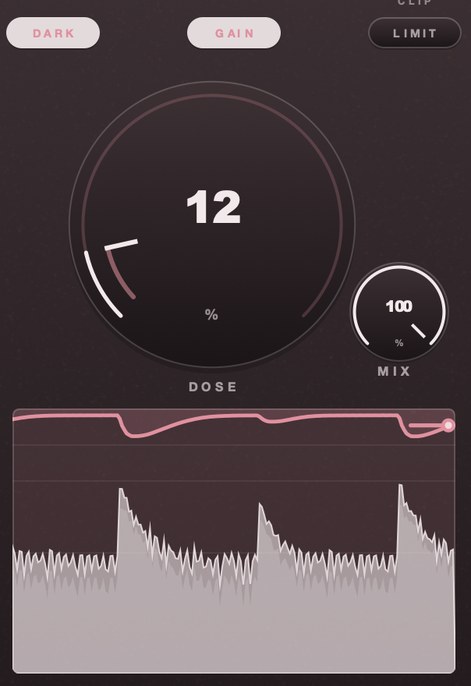 DOSE 12. The line along the bottom is gain reduction; here it barely leaves the top.
FREE DRUGS
If you want control
TDR Kotelnikov, from Tokyo Dawn Labs, is free and is the most adjustable of
the free ones. Its control scheme is built around crest factor, which means it gives you two release
controls — one for peak events and one for the RMS level underneath them — and on
drums that split is exactly the distinction you have been trying to make with a single knob. It
has a sidechain high-pass filter, stereo linking options aimed at the bus, and a delta preview
that plays you the difference between the compressed and the original signal, which is the
fastest way to hear what a compressor is actually removing. Tokyo Dawn describe it as proudly
digital and say it does not try to emulate any previously existing device. A paid Gentleman's
Edition exists with more of everything.
u-he Presswerk is 129 € and is the opposite bet: one plugin for
every dynamics job you have. Ratio from 1:1 to 20:1 with adjustable knee and linearity, six
task-specific views including Drum and Bus, internal parallel compression so you need no send, M/S
mode, and a choice of feed-forward, feed-back or interactive detection. That last control is
unusual and it matters on drums: feed-back detection, where the detector listens to the output, is
softer and later, and switching between them changes the punch more than most people's attack knob
does. Mac, Windows and Linux, the last still marked beta.
If you want console glue
Cytomic The Glue is $99 and is the reference for the best glue compressor for
drum bus work. Cytomic describe it as based on the classic 80s British big-console bus
compressor, and alongside the usual controls it has Mix, Range and a sidechain high-pass on the
face, external sidechain input, a peak clip stage and oversampling. Mac and Windows, VST2, VST3,
AU and AAX.
Worth knowing before you spend: Ableton's Glue Compressor was made in
collaboration with Cytomic and is based on the same console. Ableton's manual notes that it has
no user-adjustable knee, the knee sharpening as ratio increases, that its auto release uses two
time constants at once — a slow one as a base and a fast one that reacts to transients
— and that its Range slider caps how much compression can happen at all. If you are in
Live, you may already have most of what the $99 buys, and the walk-through for setting it up
lives on
drum bus compression in Ableton
Live rather than here.
If you want character
Klanghelm DC1A is free and is a character box first. Two knobs, an almost
hostile lack of options, and a sound that gets thick and forward quickly. On a drum loop it is
often finished before you have worked out what it is doing. Klanghelm MJUC jr.
is also free and is a variable-mu design, which makes it the cheapest way to hear what that
topology does to a kit. Klanghelm's paid line runs alongside them: DC8C, their advanced
compressor, is 23 €, and the full MJUC is 24 €, both read from their own
store page today.
Kilohearts Essentials is free with an account and includes 34 effects, among
them Compressor, Compactor, Dynamics, Limiter and Transient Shaper. The compressors in it are
plain, which is the point — they load anywhere, they run light, and having a transient
shaper sitting next to them is genuinely useful on drums, because half the problems people bring
to a compressor are transient problems wearing a disguise.
Best free drum compressor plugin: what free actually costs you
Free is not the compromise it was. The best free drum compressor plugin available now will
hold a drum bus on a finished record, and the honest summary of the gap is narrow: free rarely
gives you a character stage worth paying for, and free is less likely to be rebuilt for the next
operating system. Ours is one of the free ones, which is the disclosure and also the shortest
route to the end of this article.
Fill the utility slots for nothing. DRUGS for the drum bus itself, Kotelnikov when you want
every timing control in your own hands, DC1A when the loop needs attitude, MJUC jr. when it needs
to settle, Kilohearts Essentials for the plain ones. That set covers the entire functional range of this article at a cost of zero, and the longer piece on
free compressor plugins goes through the
selection criteria in more detail.
Where free stops being free is maintenance. A plugin that is not updated becomes a session you
cannot open in three years. Check the changelog on the maker's page before a free compressor
becomes load-bearing — Kotelnikov's carries its version history openly. A plugin with no
visible update in five years is one to render through rather than keep live.
Attack and release against tempo, with the numbers
Attack decides whether the drums punch. Release decides whether the bus breathes in time. Both
are tempo problems, and the maddening part is that the same numbers give opposite results at
different tempos, which is why copied settings so rarely survive the trip.
A quarter note lasts 60,000 divided by the tempo, in milliseconds. Three worked examples, with
the sixteenth note included because on most drum programming the sixteenth is the shortest gap
the compressor has to recover in.
- 90 bpm
- quarter 667 ms, eighth 333 ms, sixteenth 167 ms
- 140 bpm
- quarter 429 ms, eighth 214 ms, sixteenth 107 ms
- 170 bpm
- quarter 353 ms, eighth 176 ms, sixteenth 88 ms
Set the release so the gain is back near zero before the next hit you care about. At
90 bpm on a sparse boom-bap loop, the next hit you care about is usually the eighth, so 200
to 300 ms lands cleanly inside 333 ms and the compressor is idle again when the snare
arrives. At 170 bpm with sixteenth hats, 200 ms means the gain never gets back up at
all and the whole bus sits permanently pulled down, which is the flat, lifeless result people
blame on the plugin. Same setting, opposite outcome, and the only thing that changed was the
tempo.
Attack works the other way. Under about 3 ms and the compressor catches the stick itself,
which kills the crack; the plugins that do this on purpose are the FET-style ones, and the grit
they add is the compensation. At 10 to 30 ms the
transient is already through the door before
the gain moves, so the hit stays sharp and the body behind it gets squeezed. If your drums lost
their punch the moment you engaged the compressor, attack is the first thing to check and it is
right roughly nine times out of ten.
The sidechain high-pass is the control nobody mentions and it changes more than either of the
above. Without it, a drum bus compressor is very nearly a kick-triggered ducker, because the kick
carries most of the energy and the detector is an energy detector. High-pass the detector at 80
to 120 Hz and the snare and the hats start contributing to the gain decision. The kit
suddenly sounds like a kit instead of a pump. Set it by sweeping up until the gain reduction meter
stops moving in perfect lockstep with the kick, then leave it there. The full control-by-control
walk is in
drum bus compressor settings.
Best parallel drum bus compressor setup
Parallel compression lets you have the compressed sound without giving up the dynamics, which
on drums is close to having it both ways. You keep the dry kit at full transient, and you blend a
heavily compressed copy underneath it that carries the room, the decay and the density.
The old method is a send to a return track with a compressor on it. The modern method is a Mix
or Dry/Wet control on the compressor itself, which every plugin named above has, and which is
better in one specific way: the dry and wet paths are sample-aligned inside the plugin, so there
is no chance of a delay-compensation mismatch smearing the transient. If you have ever set up
parallel drums on a send and found the result oddly soft, that is the usual culprit.
Settings for the parallel copy are the inverse of the ones above. Go hard: 8:1 or higher, the
fastest attack the plugin has, a short release, 10 dB or more of gain reduction. The point of
the parallel path is to be squashed into a single dense block, because you are going to hide it
under a dry signal that already has all the punch. Then bring it up from silence until the kit
thickens, and stop about 2 dB before the point where it sounds good on its own. Our longer
piece on parallel compression covers the
routing in both directions.
On DRUGS that control is MIX, and there is no latency anywhere in the path,
so the dry stays sample-aligned with the wet at every setting and parallel compression will not
comb-filter on you. Take DOSE most of the way up, then pull MIX back until the dry kit is still
the first thing you hear. The shot below is DOSE 95 with MIX at 45, which is an ordinary
place to land on a break.
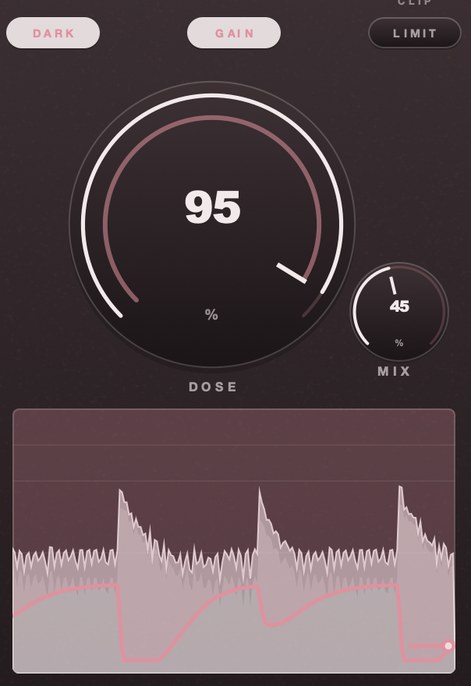 DOSE 95, MIX 45. Crushed underneath, dry on top — parallel without a send.
One check that saves an hour: listen to the parallel bus in mono. A heavily compressed drum
copy is where stereo width problems become audible first, because compression raises the
correlated and the uncorrelated content together and the room mics are the uncorrelated part.
If the kit hollows out when you sum, pull the parallel level down before you start reaching for
width tools.
Best compressor plugin for kick drum and snare drum
Channel compression on individual drums is a repair, not a default. Before you put a
compressor on a kick, ask what is wrong with it, because the answer is often a level automation
problem or a sample choice problem and a compressor will make both worse.
When it is the right tool on a kick, you want the opposite of bus settings. Fast release, so the
gain is back before the next kick; medium attack, 5 to 15 ms, to let the beater click through;
a low ratio and shallow reduction, because a kick has little dynamic range to start with and
squashing it makes it shorter rather than bigger. Any VCA design does this cleanly. A kick that
needs to be bigger rather than steadier is a
saturation job.
Snares are where channel compression earns its place, and where the best compressor plugin for
snare drum question has a real answer: a fast FET-style design. The range between the hard hits and
the ghost notes is enormous, and a fast compressor with a moderate release brings the ghosts up into
audibility, which is most of what makes a programmed snare sound played. Expect 6 dB or more of
reduction, far too much on the bus and normal on one drum. Watch the decay: too short a release and
the tail flutters, too long and the ghosts never arrive.
Then take both off and listen to the bus again. Individual compression that sounded like an
improvement in solo frequently disappears in the mix, and every stage you leave in is a stage the
bus compressor has to work around.
What you already have installed
Before buying the best drum bus compressor VST on anyone's list, check what is already on the
machine, and check the free one at the top of this page while you are at it. The stock options are
better than their reputation. What follows is what each one is, in a sentence, rather than a course
in driving it.
Ableton Live has three relevant devices. Compressor is the general-purpose one
with full timing control and a sidechain. Glue Compressor is the console-style bus compressor built
with Cytomic, described above. Drum Buss is a different animal: an
analog-style drum processor with a fixed compressor on a toggle — Ableton describe it as fast
attack, medium release, moderate ratio with ample make-up — followed by three distortion
stages, soft waveshaping, medium limiting and hard clipping with a bass boost. Drum Buss is a
character box with a compressor inside, so treat it as such.
Logic Pro ships one Compressor with main, output and side chain parameter
pages, and it is entirely capable of holding a drum bus.
FL Studio has Fruity Limiter, which Image-Line document as a single-band
compressor with sidechain, a limiter and a gate in one plugin, with COMP and LIMIT tabs and a
signal path running input, compressor, gain, limiter, saturation, output. That saturation stage on
the end makes it a reasonable one-stop drum bus. Maximus, the Fruity Compressor and the Fruity
Multiband Compressor sit alongside it.
In every case the chain position matters as much as the plugin, and
what order drum bus plug-ins go in is its own
question.
Every number on this page is a decision somebody has to make. If you would rather
not make them, DRUGS
is free, it is one knob, and the decisions are already in it.
The ten-minute audition test
This settles which compressor belongs on your bus faster than any review, including this one.
Do it with a loop you know intimately, not with a demo file. Start with ours, because it costs
nothing and steps two, five, six and seven collapse into one knob; steps three, nine and ten are
the ones that decide anything.
- Load the compressor on the drum bus with all other bus processing bypassed.
- Set ratio 4:1, attack 20 ms, release 200 ms, and lower the threshold until the meter reads 3 dB on the loudest hits.
- Adjust the output gain until bypassed and engaged measure the same loudness.
- Bypass and engage five times while listening to the hats and the room, not the kick.
- Set the attack to its fastest value and listen for the stick going soft.
- Return the attack to 20 ms and shorten the release until the bus pumps, then back off until it stops.
- Engage the sidechain high-pass and sweep it from 20 Hz to 200 Hz while watching the gain reduction meter.
- Drive the threshold down to 10 dB of reduction for fifteen seconds to hear the plugin's character with the politeness removed.
- Return to 3 dB, rematch the loudness, and play the loop on a phone speaker.
- Keep the plugin only if step nine sounded better than the bypass.
Step three is the one people skip and it invalidates everything after it. Louder wins every
blind comparison for the first few seconds, and an unmatched level is responsible for a large share
of the moments where a plugin sounds transformative in a demo and ordinary in a session. A
VU meter or any loudness meter across the bus makes the
match a five-second job.
What it costs
Bus compression is not free in any sense except the price. Four costs, plainly.
It takes away dynamic range, and dynamic range is what makes a fill feel like a fill. A bus
squeezed hard enough to sound huge in an eight-bar loop turns relentless across three minutes,
which you cannot hear while working on the loop and can hear instantly on the arrangement.
It moves the low end. Any compressor with a full-range detector is being driven mostly by the
kick, so the perceived balance between the kick and everything else shifts as you increase the
amount. The high-pass helps and does not eliminate it.
It makes mistakes further back harder to fix. Once the bus is glued, the individual drums are no
longer independent, and a snare that needed to come down 2 dB now takes the whole kit with it
when you move it. Balance first, compress second.
And it competes with the limiter at the end of the chain. Every decibel of crest factor you
remove on the drum bus is a decibel the master
limiter does not get to remove, which is fine
until both are working hard and the record stops moving at all.
Questions people ask
So what do I actually put on the drum bus?
Ours, first, because finding out costs nothing. DRUGS on the bus, DOSE up until the room comes
forward under the hits, GAIN to match the bypassed level, and listen on a phone. If ten minutes of
that leaves you wanting the timing controls back in your own hands, everything named on this page
is still there and you now know which one does what.
What is the best drum bus compressor plugin overall?
For a drum bus specifically, ours, and it is free. Past that it is a clean VCA-style bus
compressor with a sidechain high-pass: TDR Kotelnikov is the strongest free option for control and
Cytomic The Glue at $99 is the reference for the console-style sound. Either way the setting
matters more than the purchase — a 20 ms attack and a release tuned to the tempo will do
more for your drums than anything in this category costs.
What is the best type of compressor for a drum bus?
VCA, in almost every case, because a drum bus is a timing problem and VCA designs give you the
most accurate control over timing. FET when you want the compressor to add aggression, vari-mu when
the bus is already balanced and you want density with no obvious onset. Opto is the weakest choice
here, since its attack and release are largely fixed and slow.
What do people on Reddit recommend for a drum bus compressor?
The recurring recommendations are a console-style bus compressor for glue, a fast FET-style one
for parallel, and the point that most people are using too much. That last one is right. The threads
are also full of purchases made to solve problems that turned out to be an attack time, so read them
for the technique and be skeptical of the shopping list.
Is there a genuinely good free drum compressor plugin?
Several, and one of them is ours. DRUGS is free for Mac and Windows, one control, built for
this bus and nothing else. TDR Kotelnikov gives you separate release controls for peak and RMS
content plus a sidechain filter and a delta preview, which is more control than most paid plugins
offer. Klanghelm DC1A covers the character end in two knobs. Kilohearts Essentials is free with an
account and includes a compressor, a limiter and a transient shaper. None of these are crippled
trial versions.
How much gain reduction should a drum bus compressor do?
Two to four decibels on the loudest hits for glue you feel rather than hear. Four to six is
obvious and still musical on drums. Past six you are making an effect, which is a legitimate choice
as long as you made it on purpose. If the meter never returns to zero you have stopped compressing
and started limiting, and
the difference matters.
Should I use one compressor on the drum bus or one on each drum?
Start with the bus. It is the stage that makes separate hits sound like one kit and it is the one
you would miss if it vanished. Add channel compression only where a specific drum has a specific
problem, and take it off again if the bus already solved it. Two stages of light compression usually
beat one stage of heavy, but three stages is where mixes go to die.
Why do my drums sound worse after I compress them?
In order of likelihood: the attack is too fast and is eating the transients; the level is not
matched so you are comparing loud against quiet; the release is longer than the gap between hits so
the gain never recovers; or there is no sidechain high-pass and the kick is ducking the entire kit.
Work through those four in that order and the fourth one rarely survives.
What DRUGS does
DRUGS is our bus compressor for drums, free for Mac and Windows, and it is our answer to the
fork above rather than a general-purpose tool. One control called DOSE, with
MIX on the face for parallel without a send, GAIN on the way out
and a soft ceiling after it.
The timing decisions are the hard part of this category, so we made them once and hid the
evidence. What that leaves on the face is a knob you turn until the room comes up, a MIX for the
parallel version of the same move, and a level control so you can A/B honestly.
It installs as an Audio Unit, a VST3 and a standalone application, and it loads in Logic Pro,
Ableton Live, Reaper, Cubase, Studio One, Bitwig, FL Studio and GarageBand. macOS 10.13 or later
as a universal binary for Apple Silicon and Intel; Windows 10 or later, 64-bit, as a VST3. It is
free, or name your own price, and there is a demo on the product page so you can hear it before
you download anything.
The cost, stated plainly. At DOSE 0 the plugin is still in the signal path and still doing
something, so it is neither a bypass nor unity gain; A/B against the host bypass rather than
against a low knob position. One control also means one set of assumptions, and the assumptions
here are about drum buses, so DRUGS gets steadily less useful the further you move from one. On a
vocal chain or across a whole mix, one of the adjustable plugins above is the right call. On a
drum bus it is a free download and one knob, and the ten-minute test further up this page costs
nothing to run on it.
Back to the car. The loop that went small was missing the room and the ghost notes, and both
were sitting 8 dB under the peaks the whole time. Three decibels of the right compression on
the whole kit at once brings them into the same picture as the snare. That is all glue ever was,
and one knob is enough to do it.
DRUGS — a one-knob bus compressor for drums, free for Mac and Windows.
One control called DOSE, with GAIN and a soft ceiling on the way out.
FREE DRUGS
Keep reading