← Gazillion Industries/Reading material
Free boom bap plugins: chop, swing, dust and squash
Gazillion Industries ·
The search for free boom bap plugins mostly turns up drum kits, and a kit
is the easy half. The sound people are chasing lives in what happened to the drums after they were
sampled: the swing, the squash, the dust. All of that can be done without spending anything.
The free boom bap plugin chain is short: a sampler to chop with, swing from your DAW, a filter to
take the top and bottom off, and a drum bus compressor to squash the kit into one sound. Your DAW
already covers the first three. For the fourth, DRUGS is ours, free for Mac and Windows, and was
voiced for breaks.
The short version
- Drum bus compression
- DRUGS — ours, free, one knob, built for breaks
- Chopping
- your DAW's own sampler or slicer
- Swing
- your DAW's groove or swing setting, on the hats first
- Dust
- a low-pass and a high-pass before anything else
- Crunch
- a stock bitcrusher at a light setting, or skip it
- Tempo
- roughly 80–100 BPM
What a boom bap plugin actually has to do
The name is the sound: the boom of the kick and the bap of the snare, heavy, up front, with room
around them. Most of that character came from the process. Drums came off records, went through
samplers with limited memory and fidelity, got swung by hand and were squashed together on the way
to tape. A boom bap plugin chain is that process rebuilt in software.
That splits the job into four parts. Chop and arrange the drums. Swing them so the hats lean.
Filter the samples so they sit like they came off a record. Then glue the kit into one sound on the
drum bus. The first three are editing and EQ, and
every DAW ships the tools. The fourth is where a plugin earns its slot.
The free chain, in order
1. A sampler for chopping
Ableton has Simpler, Logic has Quick Sampler, and FL Studio ships its own slicers. Each slices a break across
the keyboard or pads so you can replay it in a new order. You do not need a third-party sampler to
start. The break chopping guide walks
through the slicing.
2. Swing from the DAW
Swing delays every second sixteenth note. Start around 55 to 60 percent on the hats and leave
the kick and snare where they are, then adjust by ear until the pattern leans without dragging.
This costs nothing and matters more than any plugin on this page.
3. A filter for the dust
A stock EQ does it. Roll the lows off below roughly 60 Hz and the highs off above 8 to
10 kHz, and the drums move back toward the sound of a sample. The
dusty drums guide goes further.
4. A drum bus compressor for the squash
This is the slot that turns separate hits into one kit, and it is the one we built a plugin for.
DRUGS has a single control called DOSE. Turn it up and the drums get denser while the peak level
barely moves, with the room pushed up under the hits. The release adapts on its own, so the squash
recovers between hits instead of pumping across them.
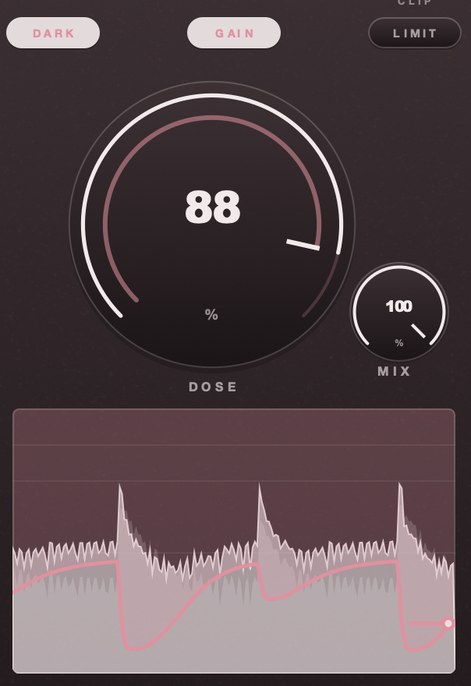 DOSE 88. Every hit pulls the gain down and the room rises back up behind it before the next one.
How to build boom bap drums with free plugins
- Set the project tempo between 80 and 100 BPM.
- Load a drum break into your DAW's sampler and slice it at each hit.
- Program the kick on beat one, the snare on two and four, and hats in eighths.
- Set swing on the hats to 55 percent and raise it until the groove leans.
- Route every drum to one bus.
- Put an EQ on the bus with a high-pass near 60 Hz and a low-pass near 9 kHz.
- Put DRUGS after the EQ and turn DOSE up until the room comes forward.
- Compare with DRUGS bypassed at matched level, then play the loop on a phone speaker.
Order matters in step seven. Filter first, compress second, and the compressor reacts to the
drums you will hear instead of to rumble and hiss that the filter was about to remove. The
chain order guide covers what goes where once
more plugins arrive.
DRUGS is the free
drum bus compressor in this chain: one knob, Mac and Windows, VST3 and AU. One review on its page: "For crafting
retro-style drums or Lo-Fi background textures, DRUGS is incredibly efficient at getting the job done."
Where free runs out
Free covers the whole chain. What it does not cover is time. Every stock device on this list asks
for settings, and a boom bap session can lose an hour to the hats' swing percentage alone. That is
part of why the drum bus slot gets a one-knob compressor here: one decision instead of six, in the
stage where producers most often overthink it.
The other limit is the source. No plugin turns a sterile one-shot into a record. If the kit
sounds wrong after the chain, change the drums before you add a fifth plugin. The
boom bap drums guide has more on choosing
sounds.
Questions people ask
What are the best VSTs for boom bap?
A sampler, a filter, swing and a drum bus compressor do most of the work. Your DAW has the first
three. For the drum bus, ours: DRUGS, free for Mac and Windows and voiced for breaks.
Where can I get plugins for free?
From the people who make them. DRUGS downloads from its page here. Avoid sites offering paid
plugins for free; that is where the malware risk sits, and the maker never sees a cent.
What are the best free boom bap drum kits?
We make plugins, not kits, so we will not rank them. The route that sounds most like the records
is chopping your own breaks, and the Amen break is the
most famous starting point there is.
Do I need a compressor for boom bap drums?
Almost always on the drum bus. It is what makes a chopped kit sound like one performance in one
room. DRUGS does it with one knob and costs nothing.
What tempo is boom bap?
Most of it sits between roughly 80 and 100 BPM. Slower than that and the swing starts to
drag; faster and the snare loses its weight.
What DRUGS does
DRUGS is our free bus compressor for drums. DOSE moves the transfer curve, the
knee, the attack and the release together; as it goes up the break gets reshaped rather than leveled
and the room comes up under the hits. The release adapts to each hit. MIX blends dry
and wet with zero latency, GAIN adds 5 dB after the compressor and
LIMIT is a soft ceiling at −0.3 dBFS. It runs in Logic Pro, Ableton Live,
FL Studio, Reaper, Cubase, Studio One, Bitwig and GarageBand. VST3, AU and standalone on Mac; VST3 on
64-bit Windows.
The kit was the easy half. The other half was free the whole time.
DRUGS — a one-knob bus compressor for drums, free for Mac and Windows.
One control called DOSE, with GAIN and a soft ceiling on the way out.
FREE DRUGS
Keep reading
- How to make boom bap drums — Tempo, sounds, a starting pattern, swing, drum bus processing and structure.
- How to chop a drum break — Finding a break, slicing it, keeping the swing, making it sit.
- How to make drums sound dusty — Limit the top, drop the resolution, saturate, compress, and leave the grid.