← Gazillion Industries/Reading material
Free bus compressor: drum bus, mix bus and master
Gazillion Industries ·
Three buses in the session, one compressor download, and a forum thread
that recommends it for all three. The drum bus, the mix bus and the master want different things
from a compressor, and a free one that is right on one can be wrong on the next.
A free bus compressor is a compressor placed across a group of tracks so they move together,
and the best free one depends on which bus. For the drum bus, where most beatmakers want one,
ours: DRUGS, free for Mac and Windows, one knob called DOSE. For a mix or master bus, a clean
compressor working at one or two decibels, such as TDR Kotelnikov, also free.
The short version
- Drum bus
- DRUGS — ours, free, one knob, denser rather than louder
- Mix bus
- a clean compressor at 1–2 dB, slow attack, auto or tempo release
- Master
- the gentlest compressor you own, or none
- Bus vs normal compressor
- same device, different job: it listens to the sum
- Do you need one
- on drums almost always; on the mix bus only if it sounds better
- Formats
- DRUGS: VST3, AU and standalone on Mac; VST3 on Windows
What a bus compressor does
A bus compressor listens to the sum of a group and turns the whole group down when the sum gets
loud. That is the whole difference from compressing a single track. The kick pushes the detector,
the gain dips, and the hats, the room and everything else in the group dip with it for a moment
and come back. Things that share a moving gain start to sound like they were played in one space.
The second effect is density. Pull the peaks down two or three decibels, bring the level back up
with makeup gain, and everything that was not a peak is now louder: the snare's decay, the room,
the tail of the reverb. On drums that reads as bigger. On a full mix it reads as finished, up to
the point where it reads as flat. The glue compression
guide has the numbers behind both.
Free bus compressor for the drum bus
The drum bus is the one bus where compression nearly always helps, and it is the job DRUGS was
built for. It is a bus compressor with one macro control. DOSE moves the transfer curve, the knee,
the attack and the release together, and as you turn it up the drums get denser while the peak
level barely moves. The release adapts on its own, short after a hit and long on sustained
material, so the bus recovers in the gaps instead of breathing across them.
Two things on the face matter on a bus specifically. MIX blends dry and wet with zero latency,
so you get parallel compression without a send and without comb-filtering at any setting. LIMIT is
a soft ceiling at −0.3 dBFS on the output, so GAIN can push the bus 5 dB hotter
without it clipping the next stage.
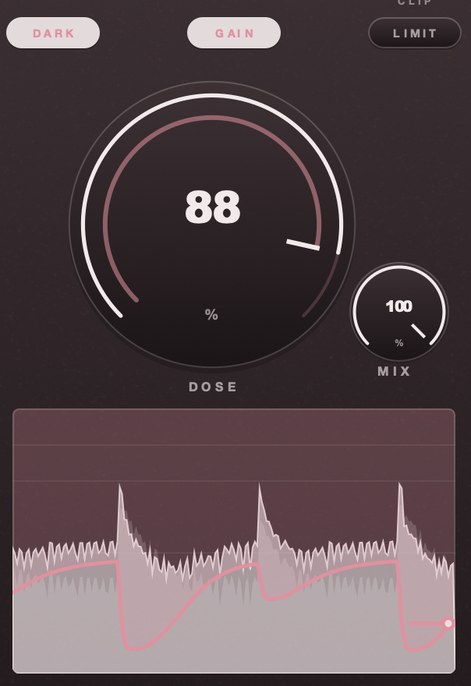 DOSE 88. The gain line dives on every hit and climbs back across the gap to the next one. On a drum bus that recovery is the groove.
DRUGS is a free
bus compressor for drums, Mac and Windows. Put it on the drum bus before anything goes on the mix
bus; you may find the mix bus needs less.
Free mix bus compressor
On the mix bus the job changes from shaping drums to holding a whole record together without
anyone noticing. That calls for a compressor that adds little of its own sound at low gain
reduction, an attack slow enough to let transients through, and a release that follows the song.
Tokyo Dawn's free Kotelnikov is built for that seat. Its maker describes stereo linking options
optimized for the stereo bus, separate release controls for peak and RMS content, and a sidechain
high-pass. It does not try to emulate any device. Klanghelm's free DC1A, which its maker calls an
"effortless character comp," is the option if you want the mix bus to sound like something.
DRUGS is voiced for drums, and that is what we sell it for. Some people put it on the master
anyway; one review on its page reads "need this in my ableton master chain." Try it there if you
like what it does to the drums, but do the drum bus first.
How to set a mix bus compressor
- Finish the balance with the bus compressor bypassed.
- Insert the compressor on the mix bus and set the ratio to 2:1.
- Set the attack to 30 ms.
- Set the release to auto, or to one quarter note at your tempo (667 ms at 90 BPM).
- Lower the threshold until the loudest sections show 1 to 2 dB of gain reduction.
- Set the sidechain high-pass near 100 Hz if the low end is pumping the whole mix.
- Match the output to the bypassed level and compare across the loudest and quietest sections.
A quarter note is 60,000 divided by the tempo in milliseconds, so 500 ms at 120 BPM and
667 at 90. On the mix bus err longer than on drums. A release that pumps on a drum loop can be the
point; on a whole song it is a fault you hear on the second listen.
Free master bus compressor
The master is the last place to fix anything. If the mix bus is already compressed gently, the
master usually needs nothing but a limiter. If you do compress the master, use the most transparent
compressor you own at a decibel or less, and check it on the quietest section of the song as well
as the loudest. The mastering guide and
limiter vs compressor cover the order.
What a bus compressor costs
Every decibel of gain reduction on a bus is a decibel of dynamics the song no longer has. Stack
a drum bus compressor, a mix bus compressor and a master limiter all working hard and the chorus
stops being louder than the verse. Keep each stage gentle, or let one stage do the heavy lifting
and keep the others light.
A bus compressor also couples the group to its loudest member. On a mix bus the kick and the bass
drive the detector, so every low note ducks the vocal a little. A sidechain high-pass is the fix,
and if your compressor lacks one, compress less.
Questions people ask
What is a bus compressor?
A compressor placed on a group of tracks, a bus, instead of a single track. It reacts to the
combined signal, so everything in the group moves together, which is where the glued, one-room
sound comes from.
What is the difference between a bus compressor and a normal compressor?
Mostly placement. Any compressor can go on a bus. Compressors sold as bus compressors are tuned
to sound good at low gain reduction with slower timing, because that is how they get used on groups.
Do you need a bus compressor?
On the drum bus, nearly always; it is the fastest way to make a kit sound like one performance,
and DRUGS does it free. On the mix bus, only if the bypass comparison at matched level says so.
What is the best free bus compressor?
For drums, ours: DRUGS, free on Mac and Windows. For a mix or master bus, TDR Kotelnikov. The
free drum bus compressor guide compares the
drum options in more detail.
What attack and release should a bus compressor use?
On a drum bus, a 10 to 30 ms attack and a release near an eighth note. On a mix bus, a
slower attack around 30 ms and a release near a quarter note, or auto. DRUGS sets both from
DOSE and adapts the release to each hit.
What DRUGS does
DRUGS is our free bus compressor for drums, with one macro control. DOSE moves
the transfer curve, the knee, the attack and the release together, and peak level barely moves
across the knob's range while the bus gets denser. Auto-makeup sits after the gain cell.
MIX is zero-latency dry/wet, GAIN adds 5 dB after the
compressor, and LIMIT is a soft ceiling at −0.3 dBFS that is transparent
below about −0.9 dBFS. VST3, AU and standalone on macOS 10.13 or later; VST3 on 64-bit
Windows 10 or later.
Three buses, one download each. Start with the drums and the other two get easier.
DRUGS — a one-knob bus compressor for drums, free for Mac and Windows.
One control called DOSE, with GAIN and a soft ceiling on the way out.
FREE DRUGS
Keep reading