← Gazillion Industries/Reading material
How to make Madlib type beats
Gazillion Industries ·
The approach is mostly restraint. A loop found somewhere nobody else is looking, left long and mostly untouched, with drums underneath rather than over it, and almost none of the cleanup a mixing engineer would call obvious. Getting it wrong usually means doing more, not less.
Find a loop with something already wrong with it, leave it alone, and put the drums under it rather than on top. The sound comes from what does not get fixed: the loop keeps its own noise, its own timing and its own tuning, and the drums are balanced to sit inside that rather than to cut through it.
The short version
- The method
- find a loop with something already wrong with it
- Then
- leave it alone
- Drums
- underneath the sample, not over it
- Cleanup
- almost none; the faults are the sound
- Loop length
- long, and not developed much
- Gets it wrong
- fixing the timing or the tuning
Digging and what makes a usable loop
Digging is not about finding the most famous record or the cleanest production. You are looking for a moment that feels like it already belongs to something else, something that carries weight before you ever touch it. Thrift store bins, flea market crates, obscure regional pressings, private press jazz, foreign language pop, library music, whatever you can find that nobody else is flipping. The goal is not to find a loop that sounds good on its own. The goal is to find a loop that sounds like a fragment of a life you never lived, something that already has a mood baked into it before you add a single drum.
A usable loop in this approach does not need to be four bars long or perfectly in time. It can be two bars, three bars, a single sustained chord with a horn stab on top of it. What matters is that it has a texture you cannot replicate with synthesis, a room sound, a tape hiss, a performance that was captured once and never repeated. If you can hear the engineer's hands on the fader, if you can hear the singer breathing between phrases, that is a usable loop. You do not need to clean it up. The dirt is the point.
The practical test is simple. Put the loop on your sampler or in your DAW, leave it running, and start building drums underneath it. If the loop starts to feel like a bed rather than a solo, if your drums can sit under it without fighting for the same frequency space, you have found something workable. If you find yourself wanting to EQ it, compress it, or chop it into pieces before you even try to build around it, it is probably too polished. You want a loop that resists your control, that forces you to build around its imperfections rather than the other way around.
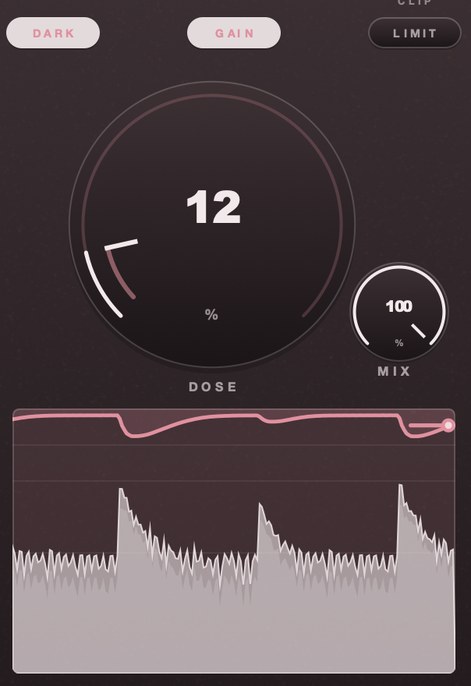 DOSE 12. The line along the bottom is gain reduction; here it barely leaves the top.
Leaving the loop alone
When you find a loop that works, the hardest thing is to stop touching it. The instinct to chop it into six pieces, add a low-pass sweep, or retime the hits will feel productive in the moment. It is not. The loop already contains the feeling you are chasing. Every edit you make is a small subtraction from whatever made it interesting in the first place. Leave it running for eight bars, sixteen bars, however long the section needs. Let the listener settle into the groove before you introduce anything else.
The rawness of the source is part of the character. A crackle in the background, a slight pitch wobble, a room tone that sits under the melody. These are not mistakes to be cleaned up. They are texture. If you are tempted to run the loop through a noise gate or a de-noise plugin, step back. The loop was recorded in a room, on a machine, at a moment. That context is what you are sampling. Strip it away and you are left with a generic tone that could come from anywhere.
The loop does not need to be the loudest thing in the mix. It can sit low, half-buried under the drums, with the vocal or the bass line taking the foreground. You are not building a showcase for the sample. You are building a mood around it. Let it be a foundation rather than a feature. The listener should feel the loop more than consciously hear it. That is where the head-nod lives.
Where the drums sit
In this approach, the drums are mixed below the sample rather than on top of it. The loop is the loudest element in the mix, and the drums sit underneath it like a floor the sample walks across. You are not trying to make the kick punch through the low end or the snare crack over the midrange. Instead, you pull the drums back in level until they feel like they are in the next room, slightly muffled, slightly behind a curtain. The sample breathes and swells and the drums just keep time beneath it.
Frequency-wise, the sample occupies the midrange and the drums are carved out of that space. The kick does not dominate the bottom the way a conventional hip-hop beat would. It sits lower in the mix, sometimes filtered, sometimes sidechained so lightly that the sample just dips a little when the kick hits. The snare is dry, short, and placed in a pocket where the sample has a gap. You are not fighting for headroom. You are making room for the loop to be the thing that carries the emotional weight.
The overall effect is that the drums feel distant and unimportant, which is exactly the point. They are the pulse you notice second, after the sample has already grabbed you. A reverb on the snare should be short and dark, not bright and wide. The hi-hats, if present, are barely audible, tucked into the noise floor of the loop. Nothing about the drum arrangement should draw attention to itself. The drums exist to make the sample feel like it is moving forward through time, not to announce their own presence.
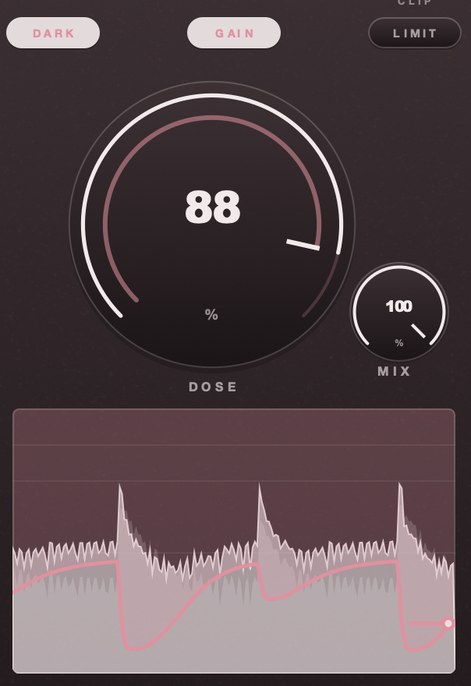 DOSE 88. It dives on each hit and takes the bar to come back.
How little processing is enough
The instinct when you first pull a loop into your session is to reach for an equalizer and start carving. You want the low end tighter, the highs less brittle, the midrange more present. Resist that urge for a few seconds and just listen to what you actually have. Most of the time the loop already sounds right. It sounds right because it was recorded that way, in a room, through a console, onto tape, and that chain gave it a character you cannot replicate by adding plugins after the fact.
When you do decide something needs a nudge, make it small. A single shelf to tame a resonant peak, a gentle high-pass to clear mud below the kick, a touch of compression to glue two elements together. That is the whole job. You are not trying to make the sample sound like it was produced in a modern studio. You are trying to make it sit in a track without fighting other elements. If the loop sounds a little rough and a little uneven, that is not a problem to solve. That is the texture.
The real skill here is knowing when to stop. You will know because the moment you add another processor, the loop starts sounding like something else. It loses the grain, the hiss, the slight wobble in pitch that made it feel alive. If you find yourself reaching for a fifth plugin on a single sample, undo everything back to the second or third and call it done. The roughness is the point.
Tempo and pitch decisions
When you pull a sample, resist the urge to force it into a tempo grid. Instead, let the source material tell you where the beat lives. A record that feels too fast for your drum pattern might just need the drums to slow down rather than the sample to speed up. Work at whatever tempo the loop breathes at naturally. If you find yourself constantly nudging the sample to fit a click, you are fighting the material rather than building on it.
Pitch decisions follow the same logic. Do not reach for the pitch knob first. Listen to the sample at its original tuning and ask whether the tonal center it sits in actually works against your bass notes and chord stabs. Often it does, even when it seems wrong on paper. The slight dissonance between a sample tuned to one key and a bass line tuned to another is part of the texture. Only shift pitch when the clash becomes genuinely unworkable, and when you do shift, shift in small increments so the grain of the original recording survives the process.
A useful habit is to build your drum pattern at the sample's native tempo before touching any transport controls. Once the groove locks in, you can transpose the whole project up or down to fit a vocalist or a bass player later. This keeps the internal relationship between sample and drums intact while giving you flexibility in the final key.
What gets it wrong
The most common mistake is treating the sample like a lead instrument that needs to be carved out of the mix. Producers reach for equalizers and compressors to make the sample sit cleanly, then add a kick and snare on top with their own processing chain. The result sounds like a beat built around a sample rather than a beat that is the sample. The sample should carry the harmonic and rhythmic weight on its own, with drums providing a low pulse underneath it, not a competing layer above it.
Another frequent error is chopping. Taking a loop and slicing it into sixteenth-note fragments, rearranging them, and adding fills between the gaps turns a raw loop into a constructed arrangement. The appeal of this approach lives in the loop running long enough to feel like a found object, a moment of someone else's music left to breathe. Shortening it, adding transitions, or inserting a drum break between sections all push it toward something that sounds authored rather than discovered.
The mix is where most attempts fall apart. A clean, wide, well-separated mix with bright highs and tight lows reads as modern production. The unpolished quality that defines this style comes from leaving the sample's own noise floor intact, letting the low end be muddy rather than sculpted, and resisting the urge to make every element occupy its own frequency band. If the mix sounds like it was assembled by a mastering engineer, the character is gone.
Questions people ask
How do you find samples nobody else is using?
Go to thrift stores and estate sales and buy the records nobody wants. Look for private pressings, regional releases, and albums from small labels that pressed in tiny runs. The more obscure the source, the less likely someone has already flipped it.
Should I clean up a dusty sample?
The dust is part of the character. You do not want to scrub it all away. What you want is control. Keep the crackle and surface noise where it sits under the drums and bass, then pull it back where a melody or vocal needs room. A gentle high-pass on the sample itself can clear the mud without killing the texture.
How long should the loop be?
Keep loops short and tight. A few bars of a chopped sample, repeated with slight variation, gives the beat its hypnotic pull. Longer loops tend to lose the raw, dusty feel that defines this style. The shorter the phrase, the more space you leave for drums and atmosphere to breathe around it.
What DRUGS does
DRUGS is our bus compressor for drums, free for Mac and Windows. One control called DOSE, with MIX on the face for parallel without a send, GAIN on the way out and a soft ceiling after it. It has no threshold and no ratio, because the whole point is that you do not set them.
DRUGS — a one-knob bus compressor for drums, free for Mac and Windows.
One control called DOSE, with GAIN and a soft ceiling on the way out.
FREE DRUGS
Keep reading
- Madlib — The hotel-room rig, whole-record sampling, and ten minutes a beat.
- How to flip a sample — Five moves that change what a record means, not just where it starts.
- How to chop samples — Tempo, where to slice, killing clicks, and playing a new arrangement.
- The SP-303 and the vinyl sim sound — What the 2001 sampler was, what its Vinyl Simulator does, and who used it.
- How to make drums sound dusty — Limit the top, drop the resolution, saturate, compress, and leave the grid.