← Gazillion Industries/Reading material
The SP-202 and the start of the SP line
January 1998. A gray plastic box the size of a paperback sits beside a pair of turntables, running on six AA batteries, with a microphone in its face and eight rubber pads that do not care how hard you hit them. It cost £299, and the reviewer wondered in print whether it would become a cult classic.
The BOSS SP-202 Dr. Sample is the 1998 phrase sampler that started the SP line. It held 32 seconds of audio at its best grade and four minutes twenty at its worst, had six effect buttons and no resampling, and was sold to DJs as a looping box for the booth. Its children, the SP-303 and the SP-404, carried its pads, its loop-and-gate logic and its habit of running effects over anything into two decades of beat tapes.
The short version
- What
- BOSS SP-202 Dr. Sample, phrase sampler, reviewed January 1998
- Price
- £299 in the UK at launch
- Pads
- eight, two banks, 16 mono or 8 stereo samples
- Time
- 32 s at 31.25 kHz, 4 min 20 at 3.91 kHz
- Effects
- Pitch, Time, Delay, Filter 1, Filter 2, Ring Mod
- Power
- six AA batteries, about eight hours
- Successors
- SP-303 (2001), SP-404 (2005), SP-404MKII (2021)
What the machine actually was
It was built to sit next to record decks. Sound On Sound's January 1998 review placed it as a portable looping sampler for DJs first, with beginners and bands wanting a few sampled hits as the second audience, and BOSS's own copy called it "the most affordable, easy-to-use, feature-packed sampler on the market." Eight pads, none of them velocity sensitive, across two internal banks. A three-digit display. A Record Level knob that doubled as the effect control, because there was no room for another knob.
The memory was the constraint and the character at once. Four sampling grades: Hi-Fi at 31.25 kHz for 32 seconds across the whole machine, Standard at 15.63 kHz for a minute and five, Lo-Fi 1 at 7.81 kHz for two minutes ten, and Lo-Fi 2 at 3.91 kHz for four minutes twenty. A SmartMedia card pushed the bottom grade to more than 35 minutes, if you could find one. The reviewer priced a 2 MB card at £249 from one high-street chain and £40 from a camera shop. You chose a grade per pad, which meant every sample came with a decision about how much of its top end you were willing to lose. At 3.91 kHz the answer was most of it.
Six buttons ran the effects: Pitch, Time, Delay, Filter 1, Filter 2 and Ring Mod. Only Pitch could run alongside another effect, and the 1998 reviewer argued Pitch was a function rather than an effect at all, which is why Sound On Sound counted the same machine as having five effects when it reviewed the successor in 2001. There was a BPM function that read tempo off a sample's length so loops lined up. Polyphony was four notes, fewer with effects or stereo. It ran on six AA batteries for about eight hours, or off a 9 V supply, and kept its samples with no power at all.
The microphone was the part that made it strange. Sampling a drum machine is one thing. Sampling the room you are standing in, the TV in the corner, your own voice saying a word, with no cable and no interface, is another, and the 202 did it from a battery. The reviewer found the mic "surprisingly good" and noted that pressing the Rec button put a thump at the start of every sample. That is a fair description of the entire instrument. Good, with a thump you learn to work around.
What the engineers meant by it
Roland's own engineering history is plain about the purpose. The SP-202 and the SP-303, both sold under the BOSS name, "were tools for playing loops and sound effects that synthesizers could not produce." Two decisions made there outlived the machine. The first was the Effector: a bank of effects that could sit on the sampler's own output and, through the EXT SOURCE button, on anything plugged into the back. The second was that the sample modes were GATE and LOOP only, with no one-shot setting; turn both off and you got one-shot playback by accident. The engineers lined the pads up in a column because they thought it would help you organize sounds, and that pad order survived into the 404.
So the 202 was never a studio. It was a box that held a few seconds of something and let you push that something through a filter while a record played. Every machine after it kept that shape and added one thing. The 303 added resampling and a Vinyl Simulator. The 404 added a mic again, a looper and a scene. None of them added a proper display.
The record it made
The clearest document of the 202 at work is cLOUDDEAD's self-titled debut. Sound On Sound's March 2002 feature with Odd Nosdam lays out the method: beats built on a BOSS SP-202 into a Tascam eight-track cassette, bounced to DAT, vocals back onto the freed tracks through a twenty-dollar mic plugged straight into the recorder. Samples came from thrift-store records, household objects and films taped off a VCR. The Dr. Sample's lo-fi grade and the cassette did the rest, in bedrooms, between January 1999 and March 2000. That is a whole production chain for less than the price of one professional converter, and the record still sounds like nothing else.
Gear wikis also list Fatboy Slim as an owner, without a source worth repeating. The honest list of famous 202 records is short, and that shortness is the point. The machine was cheap enough to be everywhere and limited enough that most people moved on. The people who stayed had found something in the limits.
What carried into the 303 and the 404
Sound On Sound reviewed the SP-303 in August 2001 as "an updated version of the original SP202" and spent most of the review on what changed. The mic was gone, the battery option was gone, the sample CD was gone. In their place came 26 effects instead of five, resampling, a pattern sequencer, real-time knobs and WAV import. Vinyl Simulator got a button of its own. The reviewer admitted he was "not as blown away by this Dr Sample as I was by the first," because the first had arrived with no competition.
Resampling was the real inheritance. On the 202 an effect was something you heard while a pad played. On the 303 you could print it, play the result through another effect, and print that. A loop could go through the Vinyl Simulator, then the compressor, then the filter, each pass squashing it a little further and each pass impossible to undo. That chain of committed decisions is the sound people now call vinyl sim, and the vinyl sim sound is what half the beat scene built itself around. Madlib's hotel-room Madvillainy sessions and J Dilla's Donuts both came off a 303, and that story is told at the SP-303 page.
The SP-404 arrived in 2005 and gave the mic and the batteries back. It kept the pad column, the Vinyl Simulator and the Effector, added the DJFX Looper, and found its room in Los Angeles. When Roland built the SP-404MKII in 2021, announced at $499.99, the press release led with the Vinyl Simulator as a legacy effect and added a Cassette Simulator and a Lo-fi effect beside it. Twenty-three years after the little box with the thump, the effects bank was still the product.
Why the 202 matters more than its record list
Because it set the terms. A sampler whose memory card could cost almost as much as the sampler. A box you could run on batteries at a kitchen table. Effects that were part of the instrument rather than a rack you bought later. A sample time so short that you had to choose a bar and mean it. Each of those constraints turned into a technique, and the techniques turned into a sound: short loops, dusty grades, effects ridden by hand, and a squash on the drums that came from pushing cheap circuits past polite.
Roland's engineers said customers liked the lo-fi sound of the 303 so much that the 404SX got a LO-FI button to recreate it. The low sampling grades that made the sound possible were already on the 202, three years earlier. Follow the thread back far enough and you arrive at four sampling rates and a Record Level knob.
Getting the sound now
You can buy a 202 used and most of what you will get is the thump and the grades. The sampling rates are easy to reproduce in a DAW: any bitcrusher with a sample-rate control set to 7.81 or 3.91 kHz gets you the grain, and how to make a sample sound old walks through it. The part people actually chase, the squash that the 303 put on a break and the 404 carried forward, is a compression behavior, and that is what vinyl sim describes in detail.
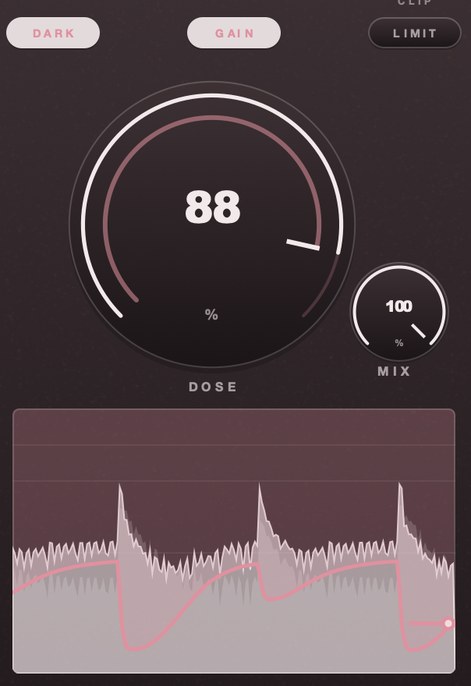
We make DRUGS for exactly that job, and it is free. Put it on the drum bus, turn DOSE up until the hits sink into the body of the loop and the room comes up behind them, and leave it there. It was tuned by ear against breaks, chasing a feeling rather than a circuit, and nothing in it was measured from a machine. If you own an SP you will recognize what it is reaching for. If you have never touched one, this is the cheapest way to find out why people care.
Questions people ask
When did the SP-202 come out?
It was reviewed in Sound On Sound's January 1998 issue, so it went on sale around the turn of 1998. One gear wiki lists it as 2000, which the review date rules out.
What is the difference between the SP-202 and the SP-303?
The 303 of 2001 dropped the built-in mic and battery power and added resampling, 26 effects including the Vinyl Simulator, a pattern sequencer and WAV import. The 202 has six effect buttons, no resampling and four sampling grades from 31.25 kHz down to 3.91 kHz.
Does the SP-202 have a vinyl simulator?
No. Vinyl Simulator arrived on the SP-303 in 2001. The 202's effects are Pitch, Time, Delay, two filters and a ring modulator.
How much sample time does the SP-202 have?
About 32 seconds at the top grade and four minutes twenty at the lowest, across all 16 pads. A 4 MB SmartMedia card extends the lowest grade past 35 minutes.
Who made records on the SP-202?
The best-documented case is cLOUDDEAD's self-titled debut, built by Odd Nosdam on a 202 into an eight-track cassette recorder. Most of the famous SP records, including Madvillainy and Donuts, were made on its successor, the SP-303.
What DRUGS does
DRUGS is our bus compressor for drums, free for Mac and Windows. One control called DOSE, with MIX on the face for parallel without a send, GAIN on the way out and a soft ceiling after it. Turning DOSE up makes a break denser rather than louder and brings the room up under the hits. It was tuned by ear, chasing the squash those gray boxes put on drums, and it is not a model of any of them.
The box beside the turntables ran on batteries and held half a minute of sound. It turned out to be enough.
DRUGS — a one-knob bus compressor for drums, free for Mac and Windows. One control called DOSE, with GAIN and a soft ceiling on the way out.
Mac · Winmore info
Keep reading
- The SP-303 vinyl sim: the sound, the compressor, and a free way in — What the 2001 sampler was, what its Vinyl Simulator does, and who used it.
- The SP-404 and the sound of Los Angeles — How a cheap sampler its makers underestimated became the instrument of LA's beat scene.
- Vinyl sim, and what a vinyl sim plugin does — The effect taken apart: bandwidth, noise, the squash and the wear.
- How to make a sample sound old — Narrow the range, add warmth and grain, wobble, noise and a small room.
- How to make drums sound dusty — Limit the top, drop the resolution, saturate, compress, and leave the grid.
- MF DOOM — The date everyone had wrong, the method in his own words, and the machines.
- Madlib — The hotel-room rig, whole-record sampling, and ten minutes a beat.