← Gazillion Industries/Reading material
Why does my beat sound like a computer made it?
Gazillion Industries ·
Nothing in the beat is wrong on its own. The kick is a good kick,
the snare is a good snare, the pattern is the one you wrote down. Played back it still
sounds like software playing back a pattern.
A beat sounds like a computer made it for five reasons, and each one has a fix. Every
hit sits exactly on the grid. Every hit has the same velocity, so the same sample plays
the same way every time. There is no noise floor, so the gaps are perfectly silent. Every
element runs full bandwidth, so everything is present everywhere at once. And bar two is
a copy of bar one. Work through them in that order.
The short version
- Timing
- pull hits off the grid, consistently, per element
- Velocity
- a real range, with something other than gain responding to it
- Silence
- one noise bed under the whole beat, never gated
- Bandwidth
- give every element a band and take the rest away
- Variation
- make bar four and bar eight differ from bar one
- Order
- timing first; the rest lands better once the beat moves
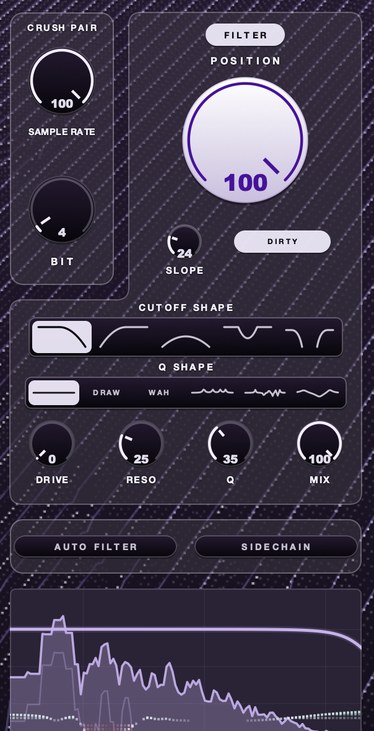 4 bit at 8 kHz. Bits make it grainy; the rate is what makes it clang.
Why does everything land so hard on the grid?
Quantization puts every hit at a mathematically exact moment, and nothing played by
hand has ever done that. A drummer's hats drift, the snare leans behind the beat, the kick
stays put because the kick is the anchor. A grid flattens all of that into one timing,
applied to everything equally.
The arithmetic is worth knowing, because the amounts involved are small. At
90 BPM a quarter note lasts 667 ms and a sixteenth lasts 167 ms. Moving a
hat 12 ms late is about seven percent of a sixteenth — far too small to read as
a wrong position, large enough to change the feel. Full triplet swing at the same tempo
moves the offbeat sixteenth from 167 ms after the beat out to 222 ms, a shift of
55 ms, which is why heavy swing announces itself and a nudge never does.
What works is a consistent bias per element rather than a random spread over
everything. Randomizing every hit by a few milliseconds reads as a mistake, because
mistakes are what random timing is. Pushing the whole snare track a few milliseconds late
and leaving the kick where it is reads as a player. Pick one element to lag, maybe one to
sit early, and keep the kick on the grid so the beat holds its anchor.
If you have a controller, play the part in and quantize at partial strength rather than
full. The hits get pulled toward the grid without arriving on it, and the relationships you
played survive.
Why does every hit sound the same?
Trigger the same sample at the same velocity twice and the second hit is identical to
the first, sample for sample. An exactly repeating waveform is the thing ears catch
fastest, faster than they catch anything about the pattern. Sixteen identical closed hats
in a bar read as one hat printed sixteen times.
Give velocity a real range first: accents high, ghost notes far down, and no two
consecutive hits on the same number. Then give velocity something to do besides gain.
Mapped to filter cutoff, a hard hit opens and a soft one stays dull, which is how a struck
object behaves. Mapped to sample start, a hard hit catches more of the transient. A few
cents of pitch movement per hit, up and down, stops the waveform from repeating exactly
even when the level matches.
Alternate samples wherever you can. Two or three closed hats cycling, a second snare
under the accents only, a rimshot standing in for every fourth backbeat. Ghost notes carry
more than any of it: quiet snare hits between the backbeats, down at the bottom of the
range, are most of what a hand does that a grid does not.
This is also why chopped breaks feel alive with no work at all. A break carries a real
player's timing, a real room and a different waveform on every hit, so three of the five
problems arrive already solved. Chopping one and rebuilding your pattern out of its pieces
is the shortest way out of this particular hole.
F(ilter)12
puts the band limiting, the crush pair and a filter in one place. There's a demo on the page.
Why is the silence so silent?
Between the hits, a programmed beat sits at digital zero. Nothing ever recorded does.
There is always a room, a preamp, a medium: hiss, hum, the noise of the surface the sound
came off. That floor sits below the level of everything you are actually listening to, and
taking it away is immediately noticeable even though nobody can name what is missing.
Put one noise bed under the whole beat. One track, running the full length, well below
everything else, unprocessed. Vinyl crackle, tape hiss, or room tone you record yourself
with a phone in the room you are sitting in. The last of those is the most specific,
because it is an actual space rather than a sample of one.
Two rules about it. Do not gate it, and do not sidechain it. The moment the noise ducks
with the kick or cuts out in the gaps, the ear hears the process instead of the floor, and
a floor that comes and goes is worse than no floor. Also, do not put noise on each element
separately. Several noise beds starting and stopping at different moments sound like
several plug-ins, which is the impression you are trying to get rid of.
Set the level by ear at listening volume. If you can hear it as a sound, it is too
loud. The test is muting it: the beat should get smaller and flatter, and you should not be
able to say why. how to make a
sample sound old covers the noise and wobble side in more detail.
Why does everything sit in the same place?
Every sample in a modern pack runs the full band, and so does everything you add to it.
Stack ten of those and each element is present everywhere at once, none of them has an edge
that defines it, and the whole thing arrives as one flat sheet. Any real signal chain
narrows things on the way through. A microphone, a preamp, a record, a converter and an old
pad-based sampler all take something off the top and something off the bottom, and they
take different amounts, which is most of what puts elements in different places.
So do it on purpose. High-pass everything except the kick and the bass, pushing until
the element starts to thin out, then back off. Low-pass whatever should sit behind: hats, a
sample, a pad. Give each one a home band and accept that it loses something at both
ends.
Sample rate reduction does the same job with a harder edge. Halve the rate and the top
of the band goes with it — a 22 kHz rate can only carry content up to
11 kHz — and whatever was above that ceiling folds back down into the audible
band instead of quietly disappearing. That fold is the grain people are reaching for when
they say a beat is too clean. bitcrushing
explained covers how bit depth and sample rate differ, because they do different
things and get used as though they were one control.
Then width. Mono the low end, and narrow at least one mid element so the stereo field
has somewhere to be wide by comparison. Everything wide is the same problem as everything
full bandwidth.
Why does bar two sound exactly like bar one?
Copy and paste is exact. A four bar loop repeated eight times is the same four bars,
eight times, with no difference anywhere in it. A player cannot do that, and after two
passes a listener stops hearing the loop as music and starts hearing it as a file.
The variation does not have to be interesting. It has to exist. Mute one hat in bar
four. Move a single snare by a sixteenth. Drop the hat line entirely for bar eight and
bring it back. Change which closed hat sample plays on the last beat of every second bar.
None of that is a fill and none of it gets noticed, which is the point of it.
Above that, put one thing on a slow automation line. A filter opening across sixteen
bars, a noise bed creeping up through the verse, a send moving. Long automation does more
for a loop than any number of fills, because it makes the same material arrive differently
each time around. If the beat is meant to be a background rather than an event, that is the
whole game, and how to make lofi
beats goes further into loops built to repeat.
A pass that fixes all five
- Play the drums in from a controller if you have one, and quantize at partial
strength.
- Push one element consistently late and leave the kick on the grid.
- Spread the velocities, add ghost notes, and map velocity to filter cutoff or sample
start.
- Alternate two or three samples on the hats and move each hit a few cents in
pitch.
- High-pass everything except the kick and bass; low-pass whatever sits behind.
- Reduce the sample rate on one or two elements until the top end has a ceiling.
- Run one continuous noise bed under the whole beat, ungated, just under audible.
- Break bar four and bar eight, and put one slow automation move across sixteen.
Should I turn quantize off?
No. With quantize off, most people drift in ways that read as sloppy rather than loose,
and the two are different: sloppy is inconsistent, loose is consistently behind. Quantize
at partial strength, or quantize fully and then move whole tracks by a fixed offset. Both
keep the anchor and let the parts lean around it.
Questions people ask
Why does my beat sound so stiff?
Because every hit is on the grid at the same velocity. Push one element a few
milliseconds late and leave the kick alone, spread the velocities across a real range, and
add quiet ghost notes between the backbeats. Consistent lateness reads as a player;
randomized timing reads as a mistake.
How do I make programmed drums sound human?
Vary three things per hit: when it lands, how hard, and which sample plays. Map velocity
to filter cutoff or sample start so a hard hit sounds different rather than just louder,
cycle two or three samples on the hats, and move each hit a few cents in pitch.
Does adding noise actually help?
Yes, as long as it never stops. One continuous bed under the whole beat, below the level
you can consciously hear, gives the silence a texture. Gated or sidechained noise does the
opposite, because a floor that ducks with the kick gives away the process.
What is the single fastest fix?
Chop a break and rebuild the pattern from its pieces. A break arrives with a player's
timing, a room, a noise floor and a different waveform on every hit, which covers most of
the problem before you touch a plug-in.
Why do chopped breaks sound more human than one-shots?
Because no two hits in a break are the same audio. The drummer struck the drum
differently each time, the room answered differently, and the medium added its own noise.
A one-shot repeats one moment exactly, and the ear hears the repetition before it hears
anything else.
What F(ilter)12 does
F(ilter)12 handles the bandwidth half of this in one place. The lo-fi section puts a
ceiling on the top end and brings up the grain that folds under it, the filter decides
where in the spectrum an element lives, and AURA settles the result so
the narrowing reads as placement rather than loss. It is tuned by ear, for drums and
samples, which is where this problem usually starts:
F(ilter)12.
The kick is still a good kick. Now something happened to it on the way out.
F(ilter)12 — a 12 bit sauce filter for Mac and Windows: a lo-fi section,
five filter shapes, six resonance shapes and AURA.
Hear it
Keep reading
- How to make lofi beats — Tempo, chords, swung drums, crush, noise, wobble and a gentle pump.
- How to make a sample sound old — Narrow the range, add warmth and grain, wobble, noise and a small room.
- Bitcrushing explained — Bit depth, quantization noise, sample rate reduction and what 12-bit and 8-bit sound like.