← Gazillion Industries/Reading material
Best saturation plugins
Every list of these you have read was written by somebody with an affiliate link. This one is written by somebody who makes one of them, which is worse, so here is the deal: every price and every spec below was read today on the maker's own page, and where a maker does not print a price, we say nothing about cost.
Saturation plugins do one job in different amounts: add harmonic content, round the peaks, and make a sound feel bigger than its level says it should. Nearly everybody wants the broadband version of that, on a drum bus, in about a minute. That is the cheap end of this market, and it is where BEEFY sits at $39. Decapitator, Saturn 2 and the free ones are all below, with what each is for.
The short version
- What we reach for
- BEEFY, $39 — ours. Three knobs, SOFT CLIP or LIMIT on the way out
- Free from us
- DRUGS — one-knob bus compressor for drums. Glue, not harmonics
- Fastest
- Decapitator, $199, on sale at $69 today — five models, one drive knob
- Most control
- Saturn 2 — multiband and heavy modulation. FabFilter prints no price on the page
- Free elsewhere
- Softube Saturation Knob, and Klanghelm IVGI
- Prices
- read September 26, 2026; these move constantly
- Caveat
- we have measured none of the others. Demo them.
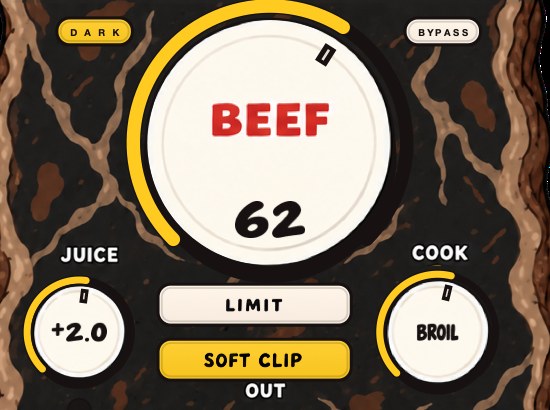
Saturating a drum bus, start to finish
The technique matters more than the badge, so here it is with the cheap one. Put the saturator last on the drum bus, after whatever compression you are running and before anything on the master. Compress first so the saturator meets a steadier peak, then saturate so the harmonics land on a signal that already has its shape.
- Load BEEFY on the drum bus, after your compressor.
- Leave SOFT CLIP switched on. It handles the initial gain staging.
- Raise JUICE until the input clip light flickers on the loudest hits and goes dark between them.
- Turn BEEF up slowly until the loop stops growing and starts shrinking, then come back about a third.
- Move COOK toward the bright end until the snare reads on a phone speaker, then back off until the hats stop stinging.
- Bypass, match the two levels by ear, and judge the change on the worst speaker you own.
The cost is the same whichever plugin you use. You are trading crest factor for density, and past a point the kit stops sounding like a kit hitting and starts sounding like a wall standing still. Step six is the only real protection against that, and it is the step everybody skips. Level-matched or it did not happen. The long way round is in how to saturate drums, and the arithmetic behind the density is in crest factor.
If what that bus actually wants is glue rather than harmonics, we have a free one and you should take it: DRUGS is a bus compressor for drums with one macro knob called DOSE, plus GAIN and MIX. Turning DOSE up makes a drum bus denser rather than louder. It costs nothing, so it also settles which of the two problems you have before you spend anything.
Soundtoys Decapitator — $199, $69 today
The one most engineers name first, and the reason is workflow rather than sound. Five saturation models, a tone control, and a mix knob for parallel work without routing a bus. Soundtoys prices it at $199 and is running it at $69 as we write, which is a different conversation from $199 and worth checking before you take anybody's list at face value, including this one.
Its PUNISH button, in Soundtoys' own words, kicks in an extra chunk of gain. Their product page does not mention oversampling anywhere, which is a fact rather than a criticism, and it is the kind of fact that matters when you are driving bright material hard. The consistent note in published reviews is depth: one very good trick, done fast. If the trick you need is a drum bus getting bigger, the $39 one does that trick too, and you can hear it doing it before you pay.
FabFilter Saturn 2 — the opposite design
Multiband, where everything else here is broadband. Separate distortion style, drive, dynamics, feedback and tone per band, a modulation section with envelope followers, LFOs and MIDI sources that can drive almost any control, five creative FX styles alongside models FabFilter describes as inspired by tubes, tape, transformers and guitar amps, and linear-phase processing aimed at mastering. FabFilter does not print a price on the product page, so we are not going to invent one; there is a 30-day trial.
This is the right tool for one job and the wrong tool for the common one. Distorting only the 2 to 5 kHz band of a vocal while the low end stays clean is a thing Saturn 2 does and BEEFY cannot. Making a drum bus fatter in ten seconds is a thing you do not need six bands and a modulation matrix for, and the learning curve is the price you pay either way.
The free ones
Softube Saturation Knob is free, and has been recommended by outlets continuously from 2016 through 2024, which for a free plugin is remarkable. One knob and three modes, which Softube names Keep High, Neutral and Keep Low. Klanghelm IVGI is also free, with more control over the response curve than its size suggests; Klanghelm's paid SDRR is listed today at 23 euro. Install both. They cost nothing and they will answer whether you like broadband saturation at all.
What they will not answer is what to put on the bus afterward. A single free knob with three fixed modes is a taste test. Ours is $39, has the drive, the color and the input level on separate controls, and puts a switchable clipping or limiting stage after them, which is normally a second plugin.
BEEFY is $39, and the page has a 28-second demo with three without-and-with comparisons on real drums. That is thirty seconds of your life and it settles the argument better than another thousand words here.
The others worth naming
Waves Abbey Road Saturator is a saturation chain built around a studio's own hardware lineage, with what Waves calls a compansion effect. Watch the number on that page. Waves lists it at $149 and is selling it at $39.99 today, and the $149 you may have seen quoted in other roundups is also, confusingly, the yearly price of one of their subscription tiers rendered on the same page. We checked which was which.
iZotope Trash is $99 and ships over 600 distortion types and impulse responses. That is a distortion instrument for sound design rather than a bus saturator, and it is a different purchase from the one this page is about. If you want harmonics on a drum bus and nothing else, you are paying $60 more than ours for 600 things you will not open.
Where BEEFY fits, honestly
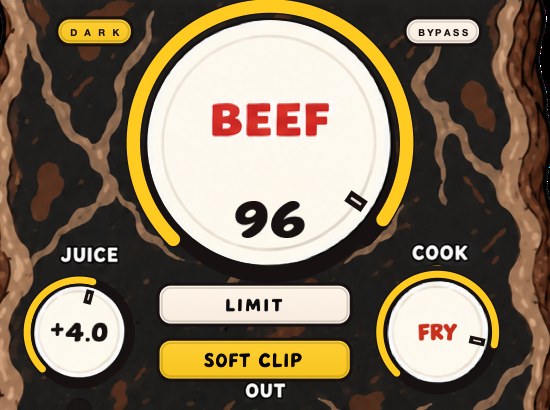
We make it, so treat this as a disclosure rather than a review. BEEFY is $39. Three knobs — BEEF for weight and density, COOK for the color and bite, JUICE for the level going in — plus SOFT CLIP and LIMIT as separate switchable output stages, and input and output clip lights so you can see both ends.
The limits are real and short. There is no multiband. There is no modulation. If you need to saturate one frequency band independently, or to move drive from an envelope, Saturn 2 does things BEEFY does not, and that is what the price difference buys.
What you get for $39 is the drive-it-and-it-gets-bigger job, at under a fifth of the list price of the plugin most people buy for that job, with the soft-clipping stage that usually arrives as a separate purchase. If your actual sentence is "make these drums hit harder without getting louder", that is the whole design brief, and there is a demo on the page that either does it for you or does not.
How to choose without reading any more lists
- Install the free ones today. They cost nothing and they settle whether you like the effect.
- Work out whether you need broadband or per-band saturation. That one question splits the market in half.
- If the answer is broadband, buy the cheapest thing that does it well and spend the difference on something else.
- Demo on your own material, level-matched. Every one of these sounds better unmatched.
- Check the CPU cost on a full session, not on one channel.
Questions people ask
What is the best saturation plugin?
For the broadband drum-bus job that most people are actually asking about, ours, at $39, with the clipping stage already in it. For per-band work, Saturn 2. For nothing at all, the Softube Saturation Knob. For speed and a name your engineer will recognize, Decapitator. Anybody who gives you one answer for all four of those is selling something.
Is an expensive saturation plugin worth it?
It buys control and workflow, not a fundamentally different kind of distortion. If you use one band and one knob, you are paying for features you are not using. Work out which of those two people you are before the sale ends rather than after.
How many saturation plugins do I need?
One broadband one you know well, and the free ones for variety. Harmonics stack across a mix, so owning six and using four at once is a faster route to a crowded record than to a warm one.
Does saturation make things louder?
Yes, in two ways: it adds harmonics in ranges the ear is sensitive to, and it rounds peaks so the average level can rise. See saturation explained and crest factor.
What is the best saturation plugin for 808s?
The question is better answered by what the part needs than by a product name. An 808-style sub is close to a sine, so a phone speaker reproduces almost none of the fundamental — what reaches the listener is the harmonics you add above it. So you want two things: harmonics landing high enough to survive a small speaker, and control over how much of the original low end comes through unchanged. Anything that gives you both will work, and ours is the cheapest thing here that gives you both. Note choice changes the answer too, because the harmonic series moves with the fundamental, and a part written low needs more help than one written a fourth above it.
What BEEFY does
BEEFY is our saturation and loudness effect for making sounds thicker, punchier and more up front. It adds body, squeezes some space out of the peaks, and brings out harmonics that help a sound feel bigger. BEEF is the main event: more weight, more density, more loudness and more attitude as you turn it up. COOK changes the color and bite, from a rounder feel toward a brighter, more cooked edge. JUICE sets the level going in. SOFT CLIP opens switched on and takes care of the initial gain staging; LIMIT is the other choice; both can be off. It is $39, for Mac and Windows, and the demo is on the page.
Prices read on September 26, 2026, on each maker's own page, and every one of them will have moved by the time you get there. Demo everything, ours included.
BEEFY — saturation and loudness plugin for Mac and Windows. There is a 28-second demo with three without/with comparisons on the page.
Keep reading
- Saturation explained — Harmonics, the types, where it goes in a chain, and what it costs.
- Soft clipping explained — What a soft clipper does, how it differs from hard clipping and a limiter, and where to use one.
- The Sausage Fattener, and how BEEFY is different — What it is, what is documented about it, and where BEEFY's controls differ.
- Best soft clipper plugins — Soft against hard, where a clipper belongs, and the free and paid ones worth demoing.