← Gazillion Industries/Reading material
The Casio SK-1
A child's keyboard with a microphone hole next to the speaker, 32 keys the width of a finger, five penlight batteries, and one button marked SAMPLING. Press it, make a noise, and for 1.4 seconds the cheapest sampler in the world is listening to you.
The Casio SK-1 is a 1985 home keyboard that could sample: 8-bit audio at 9.38 kHz, 1.4 seconds of it, played back across four voices on 32 mini keys. It cost £119 in Britain and sat in the under-a-hundred-dollar class of toy keyboards in America. It had no filter, no editing and no memory once the power went off. Producers made loops on it anyway, circuit benders made it their favorite victim, and its grain is a sound people still chase with bit depth and sample-rate controls.
The short version
- Released
- 1985, Casio; also sold by Radio Shack as the Concertmate 500
- Price
- £119 in the UK (1986 review)
- Sampling
- 8-bit PCM at 9.38 kHz, 1.4 seconds, one sample at a time
- Keys
- 32 mini keys, four-note polyphony
- Also
- eight presets, additive "organ" tone, 13 envelopes, drum box, sequencer
- Afterlife
- early hip-hop and jungle loops; the circuit benders' favorite
What the machine actually was
Making Music reviewed it in July 1986 and listed the whole spec in a paragraph. Eight preset sounds: piano, trumpet, human voice, pipe organ, brass ensemble, flute, synth drums and jazz organ. Thirteen envelope shapes selected from the black keys, which could be applied to the presets or to a sample. An additive section where nine white keys added harmonics to a tone. A drum box, a one-key sequencer that ran in real time or step by step, an auto-chord function, and a weight of 1.1 kilograms. Then the headline: sampling through the internal mic or a rear input, 8-bit at 9.3 kHz, 1.4 seconds maximum.
The numbers tell you what it sounded like. Eight bits gives 256 levels, so quiet sounds dissolve into a steady hiss of quantization and loud ones crunch at the top. A sample rate of 9.38 kHz means nothing above about 4.7 kHz survives, and whatever was up there folds back down as new content that was never in the room. Point it at a snare and you get a snare with the top sawn off and a metallic shimmer where the top used to be. Play that snare a fifth lower and the sample rate drops with it, so the shimmer sinks into the midrange and the whole thing goes dark and slow. Four of those at once was the ceiling.
The reviewer was clear about the limits. It lost the front of slow-attack sounds, had no sample editing, forgot everything when switched off, and could not be triggered from outside. The drum sounds were weak. And still: "you can't spurn the achievement and power of a four note polyphonic sampler for a ton." His advice was to use it for writing and ideas and "some careful recording," and not to expect generous treble. "Then you won't miss the fun."
Why a toy had a sampler in it
In 1985 sampling was a professional's tool, priced like studio equipment and bought by studios. Casio's home keyboards sold in department stores. Putting a sampler, however small, into a product in the under-a-hundred-dollar class meant that a teenager could own one, and a teenager who owned one in 1986 was a producer by 1990 who had learned to think in seconds of memory.
The constraint wrote the technique. With 1.4 seconds and no editing, you learned to catch a sound at exactly the right instant, to work with a kick or a word or half a bar rather than a phrase, and to pitch it across the keys to get more than one sound out of one sample. Every one of those habits turned up later on the samplers that mattered, and on this site how to get an old sampler sound is mostly a list of them.
Who made records with it
Large Professor did. Telling Complex in 2012 how he came to make "In The Ghetto" for Eric B. & Rakim in 1990, he described his setup before Paul C showed him a real sampler: "I had two turntables. I had a Casio SK-1 that I was doing loops on." Paul C, he told Red Bull Music Academy in 2015, took him out of the tape-deck era and put him on the SP-1200. The SK-1 was the bridge between pause tapes and the machine that defined his sound, which is a fair description of what it was for a lot of people.
Autechre have said it was one of the first pieces of gear they owned when they began recording. DJ Hype used one on his early jungle productions, according to Brian Belle-Fortune's 2005 history of the scene, All Crews. The composer Samuel Andreyev has written demanding chamber parts for it. Gear wikis attach another dozen names, mostly nineties alternative and electronic acts, without sources, and this page leaves those unlisted. The documented pattern is the interesting one: the SK-1 shows up at the start of a career, as the first thing that let a kid loop a record, and then it is replaced and remembered.
The circuit benders' favorite
The SK-1's second life began when people stopped using it as intended. Reed Ghazala, who had been shorting out battery toys since 1967 and named the practice circuit bending in 1992, listed the SK-1 among the devices worth opening in a Sound On Sound feature in March 2000, noting that instructions for bending it were already published online. By then the keyboard was a thrift-store staple, cheap enough to ruin and simple enough to explore with two screwdrivers on a lead.
What benders found inside was a clock they could reach. Slow it and the whole machine drops in pitch and speed together, drum box included; speed it and everything goes up and bright. Bridge the right points and the sampler plays back garbage from its own memory, loops stutter, the voice preset turns into a crowd. The instrument that had been a limited sampler became an unlimited noise box, and the circuit bending guide tells that story in full.
What the sound actually is
Strip away the nostalgia and the SK-1 sound is three mechanisms. Low bit depth, which adds a constant grain and a noise floor that rises as the sound decays. A low sample rate, which removes everything above about 4.7 kHz and folds the rest back as inharmonic shimmer. And pitching by playback rate, as the cheap samplers of the time did, so that every note you play moves the sample rate with it: low notes darker and grittier, high notes thinner and brighter. Each of those is a parameter now, and bitcrushing explained and aliasing take them one at a time.
The reason the sound still works on a record is the same reason it worked in 1986. The grain reads as age and the fold-back reads as effort, and both of them pull a clean sample back toward something that sounds like it came off a tape or a toy rather than out of a computer. Used on a whole mix it is a gimmick. Used on one drum or one chop in a clean arrangement it is the thing that makes the arrangement feel handmade.
Where it costs you
Everything on a real SK-1 is a compromise you cannot undo. The sample is gone when the batteries are, there is no filter to tame the fold-back, the keys are tiny, the mic picks up the room and the button click, and four voices is four voices. Those limits made the technique; they do not make a session easier. The honest move today is to take the three mechanisms and leave the volatile memory behind.
Questions people ask
When did the Casio SK-1 come out?
In 1985. A British magazine reviewed it in July 1986 at £119, and Radio Shack sold a version in the United States as the Realistic Concertmate 500.
What are the Casio SK-1's sampling specs?
8-bit PCM at 9.38 kHz, 1.4 seconds of audio, one sample at a time, through a built-in microphone or a line input. Playback is four-note polyphonic across 32 mini keys, and the sample is lost when the power is switched off.
Who used the Casio SK-1?
Large Professor made his first loops on one before moving to a professional sampler; Autechre have said it was among their first gear; DJ Hype used one on early jungle records. Many more names circulate without a source.
Why is the SK-1 popular for circuit bending?
It is cheap, battery-powered, built on a simple board, and has a sampler and a clock that respond to being shorted. Reed Ghazala named it as a bendable device in 2000, and bending instructions for it were online by then.
How do I get the SK-1 sound in a DAW?
Reduce the bit depth to around 8 bits, drop the sample rate to about 9 kHz with little or no anti-aliasing, and pitch samples by rate rather than with a time-stretching algorithm so the sample rate moves with the note.
What F(ilter)12 does
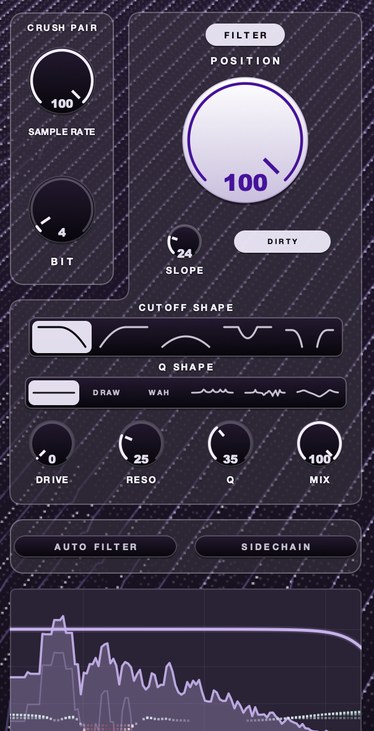
F(ilter)12 is our 12 bit sauce filter for Mac and Windows. BIT coarsens the steps, SAMPLE RATE drops the ceiling so the top folds back down as new content, and the filter behind the crush has five shapes and six resonance shapes, so you choose what reaches the rate reduction and what gets cleaned up afterward. AURA helps the result hold its place in a mix. Nothing in it is modeled on a particular machine; it was tuned by ear until chops sounded right. See F(ilter)12.
One button, 1.4 seconds, five batteries. Enough to start a career on, as it turned out, and enough to keep people listening forty years later.
F(ilter)12 — a 12 bit sauce filter for Mac and Windows: a lo-fi section, five filter shapes, six resonance shapes and AURA.
Mac · Winmore info
Keep reading
- How to get the sound of an old sampler without buying one — The old sampler sound is a stack of specific limitations, and you can apply each one on purpose.
- What does 12 bit audio actually sound like — Each bit is about 6 dB, so 12 bits gives roughly 72 dB against 16 bit's 96. The audible result is a noise floor that only exists while the music plays, quantization that sits on the signal rather than under it, and tails that go grainy and stop early. Loud material hides all of it.
- Bitcrushing explained — Bit depth, quantization noise, sample rate reduction and what 12-bit and 8-bit sound like.
- What is aliasing in audio — What it is, what it sounds like, how to prevent it, and how to use it on purpose.
- Circuit bending — Ghazala's accident, the probe method, the toys bent most, and why the clock bend mattered.
- Best 12 bit sampler plugins — What 12 bit really does, how to test one, and the free options worth trying.
- How to make a sample sound old — Narrow the range, add warmth and grain, wobble, noise and a small room.
- The SP-404 and the sound of Los Angeles — How a cheap sampler its makers underestimated became the instrument of LA's beat scene.