← Gazillion Industries/Reading material
A history of the little synth that sold for twenty years
A three-octave keyboard with keys too small for most hands, wooden end cheeks, a gooseneck microphone screwed into the top panel, and a price under £400. Sound On Sound's reviewer liked almost everything about it and concluded the whole thing had been "delivered in the wrong box." The box went on to sell for more than twenty years.
The Korg microKORG is a four-voice analog-modeling synthesizer with a vocoder, released in 2002 and still in production two decades later. It took the engine of Korg's MS2000, cut the voice count and the panel down to five knobs and 37 mini keys, bundled a microphone, and ran on six AA batteries. By 2016 Sound On Sound was calling it the world's best-selling synth. This is how a compromise became a fixture.
The short version
- Released
- 2002, Korg; reviewed January 2003 at £399
- Engine
- analog modeling, from the MS2000 of 2000
- Voices
- four; two when both timbres are layered
- Keys
- 37 mini keys, velocity, no aftertouch
- Vocoder
- 16-band analysis in eight channels, mic included
- Family
- XL (2009), S (2016), PT (2017), Crystal (2023), microKORG 2 (2024)
Where it came from
In 2000 Korg released the MS2000, a four-voice analog-modeling synth with a 44-note keyboard, a 16-band vocoder, a step sequencer and a panel full of knobs. Sound On Sound's May 2000 review opened by saying Korg had been at the forefront of analog modeling, and the MS2000 was the proof: two oscillators, noise, a multimode filter, and a DWGS wavetable of 64 small digital waves that recalled Korg's own DW-8000.
The product planner on that machine, Minoru Koike, finished it and started thinking smaller. In a 2017 interview marking the microKORG's fifteenth birthday, he said the idea was a small, lightweight, handy synth for bands, something you could carry to a gig in one hand and afford on a gig's pay. Development took about two years. The hard part, he said, was choosing which five parameters belonged on the five knobs by default, and the chief engineer's job was keeping the price down. The guts were the MS2000's. The box was new.
What shipped in 2002
Sound On Sound reviewed it in January 2003 at £399 including VAT. Each of two timbres carried two oscillators, with the MS2000's 64 DWGS waves alongside the analog shapes, a noise source, a multimode filter with a 24 dB lowpass setting, an amp, envelopes, LFOs and virtual patching. Four voices in all, and two when both timbres were layered. The keyboard was 37 velocity keys with no aftertouch, each key narrower than a normal one. There were 128 programs in two sides of eight banks of eight, an arpeggiator with six patterns and swing, one modulation effect, three delays and a two-band EQ. Six AA batteries ran it.
Then the vocoder. It analyzed the microphone in 16 bands, edited as eight channels with their own level and pan, and drove a four-voice carrier. The condenser microphone came in the box on a flexible gooseneck that plugged into the first audio input, and the reviewer called the vocoder highly capable in the same breath as calling the synth powerful.
The verdict was split down the middle. "It's a powerful synth in a compact, affordable package," and "definitely worth an audition," but also: "Personally, I felt that the Microkorg's compromises might prove too much to accept." The compromise was the keyboard and the five knobs. Twenty years of sales said the compromise was the point.
Why it sold for twenty years
Koike's own answer, in 2017, was that it was small, easy to carry and not a toy. He called it a "bread and butter machine" and, with evident affection, a "Little Giant." Within a few years, he said, it was everywhere: amateurs' bedrooms, top artists' live rigs, studios. The interviewer put a figure of more than 100,000 units to him; Korg itself has never published a number, and that figure should be read as the trade's estimate rather than the maker's.
Three things explain the run better than any one of them. The first is the vocoder with the microphone in the box. A band that wanted one robot-voice hook on one song could buy this and have it working in an afternoon, and from the mid-2000s a lot of bands wanted exactly that. The second is the price against the sound. Sound On Sound's reviewers kept returning to the gap between how the thing looked and what came out of it; the 2009 review of the XL said its sonic power and vocoder were "those of a heavyweight," and the 2016 review of the S said the original "shows no signs of fading away." The third is that it photographs well. The wooden cheeks, the gooseneck and the mini keys became a visual shorthand for a certain kind of band in a certain decade, and a synth that reads on stage from the back of the room sells itself to the people standing there.
The 2016 review drew the sharpest conclusion: "not even Korg could match the success with subsequent models." The company kept trying.
Who used it
The documented list is longer than the famous one. Tape Op's John Baccigaluppi, reviewing it in 2005 at $500, bought his after seeing Jon Brion use one live and hearing that members of Sigur Rós owned a few; while mixing a record for the band Jackpot he ran guest vocalist Jason Lytle's background vocals through its vocoder and reported that it worked. His one-line verdict: "This is one bestseller that lives up to the hype!"
Dorian Concept, the Austrian producer who has played keys for Flying Lotus, described a "love-hate relationship" with his in 2022. "It's all over my production," he said, before adding that he probably would not use it again. The 2017 anniversary piece noted that Devo had been seen with one. Gear wikis attach a dozen more names to it without a source, and this page leaves those where they are. What the sourced accounts share is a pattern: a musician buys it for the vocoder or the price, uses it on everything for a decade, and then either keeps it as a fixture or outgrows it with a pang.
The family
- microKORG XL (announced 2008, shipped early 2009; £436 / $750): a different engine, Korg's MMT from the Radias and R3, eight voices, a 16-band vocoder with an XLR mic, an amber display where the original had panel text. Sound On Sound: "it's definitely more of a synth than it appears."
- microKORG S (2016; £502.80 / $499): the original engine with a built-in speaker, 256 patch slots and eight favorite buttons. "Nearly perfect already," the review said of the original design.
- microKORG PT (2017): a platinum fifteenth-anniversary finish, otherwise standard, sold in limited numbers and discontinued.
- microKORG Crystal (2023): a twentieth-anniversary edition in a semi-translucent case with aluminum sides, announced at Superbooth at $529.99.
- microKORG 2 (unveiled January 2024; £519 / $549.99): eight voices, three oscillators per timbre, a 2.8-inch color screen, and a vocal section with a vocoder, hard tune and a harmonizer. Sound On Sound in 2025: "A worthy successor to one of the world's most popular electronic instruments."
What the instrument taught
That a synthesizer is a set of decisions before it is a set of circuits. The MS2000 and the original microKORG share an engine, and one of them is a footnote while the other is a generation's first synth. The difference was the size, the price, the five knobs and the microphone, which is to say the difference was who could own it and how fast they could get a sound out of it. Every small synth with a vocoder since has had to answer the same question: can a person who has never programmed a filter make a usable sound in the first ten minutes? The 2002 answer set the bar.
It also taught the trade something about vocoders. For most of the instrument's history a vocoder was a studio rack unit or a feature on an expensive workstation. Putting one, with a mic, into a £399 keyboard moved the robot voice from a specialist effect to a thing bands did on the second single. The guides on what a vocoder is and how to use one start from that assumption: the effect is ordinary now, and the question is how to make it sit in a mix.
Where it costs you
The keys are small, and players with large hands do not get used to them. Four voices is four voices: a layered patch is a duophonic patch. There is no aftertouch, and five knobs mean most of the engine lives behind a matrix of edit-select buttons, so deep editing is a menu dive dressed up as knob-twisting. The 2003 review's complaint about the box has never been answered, because the box is the product.
Questions people ask
When did the microKORG come out?
Korg released it in 2002, and Sound On Sound reviewed it in January 2003 at £399. Korg marked its fifteenth anniversary in 2017 and its twentieth in 2023.
Is the microKORG a real analog synth?
No. It is an analog-modeling synthesizer: a digital engine designed to behave like a subtractive analog one, taken from Korg's MS2000. The XL of 2009 used a different modeling engine, and the microKORG 2 of 2024 uses a new one.
How many voices does the microKORG have?
Four. Layering its two timbres halves that to two notes. The XL and the microKORG 2 have eight, dropping to four when the vocoder or both timbres are in use.
Is the microKORG the best-selling synth ever?
Sound On Sound called it "the world's best-selling synth" in 2016 and MusicRadar "one of the world's best-selling synthesizers" in 2024, but Korg has not published a figure. A trade estimate of more than 100,000 units was already circulating by 2009.
Does the microKORG have a good vocoder?
It analyzes the mic in 16 bands, edited as eight channels, with a four-voice carrier, and the microphone comes in the box. Reviewers in 2003 and 2005 rated it highly for the price; the XL's 16-band vocoder with an XLR mic was rated higher still.
What is the difference between the microKORG and the microKORG XL?
The XL uses Korg's MMT engine rather than the MS2000-derived one, has eight voices instead of four, a 16-band vocoder with an XLR microphone, and a display. The original keeps the engine, the sound and the look that made it famous.
What WINNETKA does
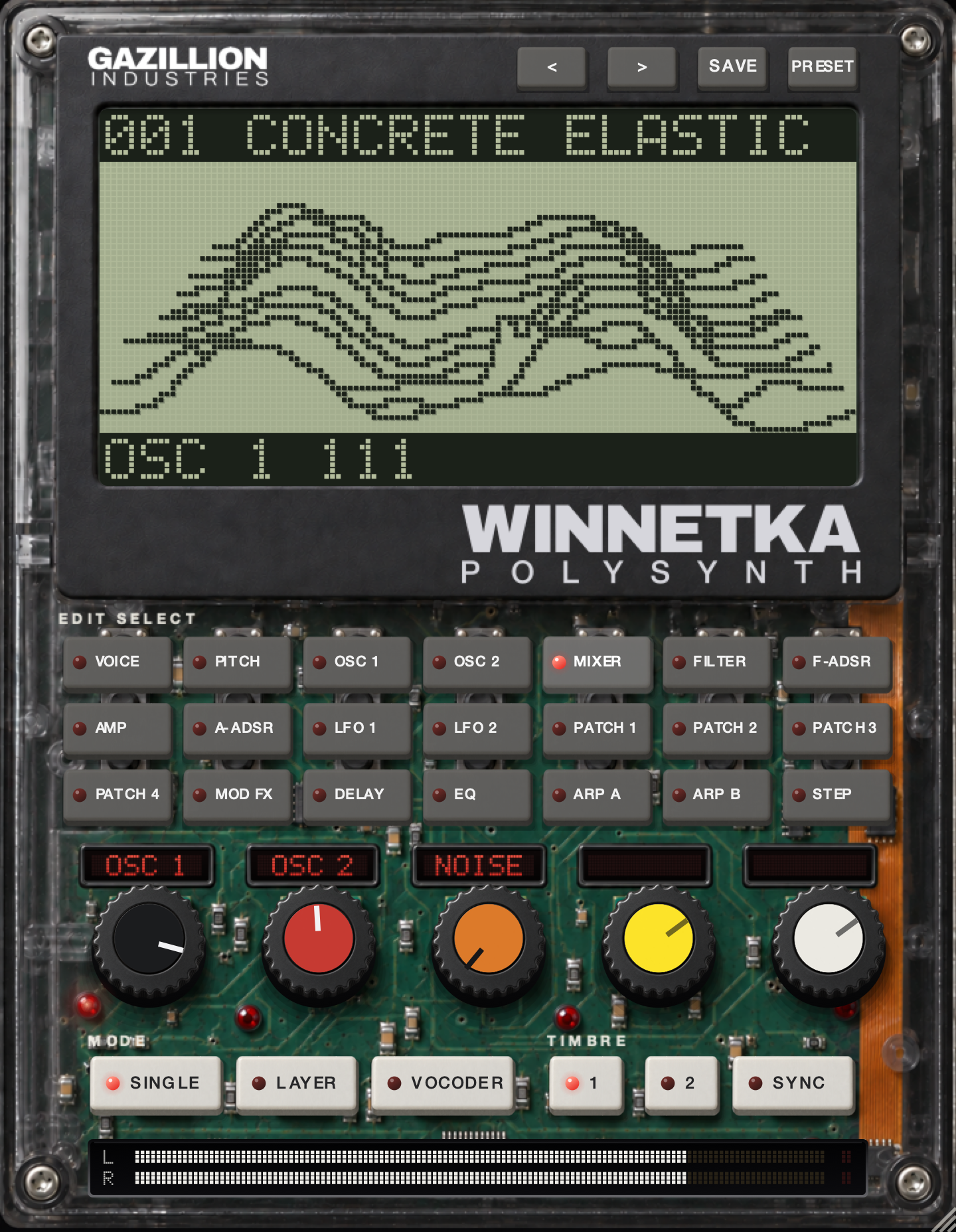
WINNETKA is our polysynth with a vocoder in it, $49, for Mac and Windows. Three modes: SINGLE plays one timbre, LAYER plays two on every key, and VOCODER turns the panel's rows into the vocoder's own, with sixteen bands drawn on the screen, formant shift, and a carrier you build from the oscillator, the right input and noise. Around it: a four-type filter, two envelopes, two LFOs, four patch cords, a three-band EQ, mod effects, delay and a sixteen-step arpeggiator. 350 presets, every one tuned by ear. It is not a model of any instrument. AU, VST3 and standalone on Mac, VST3 on Windows.
The wrong box, it turned out, was the right size.
WINNETKA — a polysynth with a vocoder and 350 presets. AU, VST3 and standalone on Mac, VST3 on Windows.
Mac · Winmore info
Keep reading
- What is a vocoder — A vocoder stage by stage, and what band count actually changes.
- How to use a vocoder — The routing problem solved host by host, and how to stay intelligible.
- Best polysynth VST — What voice count really changes, and how to audition one fast.
- Vocoder vs talkbox vs autotune — How each one works, and why software cannot be a talkbox.
- Best vocoder plugins — The three controls that decide whether your words survive the filter bank.
- Monosynth vs polysynth — What one voice buys you, and how to hear paraphonic against polyphonic.
- Best arpeggiator VST — Why a MIDI arp and a built-in arp are different tools.