← Gazillion Industries/Reading material
Monosynth vs polysynth
Gazillion Industries ·
You held a four-note voicing and one note came back. The last key your
fingers landed on, alone, carrying every bit of weight the patch had. Nothing is broken.
A monosynth plays one note at a time. A polysynth plays several at once, one voice per
held note, so a four-note chord runs four copies of the same signal path side by side.
Monosynth vs polysynth is a question about voice count and about what that count buys: on
one voice every oscillator, filter and envelope in the instrument is aimed at the single
note you can hear, and a rule called note priority decides which note that is.
The short version
- Monosynth
- one voice, one note at a time, however many oscillators it has
- Polysynth
- several voices, one per held note, each with its own filter and envelopes
- Paraphonic
- several pitches sharing one filter and one amplifier envelope
- Play mono for
- bass, leads, hooks, percussion, risers — anything that is one line
- Play poly for
- chords, pads, keys parts with voice leading
- Ours
- JOURNEYMAN,
$59, one voice, three oscillators, two ladder filters, 200 programs
What is a monosynth
A monosynth is a synthesizer with one voice. A voice is the whole path a single note
travels: oscillators into a mixer, the mixer into a filter, the filter into an amplifier,
with envelopes and modulation aimed at the stages along the way. One voice means one of
those paths exists. One path, one note.
Oscillator count is a separate question, and it is the one people get wrong in the
store. Three oscillators do not give you three notes. They give you one note built from
three layers, tuned in unison or spread across octaves, all of them arriving at the same
filter and leaving through the same amplifier. One singer with three microphones in front
of her, rather than three singers in a room.
So when you hold four keys and one note sounds, the instrument has done exactly what it
was built to do. It had to choose, and the rule it used is note priority. Low priority
keeps the bottom of what you are holding, high priority keeps the top, last priority
follows your fingers. Whichever rule is set, three of your four notes are discarded: 75
percent of what you played never reaches the output.
That sounds like a defect until you hear it on a bass part. Play a tenth in your left
hand on a polyphonic patch and the bottom of the mix turns to mud, because two low notes
an octave and a third apart share harmonics and argue about which fundamental is in charge.
Play the same figure on one voice and only the root survives. The root was the part the
record wanted.
Mono vs poly synth: what the voice count changes
Voice count changes five audible things, and only the first one is obvious. Each of
them is a reason somebody keeps a one-voice instrument open next to a polysynth rather
than replacing one with the other.
- Chords. A polysynth gives every held note its own filter and its own
pair of envelopes, so a four-note chord has four independent attacks and four independent
releases. A monosynth gives you the top, the bottom or the newest note. There is no
setting that makes one voice into four.
- Glide. Portamento is only unambiguous on a single voice, because
there is one pitch and one destination. On a polysynth, gliding from a three-note chord
to a four-note chord means the instrument has to decide which old note slides to which
new note, and different synths decide differently. One voice removes the decision.
- Trigger mode. With one voice, overlapping notes can either restart
the envelopes or leave them running. Multi trigger restarts them, so every note gets its
own attack. Single trigger leaves them running, so a legato phrase keeps one attack at
the front and the notes inside it change pitch without a new transient. On a fast
sixteenth-note bassline that switch is the difference between a stutter and a run.
- Modulation. One voice means one LFO position and one filter envelope
for everything you hear. On a polysynth each voice usually runs its own copy, so four
held notes wobble at four different points in the LFO cycle and the chord shimmers. One
voice moves as a single object, which is why monophonic modulation reads as deliberate
and polyphonic modulation reads as atmosphere.
- Load. Sixteen voices running three oscillators each is up to 48
oscillators, plus sixteen filters and thirty-two envelopes. One voice is three
oscillators. On a heavy session that difference is the reason the bass patch is the one
you never have to freeze.
Hard sync and oscillator FM belong in this list too, quietly. Both generate harmonics
far above the fundamental, and both are far easier to keep under control when the
instrument only has to do it once. If any of that comes back as a thin metallic ring on the
top octave rather than the growl you were after, read
what is aliasing in audio before
you blame the patch.
Paraphonic vs polyphonic, and how to hear the difference in ten seconds
Paraphonic sits between the two and gets sold as if it were the second one. A
paraphonic synth lets its oscillators play different pitches at the same time, so you can
hold a triad and hear three pitches. Those pitches then share one filter and one amplifier
envelope. The chord is real in pitch and shared in articulation.
The test takes ten seconds and no measurement. Set a patch with a slow attack, around
400 ms. Hold one note, let it rise to full, then add a second note without releasing the
first. On a polyphonic synth the second note swells in over its own 400 ms while the first
one stays up. On a paraphonic synth the second note either appears instantly at the level
the first one already reached, or it drags the whole chord back down to zero and starts
again. Both of those are the giveaway.
Paraphonic vs polyphonic matters most on release. Lift one finger from a paraphonic
triad and the shared envelope is still being held open by the other two, so the note you
released may simply stop dead instead of decaying. Lift one finger from a polyphonic triad
and that note releases on its own curve while the others hold. If you write parts where
notes enter and leave at different times, that is the whole ballgame.
JOURNEYMAN is monophonic. Three oscillators, one pitch at a time, one filter envelope
and one volume envelope, which is the architecture the rest of this page is about.
One voice synth: what the trade actually buys
Everything the instrument owns goes into the note you can hear. That is the entire
argument for a one voice synth, and it shows up in three places.
Thickness. Three oscillators on one pitch build a stack rather than a
chord. Tune the second an octave down and the third in unison, then detune the third
slightly, and the two unison oscillators beat against each other at the difference between
their frequencies.
The arithmetic is worth knowing because it changes with register. Two oscillators 7 cents
apart at 110 Hz differ by 0.45 Hz, which is one slow swell every 2.24 seconds. The same 7
cents at 220 Hz differs by 0.89 Hz, a swell every 1.12 seconds. Detune that feels like
breathing on a bass note feels like chorus an octave up, from the same knob position.
Filtering. A polysynth has to build one filter per voice, so sixteen
voices means sixteen filters and the design pays for all of them. One voice can afford two
filters on the single note, with a control that sets the distance between their cutoff
points. Run them as a pair of lowpass filters and you get two rolloffs at different
frequencies; split them left and right and the gap between the two becomes stereo width on
a mono source. Pole count is the other word on these panels worth learning: one pole in a
lowpass is 6 dB per octave by definition, so three poles is a gentler slope than four and
lets more of the material above the cutoff through. If cutoff and resonance are still
abstractions, start at
filter cutoff and resonance.
Reach. One voice means one destination for every modulation source you
own, so the mod wheel, a pedal and a touch surface can all be pointed at the same note
without the result turning to soup. This is the part that never shows up in a feature list
and is the reason people keep playing these things.
JOURNEYMAN
is our monosynth, $59, one voice with three oscillators under it and two ladder filters
spaced apart for width. Glide, note priority and single or multi trigger are on the panel,
and 200 programs cover basses, leads, keys, pads, percussion and fx. There's a demo on the
page.
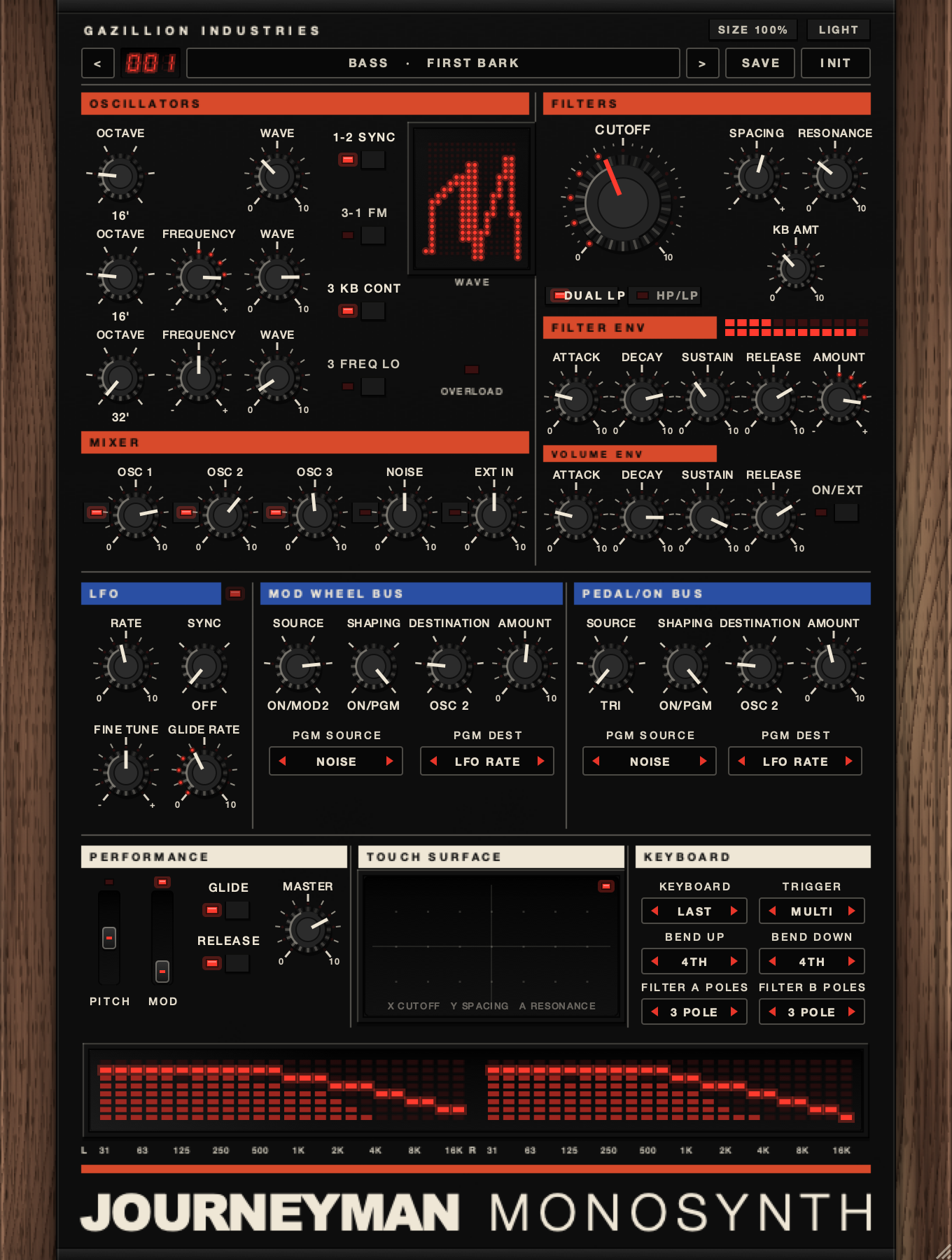 One voice, laid out left to right in signal order. SPACING sets the
distance between the two filters, and the TOUCH SURFACE moves cutoff on X and
spacing on Y.
One voice, laid out left to right in signal order. SPACING sets the
distance between the two filters, and the TOUCH SURFACE moves cutoff on X and
spacing on Y.
Monosynth vs polysynth in an arrangement: where one voice wins
Bass first, because it is the part that cannot be shared. Two low notes sounding
together share harmonics, sum unpredictably depending on their phase relationship, and
leave the listener guessing at the root. A monophonic bass forces one decision per beat,
which is why it sits. When it
still goes missing, the problem is usually the fundamental rather than the part, and
how to make bass
audible on phone speakers covers what a 3-inch driver actually reproduces. The
instrument side of the same question is in
best bass synth VST.
Leads next. A hook is one line, and a single voice holds the front of a busy beat
because nothing behind it is competing for the same filter. If the lead is thin rather than
quiet, thickness beats volume every time — see
how to make a synth sound
thicker, and
best lead synth VST for what to play it
on.
Then percussion and effects, which is the use people forget. A short volume envelope, a
fast filter envelope and a noise source in the mixer will produce hats, zaps, claves and
toms from an instrument that has no samples in it. Pointing the envelope at the filter
rather than at the amplifier gives you the attack shape that
a transient is made of. A slow sweep
across a bar with a defined ending is the same trick at a different speed; the mechanics
are in how to make a filter
sweep.
Check all of it in the car and on a phone before you commit. A one-voice part with a
heavy resonance peak can sound enormous on monitors and disappear on a laptop speaker,
because the peak is sitting under everything the small driver can actually move.
Where a polysynth is the right instrument, and what one voice costs you
If the record is built on held chords, buy voices. Pads that breathe, keys parts with
real voice leading, string stacks where each note enters and leaves on its own schedule
— none of that can be faked on a single voice, and an article that told you otherwise
would be wasting your afternoon. This is the honest cost of the trade, and it is a real
one.
Your DAW almost certainly ships a polysynth already, so check that before you spend
anything. If it does not, Vital's Basic tier is free and gives you the full synth with all
features, 75 presets and 25 wavetables, on Windows 10 and later or macOS 10.15 and later,
per the maker's own page on September 26, 2026. It is a polyphonic wavetable instrument,
which is a different animal from a one-voice subtractive synth, and that is exactly why it
is named here.
The second cost is habit. One voice teaches you to write single lines, and a producer
who only writes single lines ends up with arrangements that are all foreground. The fix is
arrangement, not gear: let the chord instrument be quiet and wide, and let the one-voice
part be narrow and loud.
So what do you actually load? For a bassline, a hook, a lead, a riser or a synthesized
percussion hit, load the one-voice instrument, because every part of it is working on the
note. For chords, load a polysynth. Most sessions want both, and the two of them together
cost less than the argument about which one is better. If the one-voice side is the gap,
best monosynth VST is the longer version
of that decision, and
best synth VST under 100 is the
same shortlist sorted by price.
Hear JOURNEYMAN
Set up a one-voice part
- Play the part with one finger at a time before you touch a control,
so you hear the note priority rather than fight it.
- Set note priority to last so the line follows your hands.
- Choose multi trigger for a part where every note needs its own attack,
and single trigger for a legato line.
- Turn glide off and write the part. Add glide afterward, only on the
intervals that need it.
- Tune the second oscillator one octave below the first and balance the
two in the mixer before you open the filter.
- Detune the third oscillator 5 to 7 cents against the first and count
the seconds between swells.
- Set the filter cutoff with the rest of the arrangement playing, never
soloed.
- Set the filter envelope amount first, then its attack and decay.
- Match levels to within 0.5 dB before you A-B anything, because louder
wins every unmatched comparison. Method in
gain staging.
- Check the part in mono, on a phone speaker and on one earbud before
you print it.
Questions people ask
What is a monosynth?
A synthesizer with one voice, meaning one complete signal path, meaning one note at a
time. Oscillator count has nothing to do with it: an instrument with three oscillators is
still a monosynth if those three oscillators stack into a single note. When you hold more
than one key, note priority picks the survivor.
What is the difference between a monosynth and a polysynth?
Voice count, and the five things that follow from it: chords, glide, trigger behavior,
whether modulation moves everything together, and CPU. A polysynth builds a full voice for
every held note. A monosynth builds one and spends the whole budget on it. Mono vs poly
synth is a question about what the part is, rather than about which instrument is
better.
Is a synth with three oscillators polyphonic?
No. Three oscillators tuned to the same note played through one filter and one amplifier
are one voice with three layers. Polyphony is counted in voices, and a voice is the whole
chain, which is the line worth reading twice on any spec sheet.
What does paraphonic mean, and how is paraphonic vs polyphonic different?
Paraphonic means the oscillators can hold different pitches while sharing one filter and
one amplifier envelope, so you get a chord in pitch with a single articulation. Polyphonic
means each note gets its own filter and its own envelopes. The audible test is a slow
attack of around 400 ms: add a second note to a held one and watch whether it swells in on
its own or arrives already at full.
Can I just set a polysynth to one voice?
You can set the voice count to 1 on most software synths, and it will play one note at a
time. What you get is a limit on polyphony. What a one-voice instrument gives you on top of
that is the behavior built around the limit — note priority you can choose, single and
multi trigger, glide that has one unambiguous destination, and a panel where the
performance controls are the controls. Try the setting first; it costs nothing to find out
which of those you miss.
Is a one voice synth enough on its own?
For bass, leads, hooks, percussion and effects, yes, and those are most of the synth
parts in most beats. For held chords and pads, no. Almost every session ends up wanting one
of each, so the useful question is which one you are short of today.
Does monophonic mean the sound is in mono?
No, and the collision of words costs people hours. Monophonic describes how many notes
the instrument plays. Mono describes how many audio channels come out of it. A monophonic
synth can have a wide stereo output — two filters split left and right will do it from
a single note — and that width still has to survive a mono fold-down. See
mono compatibility, and
phase cancellation for why width
sometimes vanishes when the two sides are summed.
What is the best free way to start?
Open what your DAW already has and set its voice count to 1 for an evening. Our free one
is DRUGS,
a one-knob drum bus compressor rather than a synth, so it is the free way to get one of ours
into your session and not the free way to get a synth. When the synth bass is written and
needs weight against the kick,
BEEFY
at $19 is the saturation stage for it, and
how to mix kick and 808 covers the
fight between the two.
What JOURNEYMAN does
JOURNEYMAN
is our monosynth, $59, for Mac and Windows. One voice, and everything in it is pointed at
that voice. Three oscillators, each with OCTAVE and WAVE,
the wave a continuous sweep from triangle through saw and square to pulse, with
1-2 SYNC and 3-1 FM between them. A MIXER
over OSC 1, 2 and 3 with NOISE and EXT IN. Two ladder
filters, left and right, with CUTOFF, SPACING between
them, RESONANCE and KB AMT, switchable DUAL LP or HP:LP
and selectable 3 or 4 pole. A FILTER ENV and a VOLUME ENV,
each ADSR. An LFO with RATE and SYNC, and
sample and hold. Two modulation busses, mod wheel and pedal, each with source, shaping,
destination and amount. GLIDE, note priority, single or multi trigger, bend
range, and a TOUCH SURFACE that moves cutoff on X and spacing on Y. Two
hundred programs across basses, leads, keys, pads, percussion and fx, every one of them
wired to the mod wheel and the touch surface. AU, VST3 and standalone on macOS 10.13 or
later, VST3 on Windows 10 or later, 64-bit, universal binary. The key arrives with the
download, activates once and then works offline.
Play the four-note voicing again. One note comes back, the one you chose, three
oscillators thick with both filters open on it. That was always the deal.
JOURNEYMAN — a monosynth for Mac and Windows. One voice, three oscillators,
two ladder filters, two envelopes, two modulation busses and 200 programs.
Hear it
Keep reading
- Best monosynth VST — Glide, envelope speed and usable resonance: how to choose a monosynth, plus free picks.
- Best bass synth VST plugins — Why one voice suits bass, and the three controls that decide it.
- Best lead synth VST: how to choose a synth lead plugin — Why a lead wants one voice, what to listen for, and the synth lead plugins people name.
- Best synth VST under 100 — Free picks, what $249 buys instead, and why one voice teaches fastest.
- The Minimoog Voyager — Bob Moog's 2002 Minimoog: the dual filters, the touch surface, and the variants.
- Best vocoder plugins — The three controls that decide whether your words survive the filter bank.
- Best polysynth VST — What voice count really changes, and how to audition one fast.
- Best free vocoder plugins — The free vocoders that are really free, and where they run out.
- Best arpeggiator VST — Why a MIDI arp and a built-in arp are different tools.