← Gazillion Industries/Reading material
Best polysynth VST
Gazillion Industries ·
The chord changes and the one before it disappears with it. Sustain pedal down, a
four-note voicing moving to another four-note voicing, and somewhere in the handover the tail of the first
chord is cut rather than faded. On monitors you miss it. On headphones on a train it is the only thing
you hear.
The best polysynth VST is the one you can steer with both hands busy: enough voices that a chord's tail
outlives the chord after it, a bank you can move through with two keys, and a screen that names the control
under your pointer. WINNETKA
is $49, does all three, and is the synth worked through below. Then voices, layering, 350 presets, a
ten-minute test, and the other plug-ins people name.
The short version
- What a polysynth is
- a synthesizer that sounds several notes at once, so it plays chords
- What voice count changes
- how long a held chord survives the chord that replaces it
- What decides quality
- a filter that stays musical, a bank you can navigate, a screen that names the knob
- What to use
- WINNETKA, $49 — polysynth, 16-band vocoder, 350 presets
- Free route
- Vital on its free tier, or Surge XT, both polyphonic and both cost nothing
- What it costs
- one filter per timbre, four patch cords, and no reverb in the box
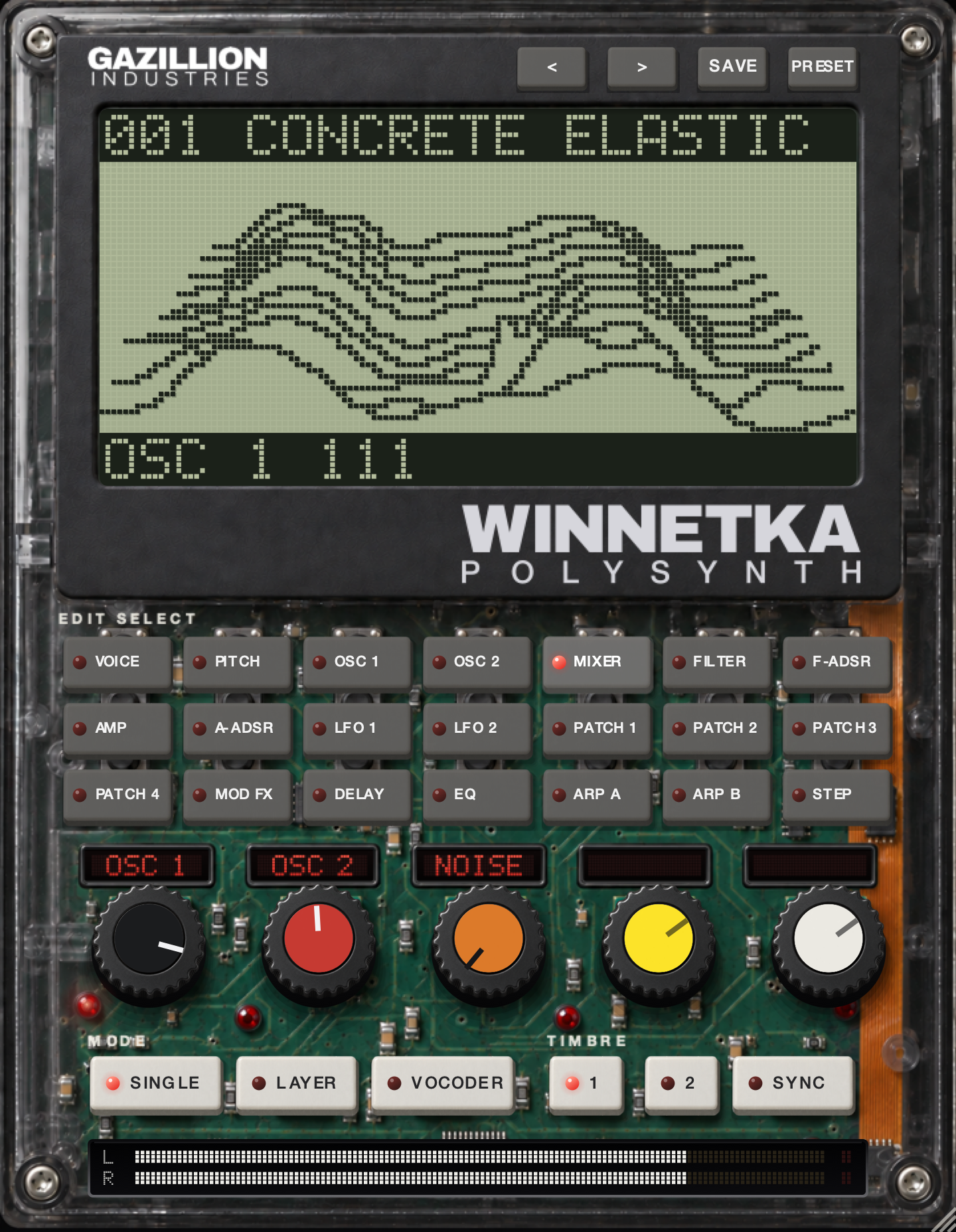 One row at a time. Twenty-one keys pick a row; the five knobs under the screen take
that row's jobs, and the red label above each knob changes with them.
One row at a time. Twenty-one keys pick a row; the five knobs under the screen take
that row's jobs, and the red label above each knob changes with them.
What a polysynth plugin actually is
A polysynth sounds several notes at once. Each key you hold takes a voice, and a voice is a complete
signal path: oscillators, a filter, two envelopes, an amplifier. Hold a four-note chord and four of those
paths run side by side.
There is a cost built into that. Every voice is arithmetic your computer has to do, so every polysynth
has a ceiling and decides what happens when you reach it. That decision is called voice stealing, and it
is why the chord in the opening paragraph vanished: the synth needed a voice, had none spare, and took
the oldest one.
Where a monosynth spends everything on one note, a polysynth divides the same attention across however
many you hold. Our piece on
monosynth against polysynth works through what each
gives up: one is for the line, the other for the harmony, and most sessions want both.
What voice count changes in practice
Voice count decides one thing you can hear and several you cannot. What you hear is the handover. Play
a chord, let it ring, play the next before the first has decayed, and the release tails of the old notes
are still holding voices. Ten fingers across two chords with a three-second release is twenty voices for
a moment, from ten keys.
Add the sustain pedal and the arithmetic runs away from you. A pedaled passage at 90 BPM with a
four-second release can be holding thirty or forty voices before you notice, and the first sign is never
a warning. It is a chord that ends early, inside the part you already liked.
WINNETKA's manual puts the ceiling at up to 128 voices at once in POLY on a single timbre, and 64 each
when two POLY timbres are layered, which is the same 128 divided in half. At those numbers the count stops
being something you manage. The four red lights on the board follow the voices as they sound, so you can
watch the instrument work without reading a number.
The other two voice modes, and what they are for
POLY is one of three settings on the VOICE row. MONO plays one note at a time, turning the same
instrument into a single-line synth for a bass or a lead. UNISON stacks four voices on every note, two per
timbre when you are layered, spread apart by a DETUNE control running from 0 to 99 cents.
UNISON is where detune stops being a garnish. Four voices five cents apart at 220 Hz beat at about
0.64 Hz, one slow swell every 1.6 seconds, and that reads as width. At 99 cents the beating passes
12 Hz and reads as a chorus you cannot switch off.
Layering two timbres, and what that buys
LAYER runs two complete sounds from one set of keys. Each timbre carries its own full set of rows,
VOICE through PATCH 4 — oscillators, filter, envelopes, LFOs and patch cords — while the
effects and the arpeggiator are shared. TIMBRE 1 and TIMBRE 2 choose which one the knobs and the screen
are showing.
The reason to reach for it is register. A pad that works in the middle of the keyboard thins out two
octaves down and turns to mud two octaves up, and the fix is two sounds with different filter settings
covering different parts of the range. One layer holds the body, the other the air, and one MIDI part
plays both.
SYNC makes the mode usable rather than tedious. With SYNC lit, every edit lands on both timbres at
once: knobs, panel keys and selectors, incoming MIDI controllers, even the envelope RESET key. Build one
sound with SYNC on, turn it off, then move the second layer's filter and tuning away from the first. The
bill is voices and attention, since two POLY timbres split the pool into 64 each and a patch with two
filters takes twice as long to fix when it is nearly right.
Presets as a buying criterion, at 350
A preset count is a marketing number until you try to find something with it. What decides whether 350
presets are useful is whether the bank is sorted and whether you can move through it without opening a
menu. WINNETKA splits its 350 into seven groups: 65 bass, 60 lead, 65 pads, 40 FX, 35 perc, 45 arp and 40
vocoder.
Those seven numbers add to exactly 350, and the split is the useful part. Anyone looking for a pad is
choosing from 65 rather than scrolling 350, and the FACTORY menu prints each group's count beside its
name. The arrow keys step the whole bank in order and wrap at the ends.
A good bank also teaches the panel. Load a bass, look at where OSC 2 sits against OSC 1, see how far
the filter envelope opens the cutoff, and you have a move you can reuse on your own sound. Sold-as-magic
preset packs teach nothing, which is why the count matters far less than whether the programs are
readable. Our piece on
choosing a synth by its presets covers what a
bank has to do before its size means anything.
Then the part most banks skip. SAVE keeps your sound in USER LIBRARY, Export writes it to a .winnetka
file and Import loads one back, one file per patch on Mac and Windows — so a sound you made on one
machine is a file you can send.
What separates a good polysynth from a spec sheet
Five things, and only two appear on a feature list. This is the checklist worth running before you
spend anything, on any synth, ours included.
Voices you never have to count
Hold a chord, play the next over the top with the pedal down, and listen to the first chord's tail. If
it survives intact, the ceiling is above your playing. If it clips off, you have found the limit, and
every pedaled passage you write will find it again.
A filter that survives resonance
Take resonance to three quarters and sweep the cutoff across the range. Listen for the peak swamping
the chord, for level jumping as it crosses a strong harmonic, and for the low end thinning as resonance
rises. WINNETKA offers 24 LPF, 12 LPF, 12 BPF and 12 HPF, from 20 Hz to 20 kHz. A 24 dB
low-pass at 500 Hz is 24 dB down at 1 kHz and 48 dB down at 2 kHz.
Envelopes fast enough for stabs
Chords are not only pads. Set attack and decay to minimum, sustain to zero, and play a chord: a good
envelope gives you a stab you can put on an offbeat, a slow one gives a soft blip whatever the numbers
say. WINNETKA's F-ADSR and A-ADSR run 0 to 20 seconds a stage, and the manual is explicit that 0 is
instant and 1 is a millisecond.
Modulation you can reach in four moves
A patch cord that takes a submenu is a patch cord you will not make. WINNETKA gives you four, each
sending a SOURCE to a DEST by an INT of ±63, and cords landing on the same destination add up.
Sources run from the two envelopes and two LFOs through velocity, key track, pitch bend and the mod wheel;
destinations cover pitch, OSC 2 tune, OSC 1's CONTROL 1, noise, cutoff, amp, pan and LFO 2's rate.
Formats, resize and the boring part
Check formats before anything else. WINNETKA is AU, VST3 and standalone on macOS and VST3 on Windows,
needing macOS 10.13 or later or Windows 10 or later, 64-bit. Then check the window: dragging the
bottom-right corner resizes it from 80% to 200%, and the size saves with your session.
WINNETKA
is our polysynth: two oscillators and a filter per timbre, one sound or two layered, a 16-band vocoder, a
sixteen-step arpeggiator and 350 presets across bass, lead, pads, FX, perc, arp and vocoder. It is $49, in
AU, VST3 and standalone on Mac and VST3 on Windows. There's a demo on the page.
How to audition a polysynth in ten minutes
Do this before you buy anything, in your own session, on your own speakers. Ten minutes gets you
further than an hour of reading roundups, this one included.
- Load the synth on an empty track and open the first pad preset in the bank.
- Hold a four-note chord for eight bars with the sustain pedal down.
- Play a second four-note chord before releasing the first, and listen for the older notes cutting off.
- Sweep the filter cutoff from 20 Hz to 20 kHz once, slowly, with the chord held.
- Raise resonance to 75 percent and repeat the sweep.
- Set the amp envelope attack to 0 and decay to 200 ms, then play the same chord as stabs.
- Switch to unison, set detune to 5 cents, then to 50 cents, holding one note through each.
- Layer a bass timbre under the pad and play the bottom two octaves.
- Step through twenty presets with the arrow keys and count how many you would actually use.
- Bounce eight bars and play them back on a phone speaker and in the car.
Step three decides the purchase, and step ten is the one people skip. A pad that reads as enormous on
monitors can arrive on a phone as a thin buzz, because a small speaker gives you almost nothing under
500 Hz and a chord's weight lives exactly there. The fix is upper harmonics rather than more level,
and you can make it in the synth before it reaches the mix.
The vocoder, and what it needs from you
A vocoder puts the shape of one sound onto another. WINNETKA listens on its audio input, measures what
it hears across 16 bands, and applies that shape to the notes you play, so the chord under your hands
speaks. It needs both halves: audio coming in, and keys held down.
Routing is the part that stops people. The left input channel is the voice it listens to; the right can
carry an instrument to be played through the vocoder as well, raised with INST in the MIXER row. In
Ableton Live, set your voice track's Audio To to the WINNETKA track and pick Audio In-WINNETKA
underneath. The standalone app starts muted so it cannot feed back, so open Settings, choose your input,
untick the mute, and wear headphones.
Twelve of the forty vocoder presets hold a vowel inside them and play with no audio at all, leaving 28
that want a microphone. You can hear what the vocoder does, and use it on a record, without plugging
anything in. FORMANT then moves the held shape: SHIFT steps it down or up by up to two bands, CUTOFF
slides it smoothly by up to two bands either way, RESONANCE sets how sharp the bands are, and HOLD freezes
what is there now and saves it with your session. Our guide to
formant shifting covers what those moves do to
a voice in general.
Polysynth or monosynth, and which to buy first
Buy for the part you cannot currently write. If your beats stall because the chords sound like a stock
piano, a polysynth is the purchase. If they stall because the bass has no character, a monosynth is, and
our guide to choosing a monosynth VST is the page to
read instead of this one.
The two instruments answer different questions. A monosynth asks what a single note should do, so it
gives you glide that tracks the interval, note priority, trigger modes and a panel arranged for one line.
A polysynth asks how several notes behave together, so it gives you voice assignment, unison and detune,
and layering. JOURNEYMAN is our monosynth at $59; WINNETKA is the polysynth at $49.
The overlap is real and worth using. WINNETKA's MONO setting plays one note at a time with SINGLE and
MULTI trigger modes and portamento from 2 ms to 5 seconds, so it writes a bass line perfectly well.
What it does not carry is the note-priority behavior a monosynth is designed around, which matters on
bass and barely registers on a lead.
The polysynth plugins people name, and ours
Everything in this section was read on the maker's own page while writing. Ours is first because it is
the one we would put under the chords. The rest are the names you meet everywhere else when you go looking
for the best polysynth plugin, and every one does something real.
Gazillion Industries WINNETKA
WINNETKA is $49, in
three modes: SINGLE, LAYER and VOCODER. Per timbre, OSC 1 offers saw, pulse, tri, sine, vox, table, noise
and audio in, with a CONTROL 1 that reshapes the wave differently for each — on VOX it moves the
formant from dark to bright, on TABLE the second knob picks one of 64 stored waves. OSC 2 adds saw, square
and tri with ring, sync and ring sync. Then a mixer, one filter with four types, two ADSR envelopes, two
LFOs and four patch cords, with mod FX, a delay and a three-band EQ shared across the instrument, plus a
sixteen-step arpeggiator running down to 1/64. 350 presets. AU, VST3 and standalone on macOS, VST3 on
Windows, and the demo is on the page. The full list is at the foot of this page.
u-he Diva
Diva is listed at 179 €. u-he give it up to 16 voices with duophonic, mono and legato modes,
five oscillator models — triple VCO, dual VCO, DCO, dual VCO eco and digital — and five filter
models: ladder, cascade, multimode, bite and uhbie. The page lists over 1200 factory presets, in CLAP,
AUv2, VST3 and AAX on macOS and VST3, CLAP and AAX on Windows, plus Linux. A free demo is offered, and
u-he say it crackles at intervals until unlocked with a serial number.
u-he Hive
Hive is 149 € and is the lighter, faster sibling. u-he describe two pairs of stereo
oscillators with nine waveforms each plus a wavetable option carrying 140 wavetables, two multimode
filters running from low-pass through comb and sideband, and up to 16 voices. The page lists over 2400
factory presets, with the same format spread as Diva.
Arturia Pigments
Pigments is listed at 199$. Arturia offer six engines in one instrument: modal physical modeling,
granular, wavetable, sample, harmonic additive and virtual analog, plus a utility engine adding
oscillators and noise. The page lists over 1700 factory presets, in VST, VST3, AAX, AU and NKS, on Windows
10 or later and macOS 11 or later. Pigments Play is a free download with 100 presets and limited
parameter control.
Xfer Records Serum 2
Serum 2 is $249.00 USD. Xfer list a wavetable oscillator alongside multisample, sample, granular and
spectral oscillators, with over 626 presets and 288 wavetables, in VST3, AU and AAX 64-bit. A 15-minute
limited demo is offered. It is the wavetable answer rather than the chord answer, and priced
accordingly.
Free polysynth VSTs worth the download
Three free synths are worth having, all three polyphonic by design rather than held down to one voice.
None carries a vocoder, which is the gap worth noticing before you decide free covers everything.
Vital
Vital's Basic tier costs nothing and includes 75 presets and 25 wavetables. The maker describes a
spectral warping wavetable synth, running on Windows 10 and higher, macOS 10.15 or later, and Ubuntu
18.04 or later, 64-bit only, needing OpenGL 3 or higher. Paid tiers add presets and wavetables; their
prices did not render on the page while writing, so the shop is the place to read them.
Surge XT
Surge XT is free and open source under GPL3, as VST3, AU, CLAP and LV2 for Windows, macOS and Linux.
Each patch runs two scenes with three oscillators each, plus twelve LFO units, six per voice and six
global. The page lists over 2800 patches and over 700 wavetables, and the FAQ is blunt that anything you
make with it is yours, commercially or otherwise.
u-he Zebralette
Zebralette is free and is one oscillator taken seriously: a single Zebra2 oscillator with a 16-slot
waveset, four waveform editing modes and 24 spectral effects, up to 16 voices, and 300 presets. It is the
best of the three for learning what a waveform actually is.
We make one free plug-in and it is DRUGS, a one-knob bus compressor for drums, which does not answer a
synth question. Our polysynth is
WINNETKA
at $49 and the demo is on the page. If this month's budget is genuinely zero, the three above are the
honest answer, our roundup of
free plug-ins worth installing covers the rest of a
starter chain, and at $49 WINNETKA sits well inside the bracket our guide to
synths under 100 works through.
What a polysynth costs you
Every instrument sends a bill. This one arrives in four parts, and all four are worth knowing before
you spend.
It costs CPU. Voices are arithmetic, and a pedaled passage holding forty of them costs roughly forty
times one. Bounce the part to audio once the sound is right, and your session will still open in a
year.
It costs decisions. WINNETKA gives each timbre one filter, two oscillators and four patch cords, and
there is no reverb in the box — the shared chain runs mod FX, then delay, then EQ. Those are real
limits, and they also mean a patch takes four moves rather than forty, which is the trade the instrument
makes on purpose.
It costs arrangement space. A chord occupies a band of the spectrum rather than a line through it, so
two polysynth parts in the same octave will fight for the whole record before an EQ gets a say. Give each
a different filter setting and a different register.
It costs setup on the vocoder. Getting audio into a plug-in's own input is a routing job in every DAW,
and it is five minutes the first time. The twelve held-vowel presets are the way around it while you
decide whether the routing is worth learning.
Questions people ask
What is the best polysynth VST?
The one with enough voices that you never hear a chord cut short, a filter that stays usable with
resonance high, and a bank you can move through with two keys. Engine count and preset totals decide
almost nothing. WINNETKA is $49, with up to 128 voices in POLY on a single timbre, four filter types and
350 presets in seven sorted groups.
What is the best free polysynth VST?
Vital on its free Basic tier, with Surge XT close behind and u-he's Zebralette worth the download
alongside them. Vital Basic gives you 75 presets and 25 wavetables at no cost; Surge XT is free and open
source under GPL3 with over 2800 patches; Zebralette is free with 300 presets and up to 16 voices. None of
the three includes a vocoder.
What is the best synth VST under 100?
At this end of the market the panel decides it, because a cheap synth you can read beats an expensive
one you never open. WINNETKA is $49 with 350 presets, a 16-band vocoder and a sixteen-step arpeggiator;
JOURNEYMAN is $59 if the job is a single line. The synths people compare them with run from
149 € to $249.00 USD.
How many voices does a polysynth actually need?
Sixteen covers almost everything you play with your hands, and anything above that is about the pedal.
Ten fingers plus release tails plus a sustained passage is where the number starts to matter, and it
matters as a chord ending early rather than as a warning. WINNETKA's manual puts the ceiling at up to 128
in POLY on one timbre and 64 each on two layered timbres.
What is the best virtual analog synth VST?
For the classic subtractive layout — oscillators into a filter into an amplifier, with envelopes
and LFOs moving the middle — u-he's Diva at 179 € is the name that comes up most, with
five oscillator models and five filter models. Arturia's Pigments at 199$ includes a virtual analog engine
among six. WINNETKA runs the same subtractive layout at $49 and adds the vocoder, which neither of the
others carries.
Do I need a microphone to use a vocoder plugin?
Not to start. Twelve of WINNETKA's forty vocoder presets hold a vowel inside them and play from the
keyboard with no audio input at all, which is enough to write with and enough to release. The other 28
want a signal on the left input channel.
Should I buy a polysynth or a monosynth first?
Whichever writes the part you currently cannot. Chords, pads and stabs want a polysynth; a bass line
with character wants a monosynth, and the note priority and glide behavior a monosynth is built around do
not transfer. A polysynth with a MONO setting, WINNETKA included, covers a single line well enough to
start, and the reverse is not true: no monosynth plays a chord.
What WINNETKA does
WINNETKA is a
polysynth with a vocoder, $49, in AU, VST3 and standalone on macOS and VST3 on Windows, for macOS 10.13 or
later and Windows 10 or later, 64-bit. Three modes. SINGLE plays one timbre, up to 128
voices at once in POLY. LAYER plays two, both sounding on every key, 64 voices each, with
SYNC landing every edit on both at once. VOCODER puts what the
instrument hears onto what you play.
Each timbre runs its own chain. OSC 1 offers saw, pulse, tri, sine, vox, table, noise
and audio in, with CONTROL 1 reshaping the wave differently for each.
OSC 2 adds saw, square and tri with ring, sync and ring sync at ±24 semitones, and
TRANSPOSE moves both oscillators ±24 semitones. A MIXER balances
the two against noise into one FILTER: 24 LPF, 12 LPF, 12 BPF or 12 HPF, 20 Hz to
20 kHz, with resonance, envelope amount and keyboard tracking.
F-ADSR and A-ADSR run 0 to 20 seconds a stage. Two
LFOs go from 0.05 to 50 Hz or lock to your tempo. Four patch cords
each send a source to a destination by ±63, and cords sharing a destination add up. Shared across
everything: MOD FX, a DELAY in stereo, cross or left-right, and a
three-band EQ with shelves and a fixed bell at 1 kHz.
The vocoder works across 16 bands, with formant shift, cutoff and resonance, a
HOLD that freezes the shape and saves with your session, and eight band knobs setting
level and position two bands at a time. The arpeggiator runs sixteen steps across ARP A,
ARP B and STEP, with twelve patterns, a range of four octaves, swing of ±100% and rates from 1/1 to
1/64 — at 120 BPM a full sixteen steps of 1/64 fits inside a single beat. 350
presets: 65 bass, 60 lead, 65 pads, 40 FX, 35 perc, 45 arp and 40 vocoder.
Same two chords, same pedal, same eight bars. This time the first one is still there underneath the
second.
WINNETKA — a polysynth with a vocoder and 350 presets. AU, VST3 and
standalone on Mac, VST3 on Windows.
Hear it
Keep reading