← Gazillion Industries/Reading material
Best lead synth VST: how to choose a synth lead plugin
Gazillion Industries ·
The beat is finished and the lead is the problem. It plays the right notes
in the right register, and in the car it still sounds like a keyboard demo somebody left running
underneath the drums — present, in tune, carrying none of the tune.
For a single melodic line, the best lead synth VST is a monosynth: one voice, so each note
hands over to the next instead of stacking on top of it, with glide, note priority and a filter
you can play with your hands.
JOURNEYMAN
is ours, $59, and it is the plug-in worked through below. After that, the mechanism, a build from
scratch, and the other synths people name.
The short version
- The job
- one line, one note at a time, loud enough to carry the melody
- Why mono
- glide, note priority and single trigger only exist when there is one voice
- What decides it
- filter slope and resonance, a fast attack, modulation under your hands
- What to use
- JOURNEYMAN, $59 — three oscillators, two ladder filters, glide, 200 programs
- Free route
- Vital's Basic tier, Surge XT, and the synth already in your DAW
- Worst habit
- building the lead as a chord, then fighting it for the rest of the mix
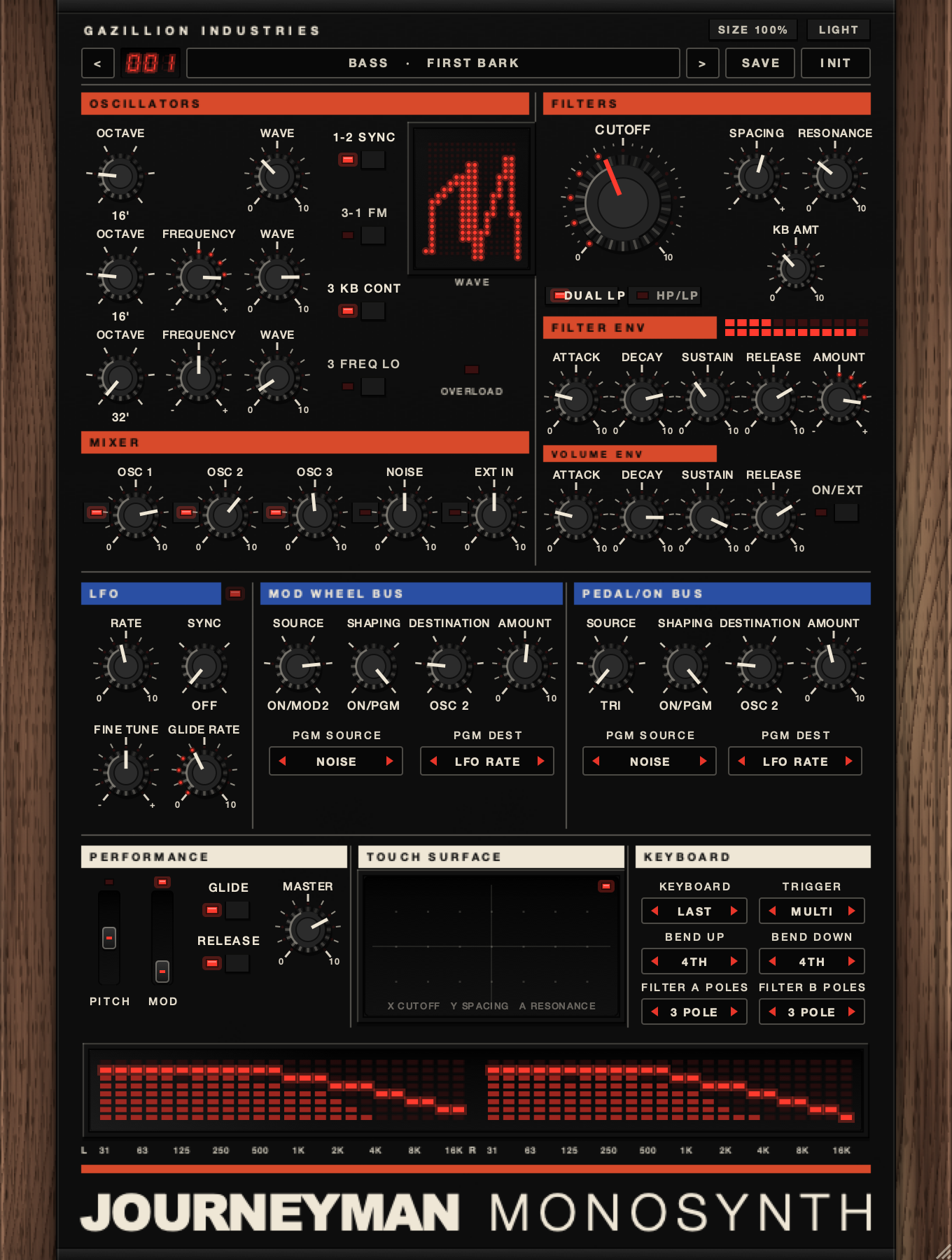 One voice, laid out in the order you build it. Oscillators and mixer top left, filters and envelopes right, everything that moves on its own along the bottom.
What a lead actually has to do
A lead carries the melody over everything else in the arrangement. That is one sentence with
three demands buried in it: it has to be heard through a dense mix, it has to be recognizable
after four bars, and it has to sound like one instrument rather than a stack of them. Most synth
leads fail the third test before they get near the first two.
The register is where the trouble starts. A lead usually lives between roughly 500 Hz and
4 kHz, which is also where the ear is at its most sensitive and where the vocal, the snare and
the top of the sample all want to be. You are not competing with the low end. You are competing
with everything that survives a phone speaker, and that fight is covered in
Fletcher-Munson.
A lead also has to move. A held note with a fixed timbre stops being information about eight
seconds in. Something has to change while the note sounds, or the listener files the part as
furniture and goes back to the drums.
Why the best lead synth VST is usually a monosynth
A monosynth plays one note at a time. That reads like a limitation on a spec sheet and it is
the reason the category exists. When an instrument can only hold one note, the engineering goes
into what happens between notes rather than into how many can sound at once, and between notes is
exactly where a lead lives.
One voice means the notes connect
Play a fast run on a polysynth with any release at all and the tails overlap. Six notes into a
sixteenth-note line you have four voices sounding, the filter envelope has retriggered four
times, and the sum is a smear with the rhythm buried in it. A single voice cannot do that. Each
new note takes the voice over, and the line stays a line.
You can hear it on a laptop speaker. Bounce the same MIDI through both and the mono version
reads as a melody while the poly version reads as a texture. Neither is wrong. Only one of them is
a lead.
Note priority and trigger, the two settings nobody reads
When two notes overlap on a one-voice instrument, something has to decide which one wins.
Last priority gives the voice to the most recent key, which is what you want for
a played line. Low and high priority hand it to the bottom or
top note instead, which is how you play a moving line against a pedal tone with one hand.
Trigger mode is the companion setting. On multi trigger every new note fires
both envelopes again, so each note has its own attack. On single trigger an
overlapping note takes the pitch without restarting the envelopes, so a legato phrase opens once
and stays open. Those two switches change the feel of a part more than any preset will.
Glide is a lead instrument's accent
Glide slides the pitch from the note you left to the note you arrived at, over a time you set.
Around 20 to 60 ms it reads as an accent on the front of the note. At 200 ms and up it reads as a
slide and starts eating the rhythm. Paired with single trigger it only runs when notes overlap,
so you play the slides in rather than program them: hold the last note a sixteenth longer than
you should and the next one arrives bent.
JOURNEYMAN
is our monosynth for Mac and Windows: one voice, three oscillators, two ladder filters spread left
and right, two envelopes, two modulation busses and 200 programs across basses, leads, keys, pads,
percussion and fx. There's a demo on the page.
What separates the best synth lead plugins from the loudest ones
Most of the difference between synth lead plugins comes down to seven things, none of which appear
in the marketing, and each one can be checked in your own session in a minute.
Detune between oscillators, and how slow it beats
Two oscillators at slightly different pitches beat at the difference frequency. Tune them 1 Hz
apart and the amplitude swells once a second; 5 Hz apart and it flutters. For a lead the slow end
is the one that sounds like an instrument, because the swell happens over a note rather than
inside it. What varies between synths is resolution: sweep the fine tuning slowly on a held note
and listen for jumps. The same principle applied to whole tracks is in
detune plugins.
Filter slope, stated in poles
A low-pass filter's steepness is measured in poles, and each pole sheds 6 dB per octave above
the corner. Four poles roll off at 24 dB per octave and close down to something dark and hollow;
three poles roll off at 18 dB per octave and leave more of the top audible at the same cutoff
setting. For a lead that has to be heard, the shallower option often survives the mix better.
Being able to choose matters more than which one a synth ships with — the mechanism is in
filter cutoff and resonance.
Resonance that stays playable
Resonance lifts a peak at the corner frequency. A little makes a filter sweep sing; too much
turns the synth into a sine wave at the cutoff and takes the body with it. Park the cutoff around
800 Hz, raise resonance to the top, and play a two-octave run. If the loudness swings wildly as
notes pass under the peak, you will be fighting that on every part you write.
Two filters, and what they do to your stereo image
Running a voice through two filters at different cutoffs, one panned left and one right, makes
a mono source sound wide. It is a real width with a real cost: the two sides no longer contain the
same signal, so summing to mono changes the tone. Check it before you commit — the mechanism
is in phase cancellation and the test is in
mono compatibility.
An envelope with a genuinely fast attack
The front of a note is where a lead announces itself. If the fastest attack setting still takes
10 ms to reach full level, every note starts soft and the part sits behind the drums however loud
you make it. Record the synth to an audio track, zoom in on one note, and look at the first rise.
The waveform tells you in a second what a spec sheet will not.
Oscillator sync and cross-modulation
Hard sync restarts one oscillator every time another completes a cycle. You get a fixed pitch
with a timbre that changes as the synced oscillator is swept, which is the hard, vocal, tearing
lead you already recognize. Frequency modulation between two audio-rate oscillators gives the
other family: bells and metal at low amounts, chaos above that. Both throw harmonics far above the
fundamental, so sweep a synced lead up two octaves and listen for tones moving the wrong way. That
is aliasing, and once you hear it you
cannot unhear it.
Modulation you can reach while playing
A matrix with forty slots is a sound design tool. A mod wheel wired to one destination with an
amount you set is a performance tool, and a lead is performed. The question to ask of any synth
lead VST is not how many routings it has but how many of them your hands can get to without
stopping the transport.
Build a lead from scratch
Building one from a single oscillator takes about ten minutes and is the fastest way to learn
where an instrument hides its character. The steps are written for JOURNEYMAN's panel; the order
works on any monosynth.
- Press INIT to clear the panel to a starting state.
- Set OSC 1 OCTAVE to 8' and turn WAVE to the sawtooth position.
- Raise OSC 1 in the MIXER until the level reads healthy and the OVERLOAD lamp stays dark.
- Play the melody in and move OCTAVE until the line sits above the bass and below the hats.
- Switch OSC 2 on, set its OCTAVE to 8', and turn FREQUENCY until you hear one beat per second.
- Set OSC 3 OCTAVE to 16' and bring it up under the other two until the line has weight.
- Close CUTOFF until the top stops hissing, then raise RESONANCE until the corner sings and back it off one mark.
- Set FILTER ENV ATTACK to 0, DECAY to about 3, SUSTAIN to about 5, then raise AMOUNT until each note opens.
- Set VOLUME ENV ATTACK to 0 and RELEASE short enough that the notes stop when you do.
- Turn GLIDE on and set GLIDE RATE so a jump of a fifth arrives in roughly 40 ms.
- Set TRIGGER to SINGLE so the glide only runs between overlapping notes.
- Set the MOD WHEEL BUS DESTINATION to OSC 2 with a low AMOUNT, then ride the wheel on held notes.
- Bounce eight bars and play them on your phone before you save the program.
Where the synth lead sits in the mix
A lead that needs volume to be heard is usually a lead with the wrong spectrum. Before you
reach for the fader, find the two or three narrow bands where the part actually speaks and check
that nothing else is sitting in them. On most records the lead and the vocal are fighting over the
same 2 to 4 kHz, and one of them has to give it up.
Saturation is the cheaper fix. Harmonics above the fundamental give a part presence on small
speakers without adding level, which matters because most phone speakers give you almost nothing
below a few hundred hertz. Mechanism in
harmonic distortion, practice in
how to make a synth sound
thicker, small speakers in
bass on phone speakers.
Compression on a lead is about evenness rather than loudness. We give away a one-knob
compressor for that job:
DRUGS
is free for Mac and Windows, and the wider list is in
best free compressor. Set your levels first
either way — a synth clipping inside the plug-in sounds like a synth with a bad filter, and
the fix is three dB lower rather than a different instrument. See
gain staging.
The synth lead plugins people name, and ours
Search this term and you will get a list of large polyphonic synths, because large polyphonic
synths are what people own. They all make a lead sound. The question is whether you want an
instrument built for one line or a workstation you have to talk into playing one.
Gazillion Industries JOURNEYMAN
Our monosynth, $59, Mac and Windows. One voice, three oscillators, two ladder filters with a
spacing control between them, two ADSR envelopes, an LFO, two modulation busses and 200 programs.
The performance controls — glide, note priority, trigger, bend range, the touch surface
— are on the front panel rather than in a menu. Full description at the bottom of this
page.
Xfer Records Serum 2
$249.00 USD on Xfer's own site, where it is described as an advanced hybrid synthesizer. It
carries wavetable, multisample and sample oscillators, flexible effect routing, an arpeggiator and
a clip sequencer. The default answer in most forum threads, and a very large instrument to open
when you want one line.
u-he Diva
179 € on u-he's own page. Diva's panels are swappable: you pick which oscillator, filter
and envelope sections to load and combine them into a layout of your own. Polyphonic, widely used
for leads, and it will have you setting voice count and CPU options before you touch the part.
Native Instruments Massive X
Native Instruments describe it on their own product page as a next-generation polyphonic
wavetable synth. The preset library is enormous, and like the others here it will hand you a lead
once you tell it to play one note at a time.
LennarDigital Sylenth1
Four unison oscillators, each capable of eight unison voices in full stereo, which
LennarDigital's own page totals at 32 voices per note across 16-note polyphony, plus two filter
sections of four stages each. It is still one of the fastest routes to a wide supersaw. Wide is
the point, and wide is the opposite of what a monosynth is for.
Free synth lead VST options worth the download
There are good free ones. None are monosynths, so the note handoff above still applies, but
if the budget is zero today, start here.
Vital
Vital's Basic tier is free on the developer's own site and includes the full synth with all
features, 75 presets and 25 wavetables; the paid tiers add presets and wavetables rather than
capability. For anybody learning what modulation does, the animated display alone is worth the
download.
Surge XT
Free and open source under GPL3, per the project's own FAQ, with several synthesis methods, a
large filter collection, MPE and microtuning. The interface is dense and the preset library is
uneven, which is the trade for a synth nobody is charging you for. More in
best free VST plugins.
The synth already in your DAW
Every major DAW ships a subtractive synth with oscillators, a filter and two envelopes, and
most of them have a mono or legato switch buried in the voice settings. Find that switch before
you download anything. It will tell you whether the problem with your lead was the instrument or
the arrangement.
What a monosynth costs you
One voice means no chords. If your part has two notes sounding at once anywhere, a monosynth
plays one and drops the other, and you find out during the bounce rather than during the take. The
workaround is a second instance on a second track, which costs you the shared glide and shared
filter movement that made you want one voice to begin with.
A single voice also exposes your playing: no second note to hide behind, no tail from the
previous chord smoothing over a late attack. That is a cost, and it is also why the good leads on
records sound played rather than drawn.
Four mistakes worth not making
Writing the lead last. A melody written over a finished arrangement inherits
every hole that arrangement left, which is usually the wrong register. Write the line early, even
if you replace the sound later.
Solving a dull lead with more detune. Detune widens. It does not make a part
more interesting, and past a certain amount it makes the pitch ambiguous, which on a melody is
fatal. If the line is boring, the line is boring.
Automating the filter instead of playing it. A drawn curve has the rhythm of a
mouse. Assign cutoff to the mod wheel or the touch surface, record a pass, keep the take —
the long version is in
how to make a filter sweep.
Judging the sound in solo. A lead that sounds thin alone is often perfect in
the mix, and one that sounds huge alone is usually eating the vocal. Solo finds problems. It does
not make decisions.
Questions people ask
What is the best lead synth VST?
For a single melodic line, a monosynth, because one voice is what gives you glide, note
priority and single trigger — the three things that make consecutive notes behave like an
instrument rather than a stack. JOURNEYMAN is ours: $59, Mac and Windows, three oscillators, two
ladder filters and 200 programs. If you already own a large polysynth, switch it to mono or legato
first and hear what changes before you buy anything.
What is the best lead synth plugin for a beginner?
The one with the fewest pages. You learn faster on a panel where every control is visible at
once and you can change one thing at a time. A monosynth is the smallest complete instrument
there is: oscillators into a mixer, mixer into a filter, filter into an amplifier, with two
envelopes and an LFO moving things. Learn that layout and every other synth becomes readable.
Is there a good free synth lead VST?
Yes. Vital's Basic tier is free on the developer's site and gives you the full synth with all
features, 75 presets and 25 wavetables. Surge XT is free and open source under GPL3 according to
the project's own FAQ. Before either, look for the mono or legato switch in the synth your DAW
already installed; it costs nothing and it answers whether you needed a new instrument at all.
What is the best synth lead VST for hip-hop and trap?
The same answer, for a specific reason: those genres put the lead in a duet with an 808, and an
808 occupies the bottom two octaves completely. A monosynth with a three-pole filter setting and a
fast attack gives you a line that sits above it with no low-end fight at all. Pair it with
saturation rather than volume, as in
saturation plugins.
Do I need a monosynth if my synth has a mono mode?
No, and it is the right first test. Mono mode on a polysynth gives you the one-voice handoff and
usually a glide control, which covers most of the benefit. What it rarely gives you is note
priority, a trigger mode switch, and a panel where the performance controls are reachable while
the transport runs. Try the switch. If you find yourself wanting those three, the dedicated
instrument is the upgrade.
Why does my synth lead disappear in the mix?
Usually one of three things. The attack is too slow, so every note starts underneath the drums
instead of on top of them. The cutoff is too low, so there is nothing above 3 kHz for a small
speaker to reproduce. Or the part occupies the same 2 to 4 kHz as the vocal, in which case volume
will not fix it and a narrow cut in the other part will.
What is the best synth lead plugin for playing live?
Whichever one puts its expression controls on the surface. On stage you need pitch bend range,
glide, filter cutoff and one modulation amount reachable without a mouse, and a standalone version
helps because it removes a DAW from the signal path. JOURNEYMAN runs standalone on macOS and as a
VST3 plug-in on Windows, with a touch surface mapping cutoff to X and filter spacing to Y.
What JOURNEYMAN does
JOURNEYMAN is our monosynth for Mac and Windows: AU, VST3 and standalone on macOS, VST3 on
Windows, universal binary, macOS 10.13 or later and Windows 10 or later, 64-bit. One voice, and a
panel where the whole signal path is visible at once.
Three oscillators. Each has an OCTAVE control marked in footages and a WAVE
control that sweeps continuously from triangle through sawtooth and square to pulse, so the
waveform is a position rather than a menu choice. Oscillators 2 and 3 add a FREQUENCY control for
detuning against oscillator 1. 1-2 SYNC hard-syncs the second oscillator to the
first; 3-1 FM routes the third into the first as a modulator. 3 KB
CONT and 3 FREQ LO take oscillator 3 off the keyboard and down into low
frequencies, which turns it into a second modulation source.
A five-channel MIXER. OSC 1, OSC 2, OSC 3, NOISE and EXT IN each get a level
knob and an on switch, with an OVERLOAD lamp above them. External audio in means the filters and
envelopes are available to anything else in your session.
Two ladder filters. One CUTOFF knob drives both, with SPACING
setting how far apart they sit and the pair spread left and right for width.
RESONANCE and KB AMT are shared, the section switches between
DUAL LP and HP:LP, and FILTER A POLES and FILTER B POLES each
select 3 POLE or 4 POLE independently.
Two envelopes and an LFO. FILTER ENV is an ADSR with its own AMOUNT into the
cutoff; VOLUME ENV is an ADSR with an ON/EXT switch. The LFO has RATE and SYNC plus sample and
hold, with FINE TUNE and GLIDE RATE beside it.
Two modulation busses. The MOD WHEEL BUS and the PEDAL/ON BUS each have
SOURCE, SHAPING, DESTINATION and AMOUNT, plus a programmable source and destination pair
underneath. All 200 programs are already wired to the mod wheel and the touch surface, so there is
something to move on the first note you play.
Performance. Pitch and mod wheels on the panel, GLIDE and RELEASE switches, a
MASTER level, a TOUCH SURFACE mapping X to cutoff and Y to spacing, keyboard priority and TRIGGER
modes, and separate BEND UP and BEND DOWN ranges. Two spectrum meters run across the bottom, left
and right, from 31 Hz to 16 kHz. The license key arrives with your download and in your receipt
email; it activates once and then works offline.
Play the same eight bars in the car again. The line arrives before the drums do, the notes lean
into each other where you held them, and nothing about it sounds like a demo left running.
JOURNEYMAN — a monosynth for Mac and Windows. One voice, three oscillators,
two ladder filters, two envelopes, two modulation busses and 200 programs.
Hear it
Keep reading
- How to make a synth sound thicker — Unison, oscillators, a mono sub, chorus, saturation and layering, without the harshness.
- Filter cutoff and resonance explained — The corner frequency, the slope, the resonant peak, and what each costs.
- What is aliasing in audio — What it is, what it sounds like, how to prevent it, and how to use it on purpose.
- Best detune plugins — Cents, beating and mono: how to pick a detune plugin, free or paid.
- Mono compatibility — Which kinds of width survive summing, and how to test for it.
- Monosynth vs polysynth — What one voice buys you, and how to hear paraphonic against polyphonic.
- Best synth VST for hip hop — The three jobs a hip hop synth has to do, and the controls in order.