← Gazillion Industries/Reading material
Tape plugins for Logic Pro
Gazillion Industries · · updated
Logic ships a very good saturation plug-in and no tape machine.
ChromaGlow covers the harmonic side properly, with models of tube and analog gear, and it
leaves speed, noise and the transport alone. Those three are most of what people mean by a
tape sound, and they are the reason to load anything else at all.
So the thing you actually load is
TRIPLE OG,
our cassette tape simulation, $29, shipping as an Audio Unit on macOS so Logic finds it.
WOW FLUT is the speed instability, HISS the noise bed,
and SLAM, SCRUB and CATCH put the
transport on the face rather than in a menu.
The short version
- Load this
- TRIPLE OG, AU on macOS, $29 — speed, noise, transport
- Spend nothing first
- DRUGS is free and ships as an AU; use it to test the menu
- Format
- Logic loads Audio Units only; VST3 will not appear
- ChromaGlow
- Logic's saturation plug-in, under Distortion
- Needs
- a Mac with an M1 or later chip to run it
- On an Intel Mac
- ChromaGlow is absent; ours runs, macOS 10.13 or later
- Not covered
- wow and flutter, cassette noise, a transport
- Tape Delay
- a delay, not a tape machine; different job
Where TRIPLE OG goes in a Logic session
On the bus, not the master. In Logic that is an Audio FX slot on the drum bus or the
summing stack, picked from the Audio Units part of the plug-in menu. Match the level before
you judge anything, because a tape path running a decibel hot always sounds better for the
wrong reason.
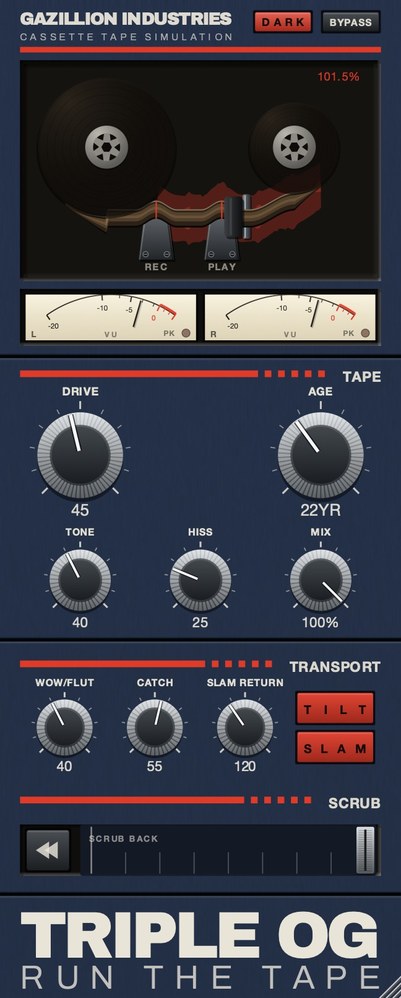 Top half is the machine, bottom half is the tape, and the SCRUB strip
along the bottom is played by hand.
Top half is the machine, bottom half is the tape, and the SCRUB strip
along the bottom is played by hand.
- Load it first in the chain. Audio FX slot one on the drum bus, from
the Audio Units menu.
- Set DRIVE for thickness. Stop at the point where the break stops
sounding thin.
- Bring AGE up to about 15 years. Go further only when you want the
wear to be audible on its own.
- Set HISS against the quietest bar in the song, not against a soloed
loop.
- Add WOW FLUT last, and check the most tonal element in the
arrangement for tuning before you commit.
- Hold SLAM through the last beat of a bar and let go.
WOW FLUT is where the number matters. In the render below, set to 65, playback speed
moves between 0.941 and 1.071 of nominal — 105 cents flat to 119 cents sharp, a swing
of more than two semitones peak to peak. On a drum break that reads as a machine. On a held
chord it reads as bad tuning, which is the cost, and it is why the tonal parts get checked
before the drums do.
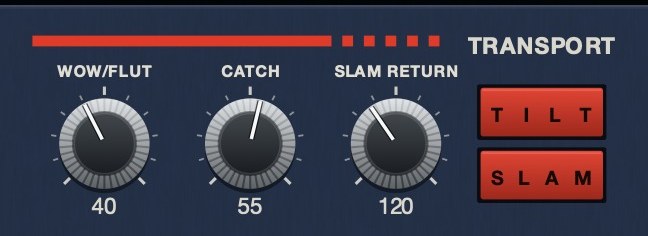 The machine rather than the tape. SLAM is a stop you press,
SLAM RETURN sets how long it takes to fall, and CATCH is the drag and the
sprint back.
The machine rather than the tape. SLAM is a stop you press,
SLAM RETURN sets how long it takes to fall, and CATCH is the drag and the
sprint back.
Hear it
Same eleven seconds three times: clean, then the speed moving on its own, then a worn
deck with the noise bed under it.
Dry — no processing — speed holds at 1.000
Wow and flutter 65 — speed moves between 0.941 and 1.071
Age 35, hiss 45, drive 30, wow 40 — a worn deck — speed 0.951 to 1.059
Rendered offline through TRIPLE OG at the settings shown. No other processing, no master bus, no edits. Play them on a phone as well as on monitors; the speed movement survives a small speaker, and most of the harmonic work does not.
The format question: Audio Units only
Logic loads Audio Units. It does not load VST or VST3, and a plug-in installed only as a
VST3 simply will not appear in the menu no matter how many times you rescan. This catches
people out constantly, because most plug-in makers lead with VST3 in their marketing and
mention the AU build further down.
So check the AU build before you buy anything. TRIPLE OG installs on macOS as an Audio
Unit alongside VST3 and a standalone app, macOS 10.13 or later, as a universal binary for
Apple silicon and Intel.
If you want one of our Audio Units in your own plug-in menu before spending a cent,
DRUGS
is free: our one-knob bus compressor for drums, AU, VST3 and standalone, Mac and Windows,
with a single DOSE control and a soft ceiling on the way out. It is a compressor, so it
settles the install question rather than the tape one. Install it, rescan, and you know
what our AU builds do in your setup.
What ChromaGlow already covers
ChromaGlow is Logic's saturation plug-in, found under Distortion in the audio effect
menu. Apple describes it as replicating the warmth and coloration of analog audio
equipment by introducing harmonic distortion, with a nonlinear response and a subtle
compression that tames transients. Its Model menu offers a range of saturation models
including Retro Tube and Modern Tube.
One catch worth knowing before you plan a chain around it: ChromaGlow is available only
on Macs with an M1 or later Apple silicon processor. On an Intel Mac it is not there, and
since TRIPLE OG is a universal binary back to macOS 10.13, the older machine is not the
thing standing between you and a tape sound.
The honest position, then, is that Logic already gives you harmonic thickening and you
should use it. What sends people looking for a tape plug-in in the first place is the other
three behaviors, and Logic has no device for any of them.
The parts Logic has nothing for
- Speed instability. Nothing in Logic's stock set varies playback
speed slightly and continuously the way a tape transport does. That is
wow and flutter, and it is the behavior
you cannot assemble from other devices. On our panel it is WOW FLUT,
built from several motions at unrelated rates rather than one sine.
- A cassette noise floor. Logic has noise generators; what a cassette
needs is a filtered, level-matched, partly decorrelated bed that sits under the music
rather than on top of it. See tape hiss. Ours is
HISS, with AGE from nought to sixty years moving wear,
noise and stability together.
- A transport. Stopping, dragging, rewinding and coming back in sync.
See tape stop plugins.
SLAM, SCRUB and CATCH are three
separate controls for it, on the face, playable while the session runs.
TRIPLE OG
ships as an Audio Unit on macOS, so it appears in Logic's menu like any stock plug-in, and
it is $29. WOW FLUT and the SLAM transport are the parts
Logic has nothing for. There's a demo on the page.
Tape Delay is not a tape machine
Logic's Tape Delay is a delay whose design references tape echo units. It is a good
delay and it is solving a different problem: repeats, feedback and the character of the
repeats. It does not put your source signal on tape, and reaching for it to get a tape
sound on a drum bus will not work. The distinction is in
tape delay explained. For the drum bus
job, the thing that puts the signal on the machine is TRIPLE OG.
Hear TRIPLE OG
Questions people ask
Does Logic Pro have a tape emulation plugin?
No. It has ChromaGlow, a saturation plug-in with models of tube and analog gear, which
covers the harmonic side of a tape sound. It has no device for speed instability, cassette
noise or a tape transport, which is what a tape plug-in is bought for. Ours is
TRIPLE OG,
$29, AU on macOS.
Can Logic use VST plugins?
No. Logic loads Audio Units only. A plug-in that ships VST3 but no AU build will not
appear, however many times you rescan. TRIPLE OG ships both, plus a standalone app.
Why can't I see ChromaGlow in Logic?
It is available only on Macs with an M1 or later Apple silicon processor. On an Intel
Mac it is not installed. TRIPLE OG is a universal binary and runs on macOS 10.13 or later
either way.
What is the best tape plugin for Logic?
An Audio Unit that supplies what Logic does not, rather than more saturation. Weight
your choice toward wow and flutter, cassette-shaped noise and transport behavior, which is
exactly how TRIPLE OG is laid out: speed and noise on the tape half, three transport
controls on the machine half. Wider field in
best tape emulation plugins.
Is there a free tape plugin for Logic?
Our free plug-in is DRUGS,
a one-knob drum bus compressor rather than a tape simulation, so it is the free way to get
one of our Audio Units into Logic and not the free way to get tape. For what free tape
actually gets you, see
best free tape plugins.
What TRIPLE OG does
TRIPLE OG
is our cassette tape simulation, $29, and on macOS it ships as an Audio Unit
alongside VST3 and a standalone app, so Logic finds it. WOW FLUT is the
speed instability, HISS a continuous broadband bed, and
AGE runs from nought to sixty years, taking wear, noise and stability
together. TONE and DRIVE handle brightness and thickness.
The transport is on the face: SLAM stops the tape and returns it in sync,
SCRUB runs the head backward and springs home, and CATCH
makes it drag and then sprint to catch up. macOS 10.13 or later, Apple silicon or Intel;
Windows 10 or later as a VST3.
Logic will color a sound beautifully. It will not put one on a machine.
“Most tape plugins treat the transport as something to model quietly in the background, but this one hands it to you as an instrument.”
Best Tape Emulation Plugins · AudioColour.com
TRIPLE OG — cassette tape simulation for Mac and Windows, with a transport
that drags, jams and sprints to catch up. There is a demo on the page.
Hear it
Keep reading
- Best tape emulation plugins — Reel and cassette are different products. Pick the machine first.
- Tape delay explained — Why the repeats darken, how the time is set, and where slapback sits.
- Wow and flutter — What causes them, what they sound like, and how to add them on purpose.
- Tape hiss — Where it comes from, how to reduce it cleanly, and how to add it on purpose.
- Best tape stop plugins — What separates a real tape stop from a pitch bend, and what to look for.