← Gazillion Industries/Reading material
Best pitch shifter plugins
Gazillion Industries ·
The same thread goes up on a plugin forum every few weeks. A sample sits a tone
flat against the beat, or a hook needs to be a fifth higher, and every pitch tool already installed
does something slightly wrong to it. Twenty replies arrive, all of them names, none of them saying
which name is for which job.
Choose the pitch shifter by what the audio is. One voice or one line wants a formant-aware
real-time shifter. A chord or a finished mix wants a polyphonic processor, or a varispeed move that
carries pitch and speed together. Anything you intend to play or automate wants a low-latency
insert rather than an offline editor. Free plugins cover the monophonic case properly; money buys
polyphony, a choice of algorithm, and control over formants.
The short version
- One line
- formant-aware real-time shifter on an insert
- Chords or a mix
- polyphonic processor, or varispeed the whole thing
- Free
- Graillon's free edition, MAutoPitch, Pitchproof
- Judge it by
- formant control, latency, what it does to transients
- Test
- two semitones on a dry vocal, then an octave, then a drum loop
- Our answer
- SKRUU, for the varispeed half of the job
Hear it
Every page in this category describes what varispeed does and then shows a screenshot of a knob. Here is
one loop through SKRUU at three speeds, then the same thing with the sampling rate stepped down. The figures
are the renderer's own readout.
Unity — PITCH 93 — rate 1.0000, +0.00 semitones
Slowed — PITCH 64 — rate 0.9275, −7.25%, −1.30 semitones
Sped up — PITCH 120 — rate 1.0779, +7.79%, +1.30 semitones
Slowed, LO-FI 2 — PITCH 64 with SAMPLING GRADE at 3.9 kHz
One source loop, rendered offline through the same engine the plug-in runs, no other processing.
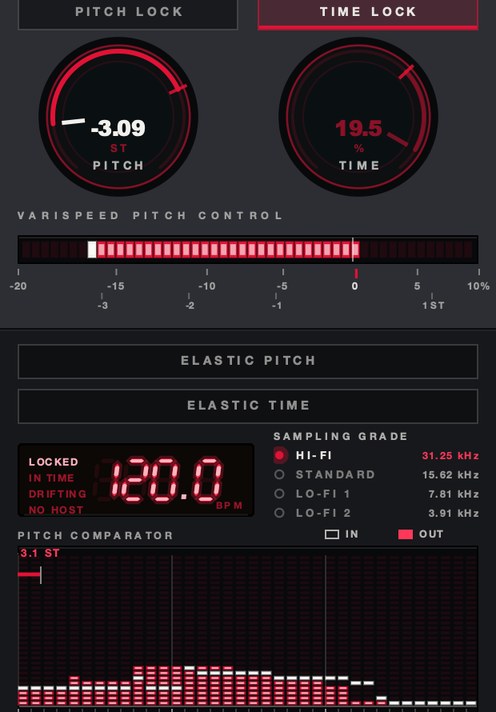 PITCH −3.09 ST. The varispeed route: pitch and speed linked, no analysis in the path.
Three families, and why they sound different
Every pitch shifter belongs to one of three families, and most of the confusion in those forum
threads comes from comparing plugins across families as if they were doing the same thing.
Resampling, also called varispeed. Play the audio faster or slower and the pitch
moves with it. There is no analysis, no window, nothing to guess at, so there are no artifacts in the
usual sense — the whole recording, formants and room included, simply moves. Doubling the speed
raises the pitch twelve semitones. What it costs is the length, which changes by the same ratio.
What varispeed is covers the math once, properly.
Time-domain grain splicing. Resample to get the pitch, then cut the result into
short grains and repeat or drop them to put the length back. Cheap on CPU, low latency, keeps
transients hard. When it fails you hear a flutter on sustained sound, because the splices are
periodic and your ear finds the period.
Frequency-domain resynthesis. Analyze the signal into frequency and phase, move
the partials, rebuild the audio. This is what handles pads, chords and long tails without stuttering,
and it is where the smeared, glassy, underwater quality comes from when you push it. Attacks are the
weak point, which is why modern versions detect transients and switch strategy at each hit.
The reason a vocal pitched up four semitones sounds like a cartoon is separate from all of that.
It is formants: the fixed resonances of the throat and mouth that tell a listener how big the singer
is. Resampling moves them with the pitch. A formant-aware shifter holds them still, or moves them on
their own knob. Formant shifting is the whole story,
and it is the single control that separates a usable vocal shift from a novelty.
What separates a good pitch shifter from a bad one
- A formant control that is its own knob. Not a preserve checkbox. You want to
pitch a vocal up three semitones and pull the formants down two, and that is a two-knob job.
- Honest latency. Some of the best-sounding algorithms need a long analysis
window and report the delay to the host. That is fine for mixing and useless for tracking. Check
the number before you decide it feels laggy.
- Transient handling you can hear. On a drum loop a weak shifter doubles the
attack or softens it into a thud. This is the fastest test there is.
- Range with resolution. An octave each way is plenty for most work, but cents
matter more than semitones: a sample two records old is rarely exactly at pitch, and a shifter with
only semitone steps cannot fix it.
- Automation and MIDI. A pitch control you can draw, or play from a keyboard,
is a different instrument from one you set once.
- A mix control. Blending the shifted signal under the dry one is how harmonies
get made, and a plugin without it forces a second track.
SKRUU is the
varispeed answer to this: PITCH and TIME on separate knobs, so you can drop a sample five semitones
and pull the length back without an analysis stage anywhere near the vocal. There's a demo on the
page.
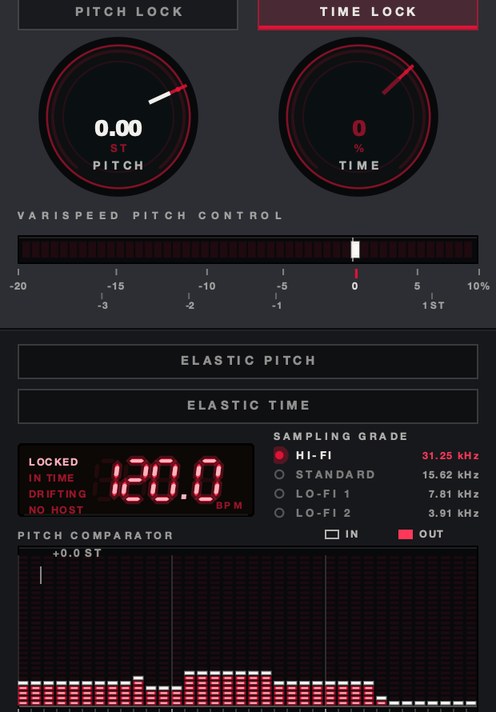 TIME −35%, PITCH at unity. Length on its own, with the pitch held.
How to test one in ten minutes
Demos are all trial versions and marketing pages. Ten minutes with your own audio settles it
faster than a week of reading threads.
- Load a dry solo vocal with no reverb and no tuning on it.
- Shift up two semitones and listen for a change in the size of the singer.
- Pull the formant control down until the size sounds right again, and note how much it took.
- Shift up twelve semitones and listen to the consonants, not the notes.
- Shift down seven semitones and listen to the breath between lines.
- Swap the vocal for a drum loop and shift two semitones either way.
- Solo the loop and check whether each attack is still one attack.
- Read the latency the plugin reports to your host.
- Bounce every version and listen to the bounce on phone speakers.
- Delete the ones that failed step seven.
Where it goes in the chain
Pitch shifting goes early, before anything that adds character. Shift first, then compress, then
saturate, then reverb. A shifter placed after a compressor hears a signal whose dynamics have already
been rewritten, and a shifter placed after reverb moves the room along with the source, which is a
specific effect rather than a default.
The exception is deliberate. Putting the shifter last, after the reverb, shrinks or stretches the
entire space, and on a send that can be the most interesting thing on the record. The rule is that
you should know which one you chose.
On a send rather than an insert, set the plugin to full wet and use the send level as the blend.
This is how octave-down bass reinforcement and shimmer-style octave-up pads get built, and it keeps
the dry signal untouched underneath.
Free pitch shifter plugins worth installing
The free tier is genuinely good now, with one caveat: almost all of it is monophonic, built for
voices and single lines.
Auburn Sounds Graillon. Auburn Sounds ships Graillon in a free edition and a paid
full edition, as a VST, AAX, AU and LV2 plugin for Windows, macOS and Linux. It does pitch shifting,
formant shifting and pitch correction, and version 3 carries three selectable pitch engines —
G2, which keeps the earlier sound, G3, and I1 from the maker's Inner Pitch plugin. The built-in
compressor, gate, chorus, preamp and bitcrusher are all voiced for vocals.
MeldaProduction MAutoPitch. Free, and described by MeldaProduction as automatic
tuning and pitch correction for vocals and other monophonic instruments. Alongside the tuning it has
a formant shift and a stereo expansion, which is a useful pair for background vocals where you want
each layer slightly different.
Aegean Music Pitchproof. A free harmonizer-style shifter with a pedal's set of
controls: a Blend knob for dry against shifted, a Pitch menu of intervals such as +7 or −7,
scale-aware harmony settings keyed to a major or minor scale, and a Detune control. There is a
mono option for lower CPU, a Transient Fix switch, and a tuner built in because the plugin is
tracking pitch anyway. Aegean Music states a maximum range of an octave up or down, a little more
with detune, and that it works best on monophonic signals.
Your host is the fourth free option and people forget it. Every major DAW licenses a competent
stretching and shifting engine, offers a transient-aware mode and a spectral mode, and will repitch
a clip without any plugin at all. How to pitch a
sample walks that route.
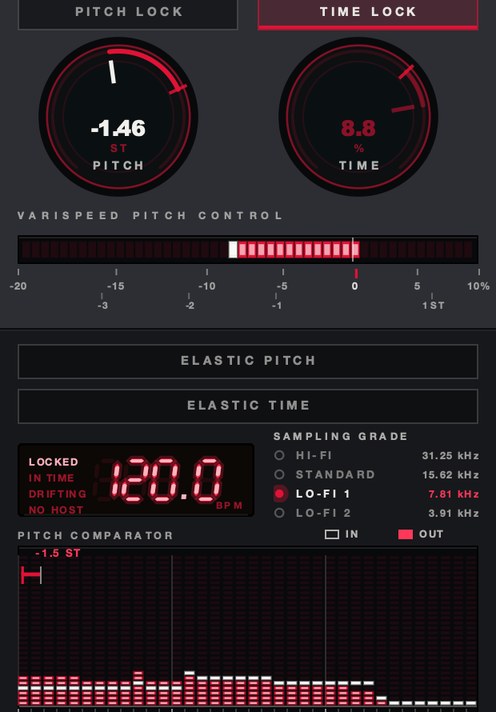 SAMPLING GRADE at LO-FI 1. 7.81 kHz rather than 31.25 — the sampler's own contribution to the pitch.
Paid options, and what the money buys
Paying gets you one of three things: a better algorithm, more than one algorithm, or the ability
to work on material that is not a single line.
Soundtoys Little AlterBoy. A monophonic voice manipulator that shifts pitch and
formant in real time, locks a voice to a single pitch for robot tones, takes MIDI from the host to
drive the pitch, and includes a tube saturation stage from the maker's Decapitator. Soundtoys lists
version 5.5 as Apple Silicon and VST 3 compatible, in AAX Native, AAX AudioSuite, VST 2, VST 3 and
AU, from 44.1 kHz to 192 kHz, on macOS 10.15 or later and Windows 10 or later — and
states it is not compatible with ARM-based Windows machines, which is worth knowing before you buy.
Polyverse Manipulator. Listed at $149, and built on granular algorithms that
alter the timbre and pitch of monophonic audio. Polyverse lists ten effects, five modulation sources,
up to four polyphonic harmony voices, MIDI control of melody, and real-time zero-latency processing
for live performance, in VST2, VST3, AU and AAX for 64-bit Windows and macOS 10.9 or later. The
interesting part is that the pitch control is one of ten things it does to a voice rather than the
only one.
Zynaptiq PITCHSHIFT. Sold in two tiers on Zynaptiq's own site: PITCHSHIFT at USD
149 with three algorithms for mono and stereo, and PITCHSHIFT PRO at USD 269 with six algorithms and
up to sixteen channels of phase-synchronous multi-channel processing. The algorithm range runs from
a classic delay-line design through resynthesis and time stretching to hybrid processing, which is
the practical argument for a dedicated plugin: one algorithm cannot be right for a guitar fifth, a
monster voice and a frame-rate pitch correction on a film mix.
Polyphonic pitch shifting, the hard case
Shifting a single note is a solved problem. Shifting one note inside a chord, or one instrument
inside a finished mix, is not, and this is where the searches get specific.
Zynaptiq PITCHMAP is built for exactly this. Zynaptiq describes it as processing
the pitch of individual sounds within mixed signals in real time, letting you play new melodies and
harmonies over a recording from a MIDI keyboard or a pitch map drawn in its interface, correcting
tuning at the same time, and suppressing individual sounds within a mix. There is a 30-day free
trial, which for a processor this unusual is the only sensible way to judge it.
Celemony Melodyne comes at it from the other direction. Rather than a real-time
insert, it offers note-based editing, where the analysis turns a recording into blobs you move. Celemony's own
description covers polyphonic instruments such as piano and guitar, and per-note editing of pitch,
vibrato, volume, sibilants, length, timing and formants, with multitrack note editing in one window.
It runs via ARA, as a plugin, or standalone.
There is a third answer that costs nothing and nobody mentions in the threads: move the whole
thing. If a two-bar loop is a semitone flat, repitching the entire loop keeps every internal
relationship intact, because you changed the playback rate rather than guessed at the parts. The key
moves and the length moves, and if that is acceptable you have avoided the hardest problem in the
category.
Real-time versus offline
A real-time shifter runs on an insert while the session plays, reports its latency to the host,
and can be automated and performed. An offline editor analyzes first and renders after, which buys
quality and per-note control and costs you the ability to change your mind while the track is
running.
The searches for a real-time pitch shifter are usually about one of two things: performing the
shift live, or automating it as a musical gesture. For the first, latency is the only number that
matters and a granular or delay-line algorithm will beat a spectral one. For the second, what you
want is a knob whose whole travel is musical, so a sweep from unity to a fifth up sounds like a
move rather than a series of steps.
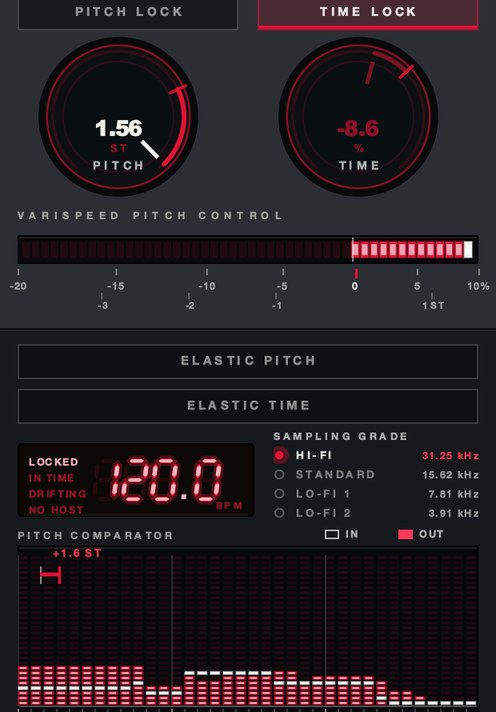 Pitched up. Same knob, other direction, length moving with it.
What it costs you
Every family in this category takes something. Resampling takes the length and the key. Grain
splicing takes the smoothness of sustained sound. Resynthesis takes the front edge of transients and
gives back a faint metallic sheen on tails, and it takes CPU and latency to do it.
Formants are the cost people notice last and mind most. Preserving them on a big shift keeps the
singer the right size and introduces its own artifacts, usually a nasal quality on vowels. Letting
them move is honest and it also means a four-semitone lift turns an adult into a child. Neither
setting is free, and choosing between them takes about fifteen seconds once you know it is a
choice.
The last cost is commitment. A shifter left live on twenty tracks is a CPU bill and a session that
behaves differently on another machine. Bounce the ones you are sure about. The rest of the argument
is in time stretching explained.
Questions people ask
What is the best pitch shifter plugin?
There is no single answer because the category contains three different machines. For one voice
or one line, a formant-aware real-time shifter on an insert. For chords or a full mix, a polyphonic
processor or a note-based editor. For a sample that needs to move as a whole, varispeed, because it
moves everything and guesses at nothing.
What is the best free pitch shifter plugin?
For vocals, Graillon's free edition is the usual recommendation and does pitch shifting, formant
shifting and correction in one window. MAutoPitch is free and adds a formant shift and stereo
expansion to its tuning. Pitchproof is free and gives you scale-aware harmonies with an octave of
range each way. All three are monophonic, which is the honest limit of the free tier.
What do people on Reddit recommend for pitch shifting?
The threads split the same way every time: vocal people name formant-capable shifters, sound
designers name granular ones, and someone points out that the DAW already does it. The useful part
of those threads is the disagreement, because it is a sign that the askers have not said whether
their source is one line or a mix. Say which, and the answer narrows to two plugins.
What is the best polyphonic pitch shifter plugin?
For real-time work on a mixed signal, PITCHMAP is the tool built specifically to address pitch
inside mixed material and has a 30-day trial. For per-note editing of chords, Melodyne works on
polyphonic instruments such as piano and guitar. If the whole passage can move together, repitching
it avoids the problem entirely and sounds like a record rather than a process.
What is the best real time pitch shifter VST?
For a real-time pitch shifter VST, look for the lowest reported latency and a formant knob. Granular and delay-line algorithms
perform live in a way spectral ones cannot, and makers who intend a plugin for live use say so
explicitly — Polyverse, for instance, lists real-time zero-latency processing for live
performance as a feature of Manipulator.
How do I change pitch without changing the tempo?
Use a pitch shifter rather than a speed control, and keep the shift small if you want it
transparent. The full method, in both directions, is in
how to change pitch without
changing tempo.
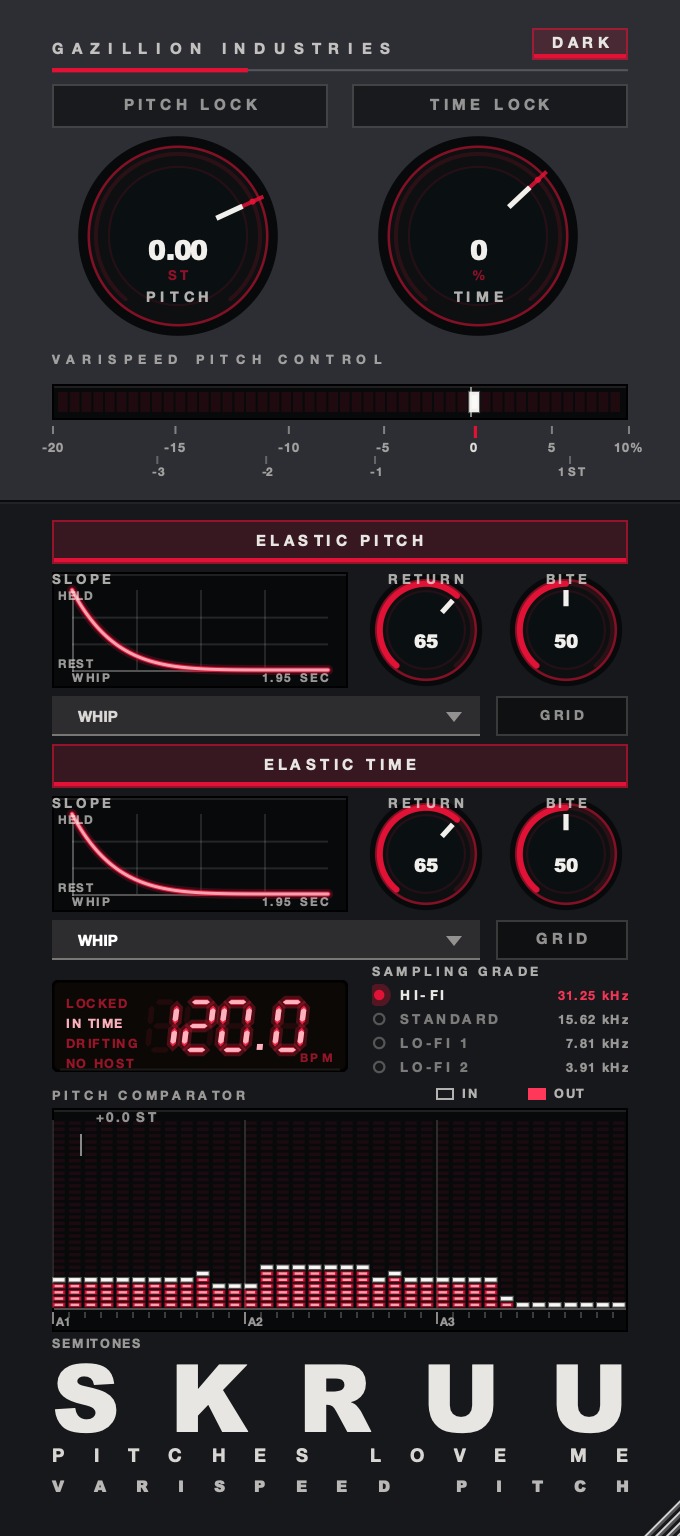 The whole panel. PITCH and TIME are the two knobs; everything else decides how they move and what the rate does on the way.
What SKRUU does
SKRUU is our varispeed pitch and time stretch plugin, $29, for Mac and Windows, as VST3, AU and a
standalone. PITCH and TIME are separate knobs and neither one
drags the other: speed a sample up while pitching it down, or lock one and play the other.
ELASTIC makes the knob sprung, so you move it, let go, and it runs home on its own,
and SLOPE picks the shape of that return from sixteen of them.
SAMPLING GRADE steps the rate down, with LO-FI 2 running at 3.9 kHz, so the
pitch move and the grit can arrive in the same gesture.
Twenty replies, all of them names. The question was never which plugin. It was whether the thing
you are pitching is one line or a whole record.
SKRUU — varispeed pitch and time stretch for Mac and Windows. Pitch and
time move independently, with sixteen elastic return shapes.
Hear it
Keep reading
- What is varispeed — Speed and pitch together: the math, how it differs from pitch shifting, and how it's used.
- How to change pitch without changing tempo — How pitch shifting and time stretching work, which mode to use, and how to avoid artifacts.
- Formant shifting — What formants are, and why a pitched-up voice sounds like a smaller person.
- Time stretching explained — How the algorithms work, which mode to use, and when to repitch instead.
- How to pitch a sample — Find the key, repitch or pitch shift, pitch the chops, and automate for movement.
- Best doppler plugins — Why most doppler moves sound wrong, and what a real one drives.