← Gazillion Industries/Reading material
Free alternatives to RC-20 Retro Color, one module at a time
Six boxes in a row, one big knob, a preset called "old radio", and a price tag of $99 for a sound your sampler used to make by accident. The question is whether a chain of free plugins can do the same six jobs, and the answer is yes for five of them and nearly for the sixth.
RC-20 Retro Color is six modules in series: Noise, Wobble, Distort, Digital, Space and Volume Drops, and each has a free stand-in below. The job no module covers, and the one most lofi chains are missing, is the squash, and that is DRUGS, ours and free. For the digital module with a real filter behind it, F(ilter)12 is $49 and does both.
The short version
- RC-20 today
- $99 one-time or $4.99 a month for 20 months; version 1.5.2, 8 Oct 2026; VST, AU, AAX
- Noise, free
- iZotope Vinyl; Caelum Tape Cassette 2
- Wobble, free
- Tape Cassette 2's wow and flutter; Wavesfactory Cassette Transport for the stop and start
- Distort, free
- Softube Saturation Knob
- Digital, free
- TAL-Bitcrusher; Kilohearts Bitcrush
- Space and Volume, free
- Voxengo OldSkoolVerb or TAL-Reverb-4; Kilohearts Trance Gate
- The missing job
- the squash: DRUGS, ours, free
- Ours, paid
- F(ilter)12 $49 for digital plus a filter; TRIPLE OG $39 for wobble, hiss and age in one transport
What RC-20 is, in a paragraph
XLN Audio sell RC-20 Retro Color at $99 or $4.99 a month over twenty months, with a ten-day trial, as VST, AU and AAX for macOS 10.13 and Windows 10 and 11. Version 1.5.2 shipped on 8 October 2026 with an "updated platform" and bug fixes. The six modules run left to right, each with its own amount knob, and a global Magnitude control scales the whole chain. There is no global dry/wet. The RC-20 guide takes it apart module by module; this page replaces it module by module.
Noise: iZotope Vinyl, or Tape Cassette 2
XLN's Noise Generator adds "one of RC-20's many noise types, from subtle vinyl crackle and tape hiss" upward. Two free plugins cover it. iZotope Vinyl is free and does the record specifically: Dust, Wear, Mechanical Noise for turntable rumble and motor noise, Warp, a Year control that filters like players of different decades, and a Spin Down. AU, AAX, VST and VST3 on the Mac, AAX, VST and VST3 on Windows. Caelum Audio Tape Cassette 2 covers the tape side with "real sampled tape noise", offered as a free download on the maker's page in VST3, AU, AAX and AUv3 for Windows 7 and macOS 10.11 and up. Vinyl for crackle, Tape Cassette 2 for hiss, and you have the module twice over.
Wobble: Tape Cassette 2, and the stop
RC-20's Wobble "adds pitch inconsistencies associated with unstable playback on analog gear". Tape Cassette 2 has wow and flutter controls alongside its saturation and noise, which makes it the one free plugin that covers two RC-20 modules at once. For the tape-stop version of the same idea, Wavesfactory Cassette Transport is free and "simulates the sound of tape speeding up and slowing down", with the mechanical noises of the deck's buttons and rotor included. Neither gives you RC-20's stereo wobble-as-chorus mode, which is the one thing in this module you would miss.
Distort: Softube Saturation Knob
XLN promise "everything from mild saturation to raging fuzz". Softube Saturation Knob is free, one big knob and a three-way switch, Keep High, Neutral or Keep Low, which decides which end of the spectrum distorts first. AU, VST, VST3 and AAX on macOS 14 and up and Windows 10 and 11. It needs a Softube account and an iLok account, with no dongle. Kilohearts' Distortion and Shaper, free with an account, are the other route. On its own, saturation is the easiest module to replace and the saturation field has a dozen more.
Digital: TAL-Bitcrusher, or ours
RC-20's Digital module exists to "recreate the sound of vintage digital gear like old-school samplers". TAL-Bitcrusher sits under the FREE Plug-Ins heading on TAL's product list, a remake of their original with a new Companding parameter, a resizable interface and a preset browser, as VST, VST3, AU, AAX and CLAP for Windows 10, macOS 10.11 and Linux. Kilohearts' Bitcrush is in their free Essentials set. Both reduce bits and sample rate, which is the module.
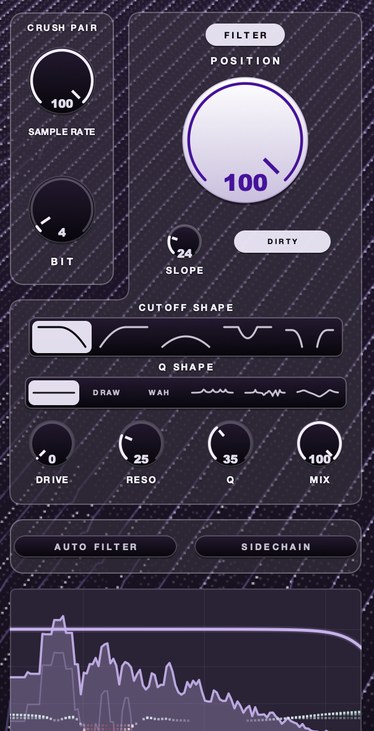
What neither has is a filter behind the crush, and that is the gap F(ilter)12 fills. SAMPLE RATE slows the rate the audio is sampled at, so the top goes and what was up there folds back down as new content; BIT coarsens the steps, so quiet detail rounds off and what is left picks up a hard edge. Twelve bits is as clean as it gets. Then the filter: five shapes, a slope from 18 dB per octave to a wall, resonance and Q as separate controls, and six resonance shapes that travel with the cutoff. RC-20 has no filter section at all, so this is one of its modules plus the thing the rack is missing, for $49.
Space: OldSkoolVerb or TAL-Reverb-4
RC-20's Space is a reverb, and at least one published review of RC-20 called it the module it could live without. Two free reverbs cover it. Voxengo OldSkoolVerb is "a free algorithmic reverberation" plugin in AAX, AU, VST and VST3 for 64-bit Mac and Windows. TAL-Reverb-4 is "a high quality plate reverb with a vintage 80's character", and it carries a bit-depth and sample-rate control of its own, so it degrades while it reverberates. VST, VST3, AU, AAX and CLAP, Windows 7 and macOS 10.9 up, Linux, version 4.0.4.
Volume Drops: the one with no exact match
XLN's sixth module reproduces "the wear, tear and volume loss associated with recording and playback on tape". No free plugin we could verify does dropouts as its job. Kilohearts Trance Gate, in the free Essentials set, is a rhythmic gate and will carve volume out on a grid, which is a cousin of the effect. Tape Cassette 2's noise and wobble cover the wear without the drops. The paid tape plugins do this properly: Wavesfactory Cassette (59 euros) models random high-frequency loss and a tape snap, Aberrant DSP's SketchCassette II ($36) has dropouts with a stereo width control and a continuous Age control, and our own TRIPLE OG ($39) has an AGE control that runs to 60 years, with hiss, drive and tone beside it. For the one module free cannot quite reach, that is the honest list.
The job RC-20 has no module for
Run a clean drum loop through all six RC-20 modules and it is dusty, wobbly, crushed and still exactly as dynamic as it was. The sound people are chasing when they reach for a lofi rack, the sampler sound, is as much a compressor as a filter: dense, slightly crushed drums with the room pushed up under the hits. RC-20 does not compress, and neither does any plugin above. DRUGS is ours, free for Mac and Windows, and it is that squash on one knob called DOSE: the drum bus gets denser rather than louder, the release adapts to the hit in front of it, and the room comes up under the drums. Put it first in the chain, before any of the stand-ins above, and the noise ends up inside the loop instead of sitting on top of it. The how to make a sample sound old guide is built on that order.
Build the free chain, in order
- Route the loop to one bus.
- Insert DRUGS first and raise DOSE until the room comes forward under the hits.
- Insert the bitcrusher second and set the sample rate before the bit depth.
- Insert the saturator third and drive it until the top of the loop has an edge.
- Insert Tape Cassette 2 fourth for wow and flutter, with its noise low for now.
- Insert the reverb fifth, short decay, mostly dry.
- Insert Vinyl last and set Year and Wear before raising Dust and Mechanical Noise.
- Bypass the whole chain at matched level and play the loop on a phone.
The order mirrors RC-20's own, with the compressor added at the front. Noise last matters most: noise added before the crush and the saturation gets crushed and saturated with the loop, which is the tell people hear and cannot name.
What the free chain costs you
Six windows instead of one, with no Magnitude knob to pull them all back at once. Three accounts: Softube and iLok for Saturation Knob, Kilohearts for Essentials, and whatever Caelum asks at download. Level drift, because every stage above changes gain and nothing compensates, so match each one as you go. And the preset list. RC-20's "cassette" and "old radio" are somebody's hour of work on six knobs at once; the free chain hands you the knobs and none of the hours. If that trade is wrong for you, $99 is the price of the hour, and the free tape plugins guide is where to stop halfway.
F(ilter)12 does the digital module and the filter RC-20 never had, for $49, and the demo on the page is the quickest way to hear the difference between a crush and a crush you can move.
Questions people ask
Is there a free version of RC-20?
No. XLN offer a ten-day trial with full functionality, then $99 or $4.99 a month for twenty months. Pages offering a "free download" of it on unrelated domains are what they look like.
What is the best free alternative to RC-20?
Caelum Audio Tape Cassette 2 covers the most modules in one plugin: noise, wobble and distortion. Add iZotope Vinyl for crackle, TAL-Bitcrusher for the digital module and a free reverb, and five of the six are done. For the squash none of them do, DRUGS is free.
Does Ableton Live have an RC-20 alternative built in?
Partly. Vinyl Distortion, in Standard and Suite, does vinyl-style harmonic distortion and a crackle generator, and Live's Saturator covers the distort job. The lofi VST guide sorts the four jobs across DAWs.
Is TAL-Bitcrusher free?
TAL list it under FREE Plug-Ins on their product page, alongside TAL-Reverb-4, TAL-Vocoder and TAL-NoiseMaker. Downloads are on the product page in VST, VST3, AU, AAX and CLAP.
Is Cymatics Origin still free?
It was free with an email address in 2021, covering noise, wobble, saturation and resampling in one plugin. Its product page did not answer at the address we had when this was written, so check before you build a chain around it.
How does F(ilter)12 compare to RC-20?
They overlap in one module. RC-20's Digital reduces bits and sample rate; F(ilter)12's SAMPLE RATE and BIT do the same. F(ilter)12 then adds a filter with five shapes, a slope to a wall and six resonance shapes, plus the adaptive correction AURA, none of which RC-20 has; RC-20 adds noise, wobble, reverb and dropouts, none of which F(ilter)12 has.
Does a free chain sound as good as RC-20?
At each module, mostly yes: noise, filtering and bit reduction are cheap to build and sound alike whoever builds them. What you lose is the one-knob depth control and the presets. What you gain, if you add the compressor, is the half of the sampler sound RC-20 never had.
What F(ilter)12 does
F(ilter)12 is a filter with a lo-fi section in front of it and an adaptive correction called AURA on top. SAMPLE RATE and BIT are the crush pair. POSITION sets where in the spectrum the filter sits, and the further it works the more it drives and the more it sings. Five shapes, low-pass, high-pass, band-pass, notch and a morph, with SLOPE from 18 dB per octave to a wall, DIRTY feeding the filter's own distortion back through itself, and Q SHAPE putting peaks and dips at fixed distances from the cutoff: WAH, VOWEL, COMB, SCOOP, PLAIN, or DRAW your own. AUTO FILTER or SIDECHAIN moves it. $49, AU, VST3 and standalone on macOS 10.13 and up, VST3 on 64-bit Windows 10 and up. The bitcrusher guide covers the crush pair on their own.
Six boxes, six free stand-ins, and a seventh box the rack never had. The preset called "old radio" was always a chain. Now it is yours.
F(ilter)12 — a 12 bit sauce filter for Mac and Windows: a lo-fi section, five filter shapes, six resonance shapes and AURA.
Mac · Winmore info
Keep reading
- RC-20 Retro Color — The six modules in order, what Magnitude does, and where it differs from a filter.
- Best lofi VST plugins — The four we make, sorted by job: bandwidth, tape, speed and drum bus density.
- How to make a sample sound old — Narrow the range, add warmth and grain, wobble, noise and a small room.
- Best bitcrusher plugins — What bit and rate reduction do, how to audition one, free and paid picks.
- Best free tape plugins — What free tape plugins do well, and where they run out.