← Gazillion Industries/Reading material
The Novation Bass Station
1993. A British company that has sold one product, a battery-powered controller for a pocket workstation, asks a synth designer to put a sound engine inside its shell. He gives it the filter from a synth he built in 1978. The result costs £349.99 and is among the first new analog synthesizers in a decade.
The Novation Bass Station is a two-oscillator analog monosynth released in 1993, designed by Chris Huggett around the filter and amplifier of his EDP Wasp, and sold as an affordable alternative to the Roland TB-303. It grew into a rack (1994), a Super Bass Station (1997) and, in 2013, the Bass Station II, still in production and in 2020 the basis of the AFX Station with Aphex Twin. Thirty years of one idea: a cheap analog bass synth with knobs, for people making dance records.
The short version
- Released
- 1993, Novation's second product; reviewed July 1994 at £349.99
- Designer
- Chris Huggett, with the Wasp's filter and VCA
- Engine
- two DCOs, 12/24 dB analog filter, two ADSRs, seven memories
- Family
- Rack 1994, Super 1997, Bass Station II 2013, AFX Station 2020
- BS II
- two oscillators plus sub, Classic and Acid filters, 128 patches, sequencer
- Price now
- £399 / $499 at the 2013 review
A controller with a synth stuffed inside
Ian Jannaway and Mark Thompson founded Novation in 1992, and the first thing they sold was the MM10, a portable battery-powered controller built mainly to give hands-on keys to Yamaha's QY10 pocket workstation. Then they went to Chris Huggett. Huggett had co-founded Electronic Dream Plant in the late seventies and designed the Wasp, a £199 synth in a yellow-and-black case with a touch keyboard and a filter people still talk about; he had gone on to the OSCar in 1983 and then to writing the operating system for a famous sampler. Novation's own history puts the Bass Station's birth in one sentence: he "took the outer shell of MM10 and added the same Filter and VCA as his now legendary Wasp synthesiser."
The timing was the whole point. Nick Bookman, one of the people who made it, later said that analog synths had been in decline as the big digital instruments took over, and by 1993 almost nobody was building new ones. Meanwhile acid house had turned the TB-303, a 1980s bass box of which, by Novation's count, Roland had made about 10,000, into the most wanted machine in dance music. Novation marketed the Bass Station as the affordable alternative. Its 12 dB filter mode was designed to recreate the 303's range of tones in software-controlled analog, and its "Autoglide" triggering mimicked the 303's slide.
What shipped
Sound On Sound's Julian Colbeck reviewed it in July 1994 at £349.99. Two oscillators, each offering sawtooth or a variable pulse whose width could be set by hand or modulated by the LFO or the second envelope. The second oscillator pitched independently with coarse and fine controls. One analog filter switchable between 12 and 24 dB per octave, self-oscillating at 24, modulated by the LFO or envelope two. Two full ADSR envelopes with velocity, attack down to one millisecond, decay and release from three milliseconds to ten seconds. Three trigger modes, Autoglide, Single and Multi. Seven patch memories. A two-octave short-scale keyboard transposable across eight octaves, and MIDI that transmitted controller data whenever you moved the filter or envelope knobs, so a sequencer could record the sweep.
"Tremendous fun and an almost unqualified bargain," Colbeck wrote. The cons were honest: "Casing a bit flimsy," and seven memories was mean even in 1994. The portamento ran about a second and a half at its slowest where the manual promised five. None of it mattered against the price and the filter. Colbeck bought one.
The rack and the Super
The Bass Station Rack of 1994 took the keys off and added everything the keyboard lacked: more memory and an LCD, LFOs that synced to MIDI clock, more parameters sent over MIDI, switchable CV and gate in and out so it could talk to the old machines it was replacing, and an external input into the filter so you could run a drum loop through the Wasp circuit. Novation's own list of who used the range reads like a mid-nineties British record collection: Massive Attack, Orbital, Underworld, Apollo 440, Radiohead, Laurent Garnier, Sneaker Pimps, Nine Inch Nails, and the RZA. That is the maker's list, and it is repeated here as the maker's claim.
The Super Bass Station of 1997 added a sub-oscillator, a ring modulator, a white-noise source, analog distortion and a stereo analog chorus, a mixer to combine them, and 150 RAM and 50 ROM memories where the original had seven. It was the Bass Station grown up, and then, for sixteen years, there was no Bass Station at all.
Bass Station II
In 2013, twenty years after the original, Novation released the Bass Station II, and Sound On Sound's Paul Nagle reviewed it that September at £399 and $499. The signal path was fully analog with digital control for patch storage. Two oscillators plus a sub-oscillator tied to the first, an octave or two down, in sine, square or pulse. Two filters to choose between: "Classic," a state-variable design with 12 and 24 dB slopes in lowpass, bandpass and highpass, the lineage of Huggett's Wasp circuit; and "Acid," a 24 dB diode ladder in lowpass only, named for the music it was built to make. A Distortion knob after the filter and an "osc filter mod" knob that let the second oscillator modulate the filter at audio rate. A two-octave keyboard with velocity and aftertouch, 128 patches with 64 factory sounds, four 32-step sequences with swing, and an arpeggiator up to four octaves.
Nagle's verdict: a synth with personality that produces "ripping, gnashy solos" as readily as solid analog bass, and "I reckon Novation have a winner!" He listed the short keyboard, the lack of pot pickup and the fixed filter tracking as the costs. Novation kept adding to it by firmware. Version 2.5, for the range's 25th anniversary in 2018, added a paraphonic mode in which the two oscillators play two notes independently, an oscillator-error control for analog-style drift, and microtuning tables.
AFX Mode and the AFX Station
Then the firmware got strange in a good way. Version 4.14, in 2019, was developed with Richard D. James, Aphex Twin, who proposed that each key on the keyboard could hold its own set of synthesis parameters. AFX Mode lets a single patch vary key by key, split the keyboard into zones, or hold a whole drum kit in one preset, with each of the 25 keys carrying its own "overlay" of tuning, oscillator and filter settings. In October 2020 Novation released the AFX Station, a Bass Station II in a new finish with AFX Mode preinstalled, 128 new patches and seven overlay banks, at £399.99 and $439.99. Attack Magazine's review summed it up as an already great synth given an analog bubble bath, and noted that the mode comes alive with the sequencer and the arpeggiator.
Chris Huggett died in October 2020, the same month the AFX Station shipped, after two years of cancer. He had contributed to every Bass Station, and to the Nova, Supernova, Peak and Summit that followed. A filter he designed for a £199 synth in 1978 was still in production forty-two years later.
Why one cheap bass synth lasted thirty years
Because it never tried to be more than one thing. A monosynth with real knobs, an analog filter with character, a keyboard you could play a bass line on and a price a bedroom producer could reach. The 303 it was sold against was a sequencer first and an instrument second; the Bass Station put the same kind of sound under a player's hands. Every version since has kept that bargain, added the things people asked for, and left the knobs where they were.
The lesson for anyone choosing a monosynth now is the one the 1994 review gave in passing: the filter and the envelopes decide the instrument, the memory count and the case are details. Best monosynth VST turns that into a ten-minute test, and ladder filter explained covers what the Acid filter's topology actually does to a bass note.
Where it costs you
Two octaves is two octaves, and the original's case was flimsy enough for a reviewer to say so. Seven memories on the 1993 model meant most owners lived with a handful of sounds. The Bass Station II fixed the memory, kept the short keyboard, and its knobs jump rather than pick up when you recall a patch. And it is a monosynth: one note, one voice, no chords unless you count the paraphonic mode's two.
Questions people ask
When did the Novation Bass Station come out?
In 1993, as Novation's second product after the MM10 controller. Sound On Sound reviewed it in July 1994 at £349.99. The Rack followed in 1994, the Super Bass Station in 1997 and the Bass Station II in 2013.
Is the Bass Station a copy of the TB-303?
No. Novation sold it as an affordable alternative to the TB-303, and its 12 dB filter mode and Autoglide were designed to cover the 303's range of tones and its slide, but it is a two-oscillator keyboard synth built on the Wasp's filter and amplifier. The Bass Station II added an "Acid" diode ladder filter as a second option.
Who designed the Bass Station?
Chris Huggett, who had designed the EDP Wasp in the late 1970s and the OSCar in 1983. He worked with Novation from 1993 until his death in 2020 and contributed to every Bass Station.
What is AFX Mode on the Bass Station II?
A firmware feature developed with Aphex Twin in 2019 that lets each of the 25 keys hold its own patch settings, so one preset can be a keyboard split, a set of variations or a whole drum kit. The 2020 AFX Station is a Bass Station II with it preinstalled.
Is the Bass Station II fully analog?
The signal path is analog, with digital control for patch memory, the sequencer and the arpeggiator. It has two analog oscillators plus a sub, two analog filters and analog distortion.
What JOURNEYMAN does
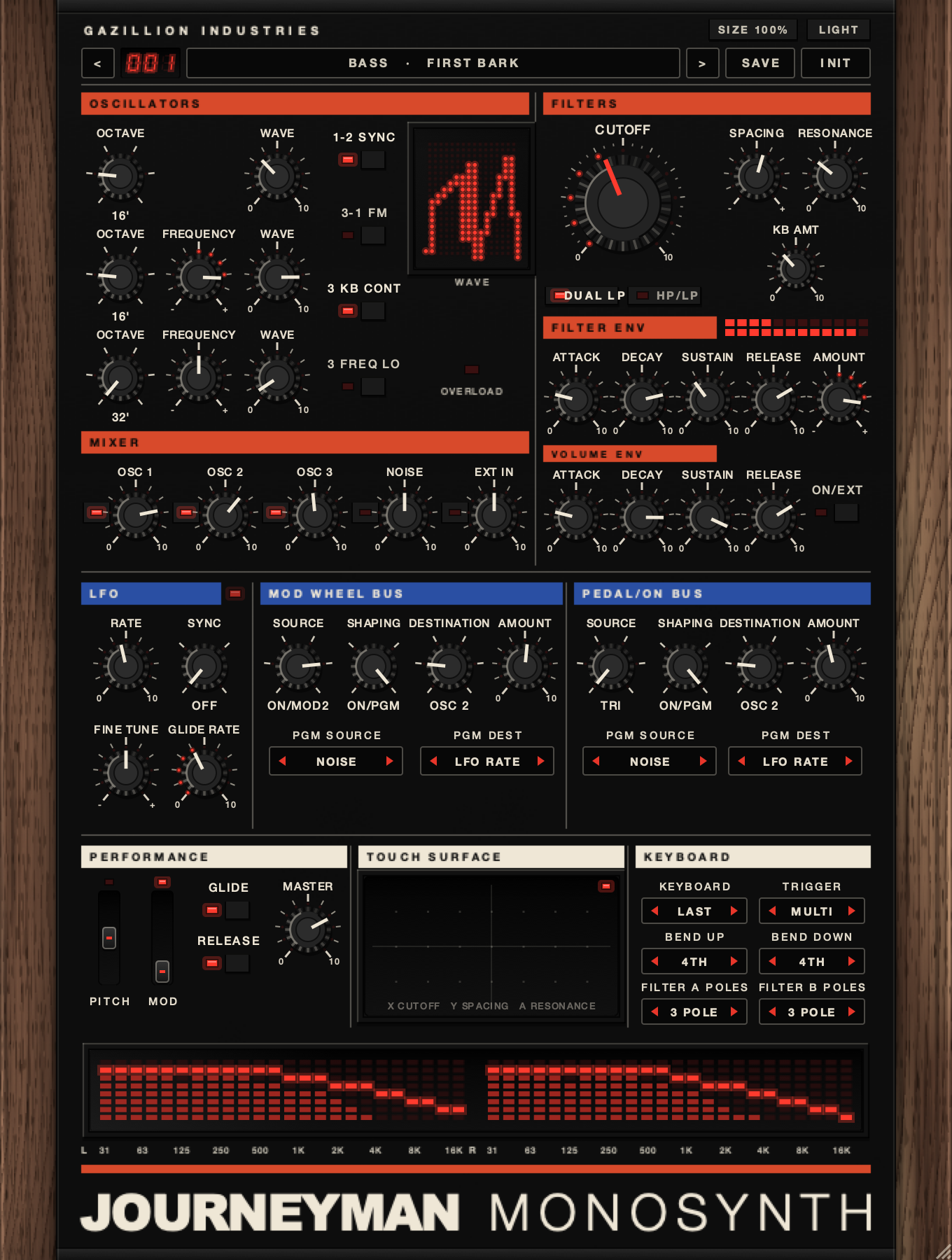
JOURNEYMAN is our monosynth for Mac and Windows, $59, in AU, VST3 and standalone on macOS and VST3 on Windows. Three oscillators, each with an OCTAVE switch and a WAVE control that sweeps continuously from triangle through saw and square to pulse. A five-source MIXER for the oscillators, NOISE and EXT IN. Two ladder filters sharing one CUTOFF with SPACING between them, switchable between DUAL LP and HP:LP. A filter envelope and a volume envelope, an LFO with sample and hold, two modulation busses, GLIDE and a touch surface. 200 programs across bass, leads, mono keys, pads, percussion and fx, every one wired to the mod wheel and the touch surface. It was tuned by ear and it is not a model of any instrument.
A controller shell, a 1978 filter and a £349 price. The bass line is still playing.
JOURNEYMAN — a monosynth for Mac and Windows. One voice, three oscillators, two ladder filters, two envelopes, two modulation busses and 200 programs.
Mac · Winmore info
Keep reading
- Best monosynth VST — Glide, envelope speed and usable resonance: how to choose a monosynth, plus free picks.
- Ladder filter explained — What a ladder filter is, and the low end resonance takes away.
- The Minimoog Voyager — Bob Moog's return, the 2002 launch, the dual filters, hip-hop's Voyagers, and why one voice teaches.
- Monosynth vs polysynth — What one voice buys you, and how to hear paraphonic against polyphonic.
- Best bass synth VST plugins — Why one voice suits bass, and the three controls that decide it.
- Best synth VST for hip hop — The three jobs a hip hop synth has to do, and the controls in order.
- How to make bass fatter — Layer a sub and mid-bass, add harmonics, compress for consistency, and make it growl.